Dynamics of natural discharge of the hydrothermal system and geyser eruption regime in the Valley of Geysers, Kamchatka (2021)
Kiryukhin A.V., Polyakov A.Y., Zhuravlev N.B., Tsuchiya N., Rychkova T.V., Usacheva O.O., Dubrovskaya I.K. Dynamics of natural discharge of the hydrothermal system and geyser eruption regime in the Valley of Geysers, Kamchatka // Applied Geochemistry. 2021. Vol. 136. № 105166. 1 p. https://doi.org/10.1016/j.apgeochem.2021.105166
Annotation
The total deep component natural mass discharge Qd (defined in terms of chloride mass discharge Qcl) of the Valley of Geysers, on an average ranges from 280 kg/s from 1961 to 1984, to 230 kg/s after 2015. Post 2012, discharge measurements reveal a seasonal variation: the discharge increases (340–370 kg/s) during the winterfrozen period, and decreases during the summer flooding period (≈100 kg/s). Long term annually averaged Qd is 274 kg/s, Qcl is 0.247 kg/s and heat flow is 265 MW. In the course of using high-frequency (min???? 1) observations specific conductance measurements from 2017 to 2020, the total natural discharge was found to be cycling due to the internal cycling of geysers. It was mostly sensitive to the Bolshoy and Velikan geysers with averaged intervals between eruptions of 60 min and 70 min, respectively. The tracer chloride method estimates the volume of hot water erupted from geysers. This method yielded the following estimates: 5–34 m3 of hot water cyclically erupted from the Bolshoy geyser; 0.5–4.5 m3 erupted from the Velikan geyser between 2018 and 2020, and 24–144 m3 erupted before the 2014 mud-flow disaster; and 289–330 m3 erupted from the Grot geyser between May–June 2012. The seasonal features of natural discharge mentioned above may be explained in terms of coldwater infiltration into a two-phase geyser geothermal reservoir, especially if gas-phase condensation induces vacuum conditions, which may further reduce some thermal discharge features.
Geothermal Explosion at the 2014 Landslide-Covered Area of the Geyser Valley, Kamchatka, Russian Far East (2023)
Allahbakhshi M., Shevchenko A., Belousov A., Belousova M., Kampf H., Walter T. Geothermal Explosion at the 2014 Landslide-Covered Area of the Geyser Valley, Kamchatka, Russian Far East // GeoHazards. 2023. Vol. 4. Vol. 1. P. 60-76. https://doi.org/10.3390/geohazards4010005
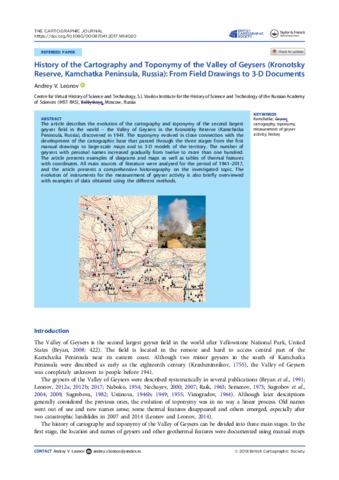
History of the cartography and toponymy of the Valley of Geysers (Kronotsky Reserve, Kamchatka Peninsula, Russia): From field drawings to 3D documents (2018)
Leonov A.V. History of the cartography and toponymy of the Valley of Geysers (Kronotsky Reserve, Kamchatka Peninsula, Russia): From field drawings to 3D documents // The Cartographic Journal. 2018. Vol. 55. Vol. 3. P. 235-255.
The Geysers of 'The Valley of Geysers'. A special report of GOSA Transactions (1991)
Bryan S.T., Hobart J., Warnock B., Rinehart J.S., Fenimore M., Colvin B. The Geysers of 'The Valley of Geysers'. A special report of GOSA Transactions. USA, California: B&J Printing. 1991. 60 p.
Valley of Geysers, Kronotsky Reserve, Kamchatka: features seen by the 1991 GOSA Expedition and Changed by the 2007 Landslide, 2013 Cyclone and 2014 Landslide (2014)
Leonov A., Leonov V., Hobart J. Valley of Geysers, Kronotsky Reserve, Kamchatka: features seen by the 1991 GOSA Expedition and Changed by the 2007 Landslide, 2013 Cyclone and 2014 Landslide // The Geyser Gazer Sput / The Newsletter of the Geyser Observation and Study Association (GOSA). 2014. Vol. 28. № 2. P. 5-26.
Video Observations Inside Channels of Erupting Geysers, Geyser Valley, Russia (2011)
Belousov A., Belousova M., Nechaev A. Video Observations Inside Channels of Erupting Geysers, Geyser Valley, Russia // EOS Transactions. AGU Fall Meeting. 2011. № 92. P. 52
Video observations inside conduits of erupting geysers in Kamchatka, Russia, and their geological framework: Implications for the geyser mechanism (2013)
Belousov A., Belousova M., Nechayev A. Video observations inside conduits of erupting geysers in Kamchatka, Russia, and their geological framework: Implications for the geyser mechanism // Geology. 2013. Vol. 41. № 4. P. 387-390. https://doi.org/10.1130/G33366.1
Кроноцкий государственный природный биосферный заповедник, образованный в 1934 году, сохраняет уникальные природные богатства нашей страны. Среди них – удивительный природный комплекс долины реки Гейзерной – один из пяти крупнейших гейзерных районов на планете. Настоящая книга, изданная к 80-летию заповедника, представляет собой своеобразный картографический путеводитель по ландшафтному разнообразию и самобытной красоте Долины гейзеров. Издание в графической и научно-популярной форме освещает различные вопросы – от истории открытия до природных особенностей и развития туризма. Особое внимание уделяется характеристикам, которые представляют природный комплекс таким, каким каким сегодня он открывается перед тысячами фотографов, туристов и ученых со всего мира. Являясь одновременно и справочником, и путеводителем, Атлас будет полезен широкой аудитории: туристам, студентам, краеведам, преподавателям, а также всем жителям Камчатки, интересующимся родным краем.
Карпов Г.А. В кальдере вулкана / Отв. ред. Рудич К.Н. М.: Наука. 1980. 96 с.
Annotation
Книга посвящена одному из интереснейших и живописных мест Камчатки — кальдере вулкана Узон. Своеобразие этого района состоит в том, что он представляет собой уникальную природную лабораторию, где происходят процессы образования минералов, бурно проявляется современная гидротермальная деятельность в виде многочисленных термальных источников и теплых озер. Автор рассказывает также о геологическом строении кальдеры, о случающихся здесь извержениях, о богатом растительном и животном мире.