Portnyagin Maxim, Duggen Svend, Hauff Folkmar, Mironov Nikita, Bindeman Ilya, Thirlwall Matthew, Hoernle Kaj Geochemistry of the late Holocene rocks from the Tolbachik volcanic field, Kamchatka: Quantitative modelling of subduction-related open magmatic systems // Journal of Volcanology and Geothermal Research. 2015. Vol. 307. P. 133 - 155. https://doi.org/10.1016/j.jvolgeores.2015.08.015
Annotation
Abstract We present new major and trace element, high-precision Sr–Nd–Pb (double spike), and O-isotope data for the whole range of rocks from the Holocene Tolbachik volcanic field in the Central Kamchatka Depression (CKD). The Tolbachik rocks range from high-Mg basalts to low-Mg basaltic trachyandesites. The rocks considered in this paper represent mostly Late Holocene eruptions (using tephrochronological dating), including historic ones in 1941, 1975–1976 and 2012–2013. Major compositional features of the Tolbachik volcanic rocks include the prolonged predominance of one erupted magma type, close association of middle-K primitive and high-K evolved rocks, large variations in incompatible element abundances and ratios but narrow range in isotopic composition. We quantify the conditions of the Tolbachik magma origin and evolution and revise previously proposed models. We conclude that all Tolbachik rocks are genetically related by crystal fractionation of medium-K primary magmas with only a small range in trace element and isotope composition. The primary Tolbachik magmas contain ~ 14 wt. of MgO and ~ 4 wt. of {H2O} and originated by partial melting (~ 6) of moderately depleted mantle peridotite with Indian-MORB-type isotopic composition at temperature of ~ 1250 °C and pressure of ~ 2 GPa. The melting of the mantle wedge was triggered by slab-derived hydrous melts formed at ~ 2.8 {GPa} and ~ 725 °C from a mixture of sediments and MORB- and Meiji-type altered oceanic crust. The primary magmas experienced a complex open-system evolution termed Recharge-Evacuation-Fractional Crystallization (REFC). First the original primary magmas underwent open-system crystal fractionation combined with periodic recharge of the magma chamber with more primitive magma, followed by mixing of both magma types, further fractionation and finally eruption. Evolved high-K basalts, which predominate in the Tolbachik field, and basaltic trachyandesites erupted in 2012–2013 approach steady-state {REFC} liquid compositions at different eruption or replenishment rates. Intermediate rocks, including high-K, high-Mg basalts, are formed by mixing of the evolved and primitive magmas. Evolution of Tolbachik magmas is associated with large fractionation between incompatible trace elements (e.g., Rb/Ba, La/Nb, Ba/Th) and is strongly controlled by the relative difference in partitioning between crystal and liquid phases. The Tolbachik volcanic field shows that open-system scenarios provide more plausible and precise descriptions of long-lived arc magmatic systems than simpler, but often geologically unrealistic, closed-system models.
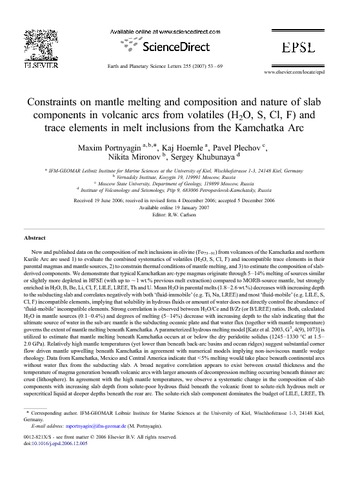
Portnyagin Maxim, Hoernle Kaj, Plechov Pavel Yu., Mironov Nikita, Khubunaya Sergey Constraints on mantle melting and composition and nature of slab components in volcanic arcs from volatiles (H2O, S, Cl, F) and trace elements in melt inclusions from the Kamchatka // Earth and Planetary Science Letters. 2007. Vol. 255. № 1-2. P. 53-69. https://doi.org/10.1016/j.epsl.2006.12.005
Annotation
New and published data on the composition of melt inclusions in olivine (Fo73_yi) from volcanoes of the Kamchatka and northern Kurile Arc are used 1) to evaluate the combined systematics of volatiles (H2O, S, Cl, F) and incompatible trace elements in their parental magmas and mantle sources, 2) to constrain thermal conditions of mantle melting, and 3) to estimate the composition of slab-derived components. We demonstrate that typical Kamchatkan arc-type magmas originate through 5-14% melting of sources similar or slightly more depleted in HFSE (with up to -1 wt.% previous melt extraction) compared to MORB-source mantle, but strongly enriched in H2O,B, Be, Li, Cl. F, LILE, LREE, Th and U. Mean H2O in parental melts f 1.8-2.6 wt.%) decreases with increasing depth to the subducting slab and correlates negatively with both 'fluid-immobile* (e.g. Ti, Na, LREE) and most 'fluid-mobile' (e.g. LILE, S, Cl, F) incompatible elements, implying that solubility in hydrous fluids or amount of water does not directly control the abundance of 'fluid-mobile' incompatible elements. Strong correlation is observed between H2O/Ce and B/Zr (or B/LREE) ratios. Both, calculated H2O in mantle sources (0.1-0.4%) and degrees of melting (5-14%) decrease with increasing depth to the slab indicating that the ultimate source of water in the sub-arc mantle is the subducting oceanic plate and that water flux (together with mantle temperature) governs theextent of mantle melting beneath Kamchatka. A parameterized hydrous melting model [Katzetal. 2003, G3,4(9), 1073] is utilized to estimate that mantle melting beneath Kamchatka occurs at or below the dry peridotite solidus (1245-1330 °C at 1.5-2.0 GPa). Relatively high mantle temperatures (yet lower than beneath back-arc basins and ocean ridges) suggest substantial corner flow driven mantle upwelling beneath Kamchatka in agreement with numerical models implying non-isoviscous mantle wedge rheology. Data from Kamchatka, Mexico and Central America indicate that <5% melting would lake place beneath continental arcs without water flux from the subducting slab. A broad negative correlation appears to exist between crustal thickness and the temperature of magma generation beneath volcanic arcs with larger amounts of decompression melting occurring beneath thinner arc crust (Uihosphere). In agreement with the high mantle temperatures, we observe a systematic change in the composition of slab components with increasing slab depth from solute-poor hydrous fluid beneath the volcanic front to solute-rich hydrous melt or supercritical liquid at deeper depths beneath the rear arc. The solute-rich slab component dominates the budget of LILE, LREE,Th and U in the magmas and originates through wet-melting of subducted sediments and/or altered oceanic crust at > 120 km depth. Melting of the upper parts of subducting plates under water flux from deeper luhosphere (e.g. serpentinites), combined with high .emperatures in the mantie wedge, may be a more common process beneath volcanic arcs than has been previously recognized. 0 2006 Klsevier B.V. All rights reserved.
Portnyagin Maxim, Hoernle Kaj, Plechov Pavel, Mironov Nikita, Khubunaya Sergey Constraints on mantle melting and composition and nature of slab components in volcanic arcs from volatiles (H2O, S, Cl, F) and trace elements in melt inclusions from the Kamchatka Arc // Earth and Planetary Science Letters. 2007. Т. 255. № 1-2. С. 53-69. doi:10.1016/j.epsl.2006.12.005
Portnyagin Maxim, Ponomareva Vera Kliuchevskoi volcano diary // International Journal of Earth Sciences. 2012. Vol. 101. № 1. P. 195 doi:10.1007/s00531-011-0710-y
Annotation
Numerous ash layers deposited at the slopes of Kliuchevskoi volcano provide a detailed and continuous record of its explosive activity during the last ca. 10,000 years.
Puzankov M.Yu., Bazanova L.I., Maximov A.P., Moskalyova S.V. The initial plinian basic andesite eruptions of the young cone, Avachinsky volcano (Kamchatka) // IV International Biennial Workshop on Subduction Processes emphasizing the Japan-Kurile-Kamchatka-Aleutian Arcs. August 21-27, 2004, Petropavlovsk-Kamchatsky. 2004. P. 158-160.
Ramsey Michael, Dehn Jonathan Spaceborne observations of the 2000 Bezymianny, Kamchatka eruption: the integration of high-resolution ASTER data into near real-time monitoring using AVHRR // Journal of Volcanology and Geothermal Research. 2004. Vol. 135. № 1-2. P. 127-146. doi:10.1016/j.jvolgeores.2003.12.014
Annotation
Since its launch in December 1999, the Advanced Spaceborne Thermal Emission and Reflection Radiometer (ASTER) instrument has been observing over 1300 of the world's volcanoes during the day and night and at different times of the year. At the onset of an eruption, the temporal frequency of these regularly scheduled observations can be increased to as little as 1–3 days at higher latitudes. However, even this repeat time is not sufficient for near real-time monitoring, which is on the order of minutes to hours using poorer spatial resolution (>1 km/pixel) instruments. The eruption of Bezymianny Volcano (Kamchatkan Peninsula, Russia) in March 2000 was detected by the Alaska Volcano Observatory (AVO) and also initiated an increased observation frequency for ASTER. A complete framework of the eruptive cycle from April 2000 to January 2001 was established, with the Advanced Very High Resolution Radiometer (AVHRR) data used to monitor the large eruptions and produce the average yearly background state for the volcano. Twenty, nearly cloud-free ASTER scenes (2 days and 18 nights) show large thermal anomalies covering tens to hundreds of pixels and reveal both the actively erupting and restive (background) state of the volcano. ASTER short-wave infrared (SWIR) and thermal infrared (TIR) data were also used to validate the recovered kinetic temperatures from the larger AVHRR pixels, as well as map the volcanic products and monitor the thermal features on the summit dome and surrounding small pyroclastic flows. These anomalies increase to greater than 90 °C prior to a larger eruption sequence in October 2000. In addition, ASTER has the first multispectral spaceborne TIR capability, which allowed for the modeling of micrometer-scale surface roughness (vesicularity) on the active lava dome. Where coupled with ongoing operational monitoring programs like those at AVO, ASTER data become extremely useful in discrimination of small surface targets in addition to providing enhanced volcanic mapping capabilities.
Riley Colleen Origin of scatter in paleomagnetic directions of
samples from Gorely Volcano, Kamchatka, Russia. 1994. Дисс. докт. геол.-мин. наук. 70 p.
Annotation
Lava flows from sixteen sites at Gorely Volcano, Kamchatka were sampled. Initial analysis showed high within-site scatter for NRM specimen directions. Alternating field and thermal demagnetization of specimens showed single-component magnetization indicating that specimens had not moved or were not exposed to changes in the magnetic field during acquisition of a magnetic direction. Scatter is thought to be either due to movement of the specimen with respect to the magnetic field or change in the magnetic field with respect to the specimen. Four factors were found that would contribute to scatter in specimen directions. These are 1) cooling rate, 2) range of unblocking temperatures, 3) relative time of emplacement, and 4) how the specimen moved or was affected by changes in the magnetic field. Only two sites showed that scatter was due to movement of the specimen. It appears that scatter in other sites resulted from changes in the magnetic field generated from a magma-induced electrical current due to lava flowing in the earth’s magnetic field. These changes in the magnetic field are shown to have more affect on material sampled at the surface than on material sampled at depth because massive interiors of flows showed less dispersion in specimen directions than levees or pull-aparts.
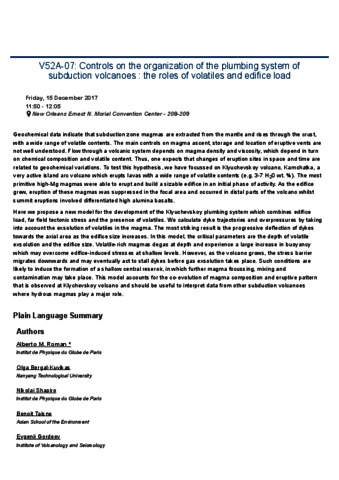
Roman Alberto, Bergal-Kuvikas Olga, Shapiro Nikolay M., Gordeev E.I., Taisne Benoit, Jaupart Claude Control on the organization of the plumbing system of subduction volcanoes: the role of volatiles and edifice load // AGU Fall Meeting Abstracts. 2017.
Romanova I.M., Girina O.A. Spatial Data Infrastructure for information support of volcanological investigations // 10th Biennual workshop on Japan-Kamchatka-Alaska subduction processes (JKASP-2018). Petropavlovsk-Kamchatsky, Russia, August 20-26. // 10th Biennual workshop on Japan-Kamchatka-Alaska subduction processes (JKASP-2018). Petropavlovsk-Kamchatsky: IVS FEB RAS. 2018. P. 193-195.