Апродов В.А. Вулканы. М.: Мысль. 1982. 367 с.
Annotation
Справочник содержит характеристику около трех тысяч вулканов земного шара, сгруппированных по вулканическим поясам и другим районам проявления вулканизма. Этим поясам и районам предшествует их общая геолого-географическая характеристика. Сведения о вулканах включают географическое положение, морфологию, геологическую структуру, активность и т.д. Книга рассчитана не только на специалистов, но и на более широкий круг читателей.
Арапов В.А., Ткачёв В.Н. О верхнепалеозойских туфолавах и игнимбритах Кураминского хребта // Труды Лаборатории вулканологии АН СССР. 1961. Вып. 20. С. 199-205.
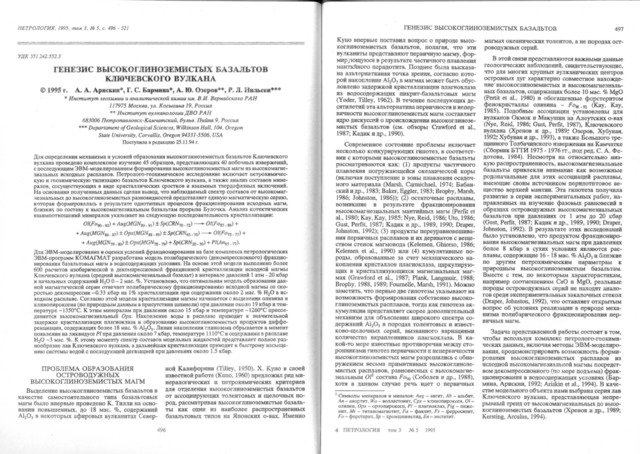
Арискин A.A., Бармин А.А., Озеров А.Ю. Модель образования высокоглиноземистых магма Ключевского вулкана // Материалы конференции "Российской фонд фундаментальных исследований в Сибирском регионе. Земная кора и литосфера". Иркутск: 1995.
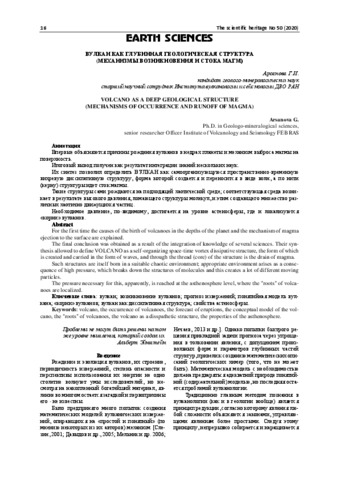
Арсанова Г.И. Вулкан как глубинная геологическая структура (механизмы возникновения и стока магм) // The Scientific Heritage. 2020. Т. 1. № 50. С. 16-24.
Annotation
For the first time the causes of the birth of volcanoes in the depths of the planet and the mechanism of magma ejection to the surface are explained. The final conclusion was obtained as a result of the integration of knowledge of several sciences. Their synthesis allowed to define VOLCANO as a self-organizing space-time vortex dissipative structure, the form of which is created and carried in the form of waves, and through the thread (core) of the structure is the drain of magma. Such structures are itself born in a suitable chaotic environment; appropriate environment arises as a consequence of high pressure, which breaks down the structures of molecules and this creates a lot of different moving particles. The pressure necessary for this, apparently, is reached at the asthenosphere level, where the "roots" of volcanoes are localized.
Арсанова Г.И. О природе вулканической деятельности (Опыт использования принципов синергетического мировидения) / Сб. Система «Планета Земля». 200 лет со дня кончины М.Б. Барклая-де-Толли (1761-1818). М.: ЛЕНАНД. 2018. С. 37-63.
Water plays an extremely important role in volcanism: it acts as an evacuator of viscous melts in a variety of ways, which is ensured by the presence of relevant properties of its phase states, which successively changing with the fall of the environmental parameters. In this sense, the supercritical (fluid) state of water is especially significant. The paper provides a summary of fluid properties that are unique in many ways. The properties determine the relationship between water fluid and silicate melt, which in turn explains the cause of volcanic phenomena and the course of eruptions: explosions of different power, the emergence of the so-called fluidized mass, scorching clouds, landslides and breakthroughs on the slopes, the formation of ignimbrites, as well as the mechanism of gas transport to the foot of volcanoes. Both by role and quantity, water is the main volcanic substance, which together with the silicate melt constitutes magma.
Арсанова Г.И. Сверхкритическое состояние воды как причина вулканических явлений // The Scientific Heritage. 2020. Т. 2. № 45. С. 7-17.
Annotation
Features of the dynamics of volcanic eruptions for the first time are explained as a consequence of the properties of high-temperature phases of water and their transitions. Some properties of water in supercritical (fluid) condition are given. The latter determine the nature of the relationship between water and melt in the volcanic process, which in turn explains the explosions of different power, the rapidity of scorching clouds, the transfer of gases to the foot of volcanoes, breakouts and landslides on the slopes, the occurrence of ash, pumice, pseudoliquefied mass, as well as possibly ignimbrits and volcanic glass. It shows the impossibility of penetration of cold water into the active volcanic channel, as well as their high (before the change of phase) heating in the conditions of the crust.