Мелекесцев И.В. Вулкан Корякский (Камчатка): Извержение 1895 – 1896 гг. выделено ошибочно // Вулканология и сейсмология. 1996. № 2. С. 91-95.
Annotation
The explosive-effusive eruption of 1895-1896 which has been supposed to occur on Koryakskiy Volcano, Kamchatka did not occur at all. It therefore is to be eliminated from the list of the volcano's eruptions, as well as from regional and worldwide catalogs of eruptions on active volcanoes and from other reference publications.
Мелекесцев И.В. Вулкан Корякский (Камчатка): предварительный прогноз будущей вулканической опасности // Вулканизм и геодинамика. Материалы IV Всероссийского симпозиума по вулканологии и палеовулканологии, Петропавловск-Камчатский, 22-27 сентября 2009 г. Петропавловск-Камчатский: ИВиС ДВО РАН. 2009. Т. 2. С. 637-640.
Мелекесцев И.В. Гигантские марсианские вулкано-тектонические мегаморфоструктуры центрального типа и их вероятные земные минианалоги // Вулканология и сейсмология. 2023. № 1. С. 70-84. https://doi.org/10.31857/S0203030622700067
Annotation
We show that the terrestrial land and seafloor contain no volcano-tectonic mega landforms expressed in relief that could be similar in size to those identified on Mars, and could have analogous structure and origin to the giant landforms whose volumes of constituent rocks are (1-2.4) x 106 km3 (Alba Patera, Olympus Mons, Arsia Mons, Ascraeus Mons, Pavonis Mons, and Elysium Mons). No fragments or traces of similar features have ever been unambiguously identified and described in geological rock sequences, not only in Mesozoic and Cenozoic rock sequences, but also in those dating back to Paleozoic time. The same applies to the older epochs on Earth. Now the topographic constituent components of Martian mega landforms have the appearance of very magnified copies of well-known and repeatedly described terrestrial volcanic edifices, viz., dominantly shield-like and lava volcanoes, lava domes, as well as calderas of various types. However, the edifices of the above types of volcanoes are not identical with their Martian counterparts as to morphology, being shorter in height and having steeper slopes. The calderas are smaller by factors of multiple times. The Martian volcanic landforms are much older. There is a unique edifice, namely, Olympus Mons, a mega land-form that stands in a large glacier sheet and for whose origin glacial processes are also responsible. It is classified as belonging to the type of giant tuyas. Its mini analogues are glacial subaerial tuyas of different ages and parameters that have been subjected to glaciation in volcanic areas on Earth.
Мелекесцев И.В. Гора Ранняя и обрыв Шеридана в Антарктиде – самые старые и высокоширотные тюйя на земле // Вестник КРАУНЦ. Серия: Науки о Земле. 2011. Вып. 17. № 1. С. 142-146.
Annotation
Mount Rannyaya (86°58' S, 163°20' W, 2270 m a.s.l., 18-20 Ма) и Sheridan Bluff (87°04' S, 153°46' W, 2720 m a.s.l., ~ 16 Ма) were explored in 1934 and 1962-1963, and studied and dated in 1978-1979 bу Antarctic researches. The article shows that these volcanoes are typical tuya, the oldest and high-latitude volcanoes on Earth. It confirms that in early Miocene thick glaciers existed in western Antarctic near the Pole, and subglacial volcanic activity was strong.
Мелекесцев И.В. Действующие и потенциально активные вулканы Курило - Камчатской островной дуги в начале XXI в.: этапы исследований, определение термина "действующий вулкан", будущие извержения и вулканическая опасность // Вестник КРАУНЦ. Серия: Науки о Земле. 2006. Вып. 7. № 1. С. 15-35.
Annotation
Three stages of study of active and potentially active volcanoes on Kamchatka and the Kurile Islands were distinguished: the anterior stage (1700-1935), the new stage (1935-1962) and the recent stage (from 1962 till present time).
This paper provides a new, for the first time scientifically based term of «active volcano». Updated catalogues display active and potentially active volcanoes of Kamchatka and the Kurile Islands. Here we propose a long-term forecast of behavior and parameters of impending eruptions and related volcanic hazards for the typical volcanoes of the 1st and the 2nd stages of evolution.
Мелекесцев И.В. Изменение во времени максимальной энергии катастрофических извержений и продуктивности вулканизма // Вулканизм и связанные с ним процессы. Тезисы докладов VI Всесоюзного вулканологического совещания. Петропавловск-Камчатский, сентябрь 1985 г. Петропавловск-Камчатский: ИВ ДВНЦ АН СССР. 1985. Вып. 1. С. 43-45.
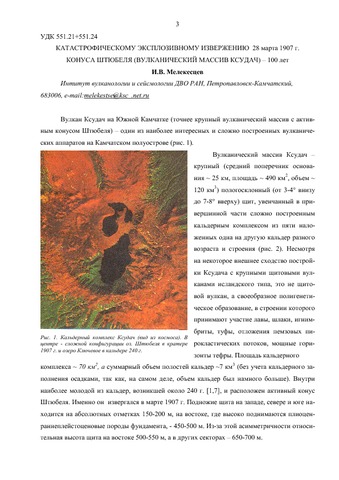
Мелекесцев И.В. Катастрофическому эксплозивному извержению 28 марта 1907 г. конуса Штюбеля (вулканический массив Ксудач) - 100 лет // Материалы ежегодной конференции, посвященной Дню вулканолога, Петропавловск-Камчатский, 28-31 марта 2007 г. Петропавловск-Камчатский: ИВиС ДВО РАН. 2007. С. 3-8.
Мелекесцев И.В. Комментарий ученого к статье Е.М. Верещаги и И.В. Витер "Остров Матуа: последствия цунами 2006 г. и извержения вулкана Пик Сарычева в 2009 г. (Из наблюдений участников Камчатско-Курильских историко-географических экспедиций в 2007-2009 гг.)" // Вопросы географии Камчатки. 2011. № 13. С. 132-133.
Мелекесцев И.В. Новейшие локальный (1955−1976 гг.) и региональный (1907−1976 гг.) эпизоды вулканического катастрофизма на Камчатке и Курильских островах // Вестник КРАУНЦ. Серия: Науки о Земле. 2018. Вып. 39. № 3. С. 26-41. https://doi.org/10.31431/1816-5524-2018-3-39-26-41
Annotation
The paper presents data on identified and described short-term local (1955−1976) enhanced volcanic activity within the Northern Group at the Central Kamchatka Depression and regional disasters (1907-1976), clearly revealed within Kamchatka Peninsular and the Kurile Islands. In scale (volume is about 9 km3, weight of erupted and replaced productswas calculated to be about 16×109 t), the local volcanic disaster was the most powerful in Kamchatka and Kurile Islands over the period of the last 2000 years. This volume exceeds 80% of ~19×109 t totally erupted by all volcanoes over the same period of time. Over the period 1907−1976, the Kamchatka and Kurile volcanoes erupted and transported about 29.5×10⁹ t of juvenile and resurgent material while other volcanoes in the world erupted about 122×109 t.