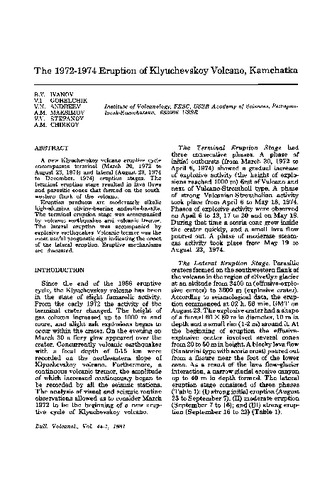
A new Klyuchevskoy volcano eruptive cycle encompasses terminal (March 30, 1972 to August 23, 1974) and lateral (August 23, 1974 to December, 1974) eruption stages. The terminal eruption stage resulted in lava flows and parasitic cones that formed on the south-western flank of the volcano.
Eruption products are moderately alkalic high-alumina olivine-bearing andesite-basalts. The terminal eruption stage was accompanied by volcanic earthquakes and volcanic tremor. The lateral eruption was accompanied by explosive earthquakes. Volcanic tremor was the most useful prognostic sign indicating the onset of the lateral eruption. Eruptive mechanisms are discussed.
Ivanov B.V., Kadik A.A., Maksimov A.P. Conditions of the crystallization of andesites from the Klyuchevskaya volcanic group (Kamchatka) Arc volcanism (abstr.).. // Arc Volcanism: Physics and Tectonics. Proceedings of a 1981 IAVCEI Symposium, Arc Volcanism, August-September, 1981, Tokyo and Hakone. Tokyo: Terra Scientific Pub. Co.. 1983.
Izbekov P., Eichelberger J., Belousova M., Ozerov A. Post-collapse trends at Bezymianny Volcano, Kamchatka, Russia and the May 6, 2006 eruption // AGU Fall Meeting 2006. Eos Trans. AGU, 87(52), Fall Meet. Suppl., Abstracts. 2006. P. V11B-0576.
Izbekov P., Eichelberger J., Ivanov B., Maximov A. Variations of Volcanic Glass Composition Show Possible Mixing Event at the Beginning of 1996 Eruption of Karymsky Volcano, Kamchatka, Russia // Trans. American Geophys. Union, Fall Meet. Suppl, Abstract . 1998. Vol. 79(45). P. V22B-10.
Izbekov P., Koloskov A., Maximov A., Khabunaya S. The 2012 Fissure Tolbachik Eruption: Preliminary Results of Petrological Investigation // Geophysical Research Abstracts. EGU General Assembly, Vienna, 2014. Vienna, Austria: EGU General Assembly 2014. 2014. Vol. 16. P. 11710.
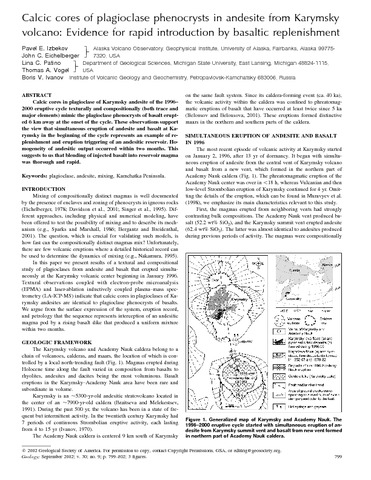
Izbekov Pavel E., Eichelberger John C., Patino Lina C., Vogel Thomas A., Ivanov Boris V. Calcic cores of plagioclase phenocrysts in andesite from Karymsky volcano: Evidence for rapid introduction by basaltic replenishment // Geology. 2002. Vol. 30. № 9. P. 799-802.
Аннотация
Calcic cores in plagioclase of Karymsky andesite of the 1996–2000 eruptive cycle texturally and compositionally (both trace and major elements) mimic the plagioclase phenocrysts of basalt erupted 6 km away at the onset of the cycle. These observations support the view that simultaneous eruption of andesite and basalt at Karymsky in the beginning of the cycle represents an example of replenishment and eruption triggering of an andesitic reservoir. Homogeneity of andesitic output occurred within two months. This suggests to us that blending of injected basalt into reservoir magma was thorough and rapid.
Ji Lingyun, Lu Zhong, Dzurisin Daniel, Senyukov Sergey Pre-eruption deformation caused by dike intrusion beneath Kizimen volcano, Kamchatka, Russia, observed by InSAR // Journal of Volcanology and Geothermal Research. 2013. Vol. 256. P. 87 - 95. https://doi.org/10.1016/j.jvolgeores.2013.02.011
Аннотация
Abstract Interferometric synthetic aperture radar (InSAR) images reveal a pre-eruption deformation signal at Kizimen volcano, Kamchatka, Russia, where an ongoing eruption began in mid-November, 2010. The previous eruption of this basaltic andesite-to-dacite stratovolcano occurred in 1927–1928. InSAR images from both ascending and descending orbital passes of Envisat and ALOS PALSAR satellites show as much as 6 cm of line-of-sight shortening from September 2008 to September 2010 in a broad area centered at Kizimen. About 20 cm of opening of a nearly vertical dike provides an adequate fit to the surface deformation pattern. The model dike is approximately 14 km long, 10 km high, centered 13 km beneath Kizimen, and strikes NE–SW. Time-series analysis of multi-temporal interferograms indicates that (1) intrusion started sometime between late 2008 and July 2009, (2) continued at a nearly constant rate, and (3) resulted in a volume expansion of 3.2 × 10⁷ m3 by September 2010, i.e., about two months before the onset of the 2010 eruption. Earthquakes located above the tip of the dike accompanied the intrusion. Eventually, magma pressure in the dike exceeded the confining strength of the host rock, triggering the 2010 eruption. Our results provide insight into the intrusion process that preceded an explosive eruption at a Pacific Rim stratovolcano following nearly a century of quiescence, and therefore have implications for monitoring and hazards assessment at similar volcanoes elsewhere.
Jiang Guoming, Zhao Dapeng, Zhang Guibin Seismic tomography of the Pacific slab edge under Kamchatka // Tectonophysics. 2009. Vol. 465. № 1–4. P. 190 - 203. https://doi.org/10.1016/j.tecto.2008.11.019
Аннотация
We determine a 3-D P-wave velocity structure of the mantle down to 700 km depth under the Kamchatka peninsula using 678 P-wave arrival times collected from digital seismograms of 75 teleseismic events recorded by 15 portable seismic stations and 1 permanent station in Kamchatka. The subducting Pacific slab is imaged clearly that is visible in the upper mantle and extends below the 660-km discontinuity under southern Kamchatka, while it shortens toward the north and terminates near the Aleutian–Kamchatka junction. Low-velocity anomalies are visible beneath northern Kamchatka and under the junction, which are interpreted as asthenospheric flow. A gap model without remnant slab fragment is proposed to interpret the main feature of high-V anomalies. Combining our tomographic results with other geological and geophysical evidences, we consider that the slab loss may be induced by the friction with surrounding asthenosphere as the Pacific plate rotated clockwise at about 30 Ma ago, and then it was enlarged by the slab-edge pinch-off by the asthenospheric flow and the presence of Meiji seamounts. As a result, the slab loss and the subducted Meiji seamounts have jointly caused the Pacific plate to subduct under Kamchatka with a lower dip angle near the junction, which made the Sheveluch and Klyuchevskoy volcanoes shift westward.
Kalacheva E. G., Kotenko T. A., Voloshina E. V., Erdnieva D. Yu., Melnikov D. V. The Verkhne-Yuriev Thermal Springs: The Evolution of Chemical and Isotope Compositions (1952–2022) in Relation to Active Periods of Ebeko Volcano, Paramushir Island // Journal of Volcanology and Seismology. 2025. Vol. 19. № 1. P. 13-29. 17 p. doi:10.1134/S0742046324700908
Аннотация
This paper describes the chemical composition of the thermal waters discharging on the northwestern slope of the active Ebeko Volcano in the Yuriev River valley. We are using continuous multiyear observations of the evolution of chemical and isotope compositions to estimate the response of volcanic events to the state of the hydrothermal system. It is shown that phreatomagmatic eruptions of the volcano were preceded by a change in the chemical and isotope compositions of thermal waters caused by increased inflow of magmatic volatiles into the system. The springs are observed to show increased concentrations of anion-generating components (chloride, sulfate, and fluorine ions) with concurrent increases in heavier isotopes of oxygen and hydrogen (deuterium) toward “andesitic” water. Recalling that the changes were detected a few months before the eruption, we infer that such geochemical effects can serve as predictive markers when monitoring the state of the volcano.
Kalacheva E.G., Melnikov D.V., Dolgaya A.A., Voloshina E.V. The Formation of the Chemical Composition of Karymsky R. Water As Affected by Hydrothermal and Volcanic Activity in Kamchatka // Journal of Volcanology and Seismology. 2024. Vol. 18. № 2. P. 132-148. 17 p. doi:10.1134/S0742046324700490
Аннотация
This paper examines the Karymsky Volcanic Center to estimate how much volcanic and hydrothermal activity affects the chemical composition of river water. We evaluate the volumes of major and trace elements coming to the Pacific Ocean via the Karymsky River. We assess the quality of river water in compliance with the regulations for potable water, water used for household work, and in fisheries. It is shown that the formation of ion load of the river water mostly occurs by inflow of thermal waters, as well as due to water-soluble complexes of ashes discharged by Karymsky Volcano and coming to the catchment area of the river. The annual volume of dissolved material transported by the river to the Kronotsky Bay of the Pacific Ocean amounts to more than 90 kilotons.