Belousov Vladimir, Belousova Irina, Khubaeva Olga Long-lived Volcanic Centers of Kamchatka Geothermal Areas // World Geothermal Congress 2020+1. Reykjavik, Iceland: 2020. С. 1-8.
Аннотация
The current problems of hydrothermal processes and ore-forming systems are volcanic heat sources and mechanisms of heat
transfer. In Pauzhetsky, Semyachik and Mutnovsky geothermal areas in Kamchatka, active long-lived volcanic centers have been
studied, with which high-temperature hydrothermal systems are associated. In the Banno-Paratunsky geothermal area the Paleogene
and Neogene long-lived volcanic centers were identified, with which low-temperature hydrothermal systems are associated. The
geological history of the long-lived volcanic centers development is characterized by changes in their structure as a result of
hydrothermal-magmatic activity. These changes are manifested in the generation and evolution of magma chambers in the mantle
and in the Earth’s crust. Basalt melts of the mantle chambers transport the deep heat to the Earth’s surface through plane magmatic
channels without significant losses. The heat flow of these volcanic centers is short-lived and is characterized by a significant
capacity of ~8,000 kcal/km2s. The long-lived volcanic centers are characterized by the presence of magma chambers in the Earth's
crust. They shield the part of the mantle heat flow. Their thermal capacity on the Earth's surface is estimated from 1000 kcal/km2s
to 5000 kcal/km2s. It is assumed that a significant amount of thermal energy is retained in the long-lived volcanic centers. It is
spent on formation and activity of the chambers as well as the convective hydrothermal ore-forming systems. The evolution of such
centers is accompanied by the formation of complexes of metamorphic rocks which interaction with high-temperature mantle melts
is accompanied by redox reactions like combustion. As a result of these reactions, thermal energy is produced in such magma
chambers. A long-lived jet magmatic system is formed, and it provides the transfer of mantle heat. Heat transfer in the system is
accompanied by minimization of heat losses, accumulation of heat and its additional generation which is necessary for the heat
transfer in the structures with low thermal conductivity. The formation, evolution and extinction of magma chambers and reservoirs
in such heat-conducting structures are controlled by the thermophysical properties of the rocks, their geological structure and redox processes in them.
Belousova Marina, Belousov Alexander Prehistoric and 1933 debris avalanches and associated eruptions of Harimkotan Volcano (Kurile Islands) // Periodico di Mineralogia. 1995. № LXIV. P. 99-101.
Beloussov V.I., Ivanov B.V. Pumice formations in the area Uzon depression-geysernaia river valley in Kamchatka // Bulletin Volcanologique. 1967. Vol. 30. Vol. 1. P. 75-79. 5 p. doi:10.1007/BF02597657
Bergal-Kuvikas Olga, Bindeman Ilya, Chugaev Andrey, Larionova Yulia, Perepelov Alexander, Khubaeva Olga Pleistocene-Holocene Monogenetic Volcanism at the Malko-Petropavlovsk Zone of Transverse Dislocations on Kamchatka: Geochemical Features and Genesis // Pure and Applied Geophysics. 2022. https://doi.org/10.1007/s00024-022-02956-7
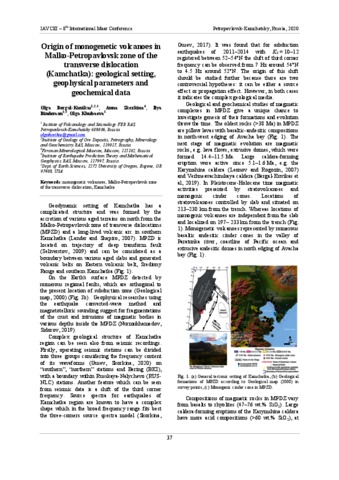
Bergal-Kuvikas Olga, Bindeman Ilya, Skorkina Anna, Khubaeva Olga Origin of monogenetic volcanoes in Malko-Petropavlovsk zone of the transverse dislocation (Kamchatka): geological setting, geophysical parameters and geochemical data // Abstract volume of the 8th International Maar Conference. Petropavlovsk-Kamchatsky: IVS FEB RAS. 2020. P. 37-38.
Bergal-Kuvikas Olga, Buslov M.M., Bushenkova N.A., Dolgaya A.A. Transition from the Continental Margin of Kamchatka to the Island Arc of the Kurile Islands: Features of Volcanism, Crustal Deformation and Geophysical Parameters of the Slab // Russian Geology and Geophysics. 2023. https://doi.org/10.2113/RGG20234558
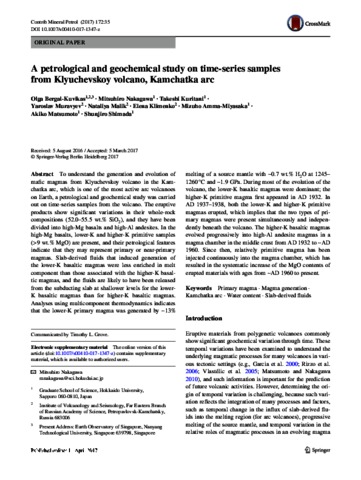
Bergal-Kuvikas Olga, Chugaev Andrey, Larionova Yulia, Cherkashin Roman, Nuzhdina I.N., Muravyev Y.D. Major, Trace Element and Sr–Nd–Pb Isotopic Geochemistry of Gorshkov Vent (18.02–21.03.2021), Klyuchevskoy Volcano (Kamchatka, Russia): Restarting a New Cycle of Volcanic Activity? // Geochemistry International. 2023. Vol. 3. https://doi.org/10.1134/S0016702923030035
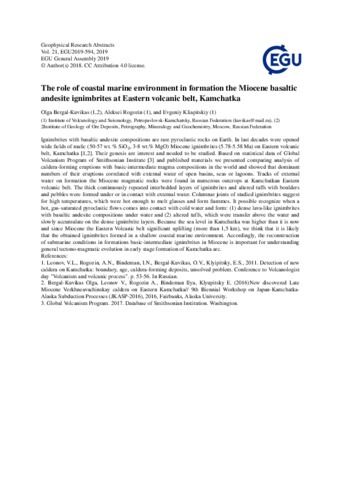
Bergal-Kuvikas Olga, Rogozin Aleksei, Kliapitskiy Evgeniy The role of coastal marine environment in formation the Miocene basaltic andesite ignimbrites at Eastern volcanic belt, Kamchatka // Geophysical Research Abstracts, EGU2019-594. 2019. Vol. 21.
Bessonova E.P., Bortnikova S.B., Gora M.P., Manstein Yu.A., Shevko A.Ya., Panin G.L., Manstein A.K. Geochemical and geo-electrical study of mud pools at the Mutnovsky volcano (South Kamchatka, Russia): Behavior of elements, structures of feeding channels and a model of origin // Applied Geochemistry. 2012. Vol. 27. № 9. P. 1829 - 1843. https://doi.org/10.1016/j.apgeochem.2012.02.018
Аннотация
This study presents data on the geochemical composition of boiling mud pools at the Mutnovsky volcano. The physicochemical characteristics of the pools and the concentrations of major, minor and trace elements in pool solutions vary widely. A comparison of the geochemical compositions of host rocks and solutions indicates that leaching from rocks is not the only source of chemicals in thermal solutions. Geophysical studies reveal the inner structure of thermal fields, which reflect the shapes of the underground reservoirs and feed channels. Using geophysical methods (electrical resistivity tomography and frequency domain investigations), it was shown that the vertical structure and complex geochemical zonation of the feed channels leads to a high contrast in the compositions of the mud solutions. These findings answer questions about the origin and composition of surface manifestations. To elucidate the mechanisms of solution formation, an attempt was made to describe the magmatic fluid evolution and the resulting mixing of waters by physical and mathematical models. The model illustrates fluid migration from a magma chamber to the surface. It is shown that the formation of brines corresponding to the mud pool composition is possible during secondary boiling.