Fedotov S.A., Ozerov A.Yu., Maguskin M.A., Dvigalo V.N., Grib E.N., Ivanov V.V. The 1996-2003 eruptions in the Akademii Nauk Caldera and at the Karymsky volcano, Kamchatka // IUGG-2003 Abstract. 2003. P. A.523.
Fedotov S.A., Sugrobov V.M., Utkin I.S., Utkina L.I. On the possibility of using heat stored in the magma chamber of the Avachinsky volcano and the surrounding rock for heat and power supply // Journal of Volcanology and Seismology. 2007. Vol. 1. № 1. P. 28-41. doi:10.1134/S0742046307010022
Аннотация
The results of geological and geophysical studies, including recent ones, which make it possible to verify the existence of a liquid magma chamber below the Avachinsky volcano on Kamchatka, and to estimate the chamber depth and approximate dimensions, are analyzed. The heat stored in the host rock heated by the volcanic magma chamber from the time of chamber origination to the present is estimated, taking variable chamber dimensions during the process of evolution into account. The geological-geophysical prerequisites for using the thermal energy of the heated rock which surrounds the magma chamber to supply heat and power to Petropavlovsk-Kamchatskii are analyzed. The creation of an underground geothermal circulation system (fracture heat exchanger) using deep boreholes is proposed.
Fedotov S.A., Zharinov N.A., Gontovaya L.I. The magmatic system of the Klyuchevskaya group of volcanoes inferred from data on its eruptions, earthquakes, deformation, and deep structure // Journal of Volcanology and Seismology. 2010. Т. 4. № 1. С. 1-33. doi:10.1134/S074204631001001X
Аннотация
Abstract-The study of magmatic plumbing systems of volcanoes (roots of volcanoes) is one of the main tasks facing volcanology. One major object of this research is the Klyuchevskaya group of volcanoes (KGV), in Kamchatka, which is the greatest such group that has been found at any island arc and subduction zone. We summarize the comprehensive research that has been conducted there since 1931. Several conspicuous results derived since the 1960s have been reported, emerging from the study of magma sources, eruptions, earthquakes, deformation, and the deep structure for the KGV. Our discussion of these subjects incorporates the data of physical volcanology relating to the mechanism of volcanic activity and data from petrology as to magma generation. The following five parts can be distinguished in the KGV plumbing system and the associated geophysical model: the source of energy and material at the top of the Pacific Benioff zone at a depth of about 160 km, the region of magma ascent in the asthenosphere. the region of magma storage in the crust-mantle layer at depths of 40-25 km,
magma chambers and channelways in the crust, and the bases of volcanic edifices. We discuss and explain the properties of and the relationships between these parts and the mechanisms of volcanic activity and of the KGV plumbing system as they exist today. Methods for calculating magma chambers and conduits, the amount of magma in the system, and its other properties are available.
Felitsyn S.B., Kirianov V.Yu. Areal variability of tephra composition as indicated by bulk silicate analysis data // Volcanology and Seismology. 1990. Vol. 9. № 1. P. 1-20.
Felitsyn S.B., Vaganov P.A., Kirianov V.Yu. Trace Element Distribution in Kamchatkan Ashes from Instrumental Neutron Activation Analysis // Volcanology and Seismology. 1991. Vol. 12. № 2. P. 195-213.
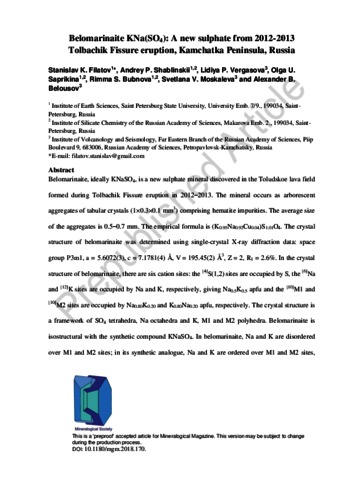
Filatov S., Shablinskii A., Vergasova L., Saprikina O., Bubnova R., Moskaleva S., Belousov Alexander Belomarinaite KNa (SO 4): A new sulfate from 2012–2013 Tolbachik Fissure eruption, Kamchatka Peninsula, Russia // Mineralogical Magazine. 2019. Vol. 83. № 4. P. 569-577. https://doi.org/10.1180/mgm.2018.170
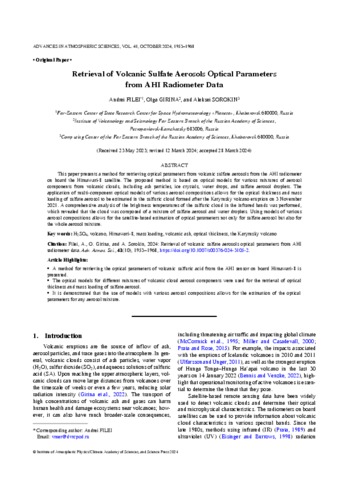
Filei Andrei, Girina O.A., Sorokin A.A. Retrieval of Volcanic Sulphate Aerosols Optical Parameters from AHI Radiometer Data // Advances in Atmospheric Sciences. 2024. Vol. 41. Vol. 10. P. 1953-1968. https://doi.org/10.1007/s00376-024-3105-2
Аннотация
This paper presents a method for retrieving volcanic sulphate aerosols optical parameters from the AHI radiometer on board the Himawari-8 satellite. The proposed method is based on optical models for various mixtures of the volcanic cloud’s aerosol components, including ash particles, ice crystals, water drops, and sulphate aerosol droplets. The application of multicomponent optical models of various aerosol compositions allowed the optical thickness and mass loading of sulphate aerosol to be estimated in the sulfuric cloud formed after the Karymsky volcano eruption on November 3, 2021. A comprehensive analysis of the brightness temperatures of the sulfuric cloud in the infrared bands was performed, which revealed that the cloud composed a mixture of sulphate aerosol and water droplets. The use of the models of various aerosol composition allows the satellite-based estimation of optical parameters not only for sulphate aerosol but also for the whole aerosol mixture.
Firstov P.P., Shakirova A.A. Seismicity observed during the precursory process and the actual eruption of Kizimen Volcano, Kamchatka in 2009-2013 // Journal of Volcanology and Seismology. 2014. Vol. 8. № 4. P. 203-217. https://doi.org/10.1134/S0742046314040022
Аннотация
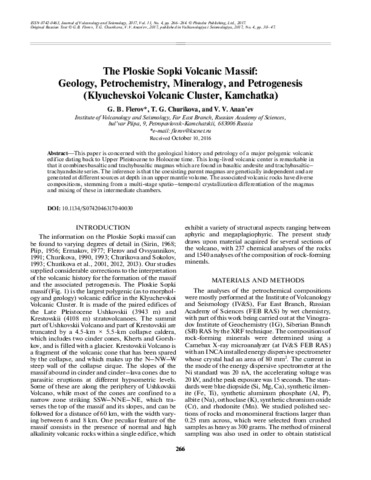
Flerov G.B., Churikova T.G., Anan'ev V.V. The Ploskie Sopki volcanic massif: Geology, petrochemistry, mineralogy, and petrogenesis (Klyuchevskoi Volcanic Cluster, Kamchatka) // Journal of Volcanology and Seismology. 2017. Vol. 11. Vol. 4. P. 266-284. https://doi.org/10.1134/S0742046317040030
Аннотация
This paper is concerned with the geological history and petrology of a major polygenic volcanic edifice dating back to Upper Pleistocene to Holocene time. This long-lived volcanic center is remarkable in that it combines basaltic and trachybasaltic magmas which are found in basaltic andesite and trachybasaltic– trachyandesite series. The inference is that the coexisting parent magmas are genetically independent and are generated at different sources at depth in an upper mantle volume. The associated volcanic rocks have diverse compositions, stemming from a multi-stage spatio–temporal crystallization differentiation of the magmas and mixing of these in intermediate chas.