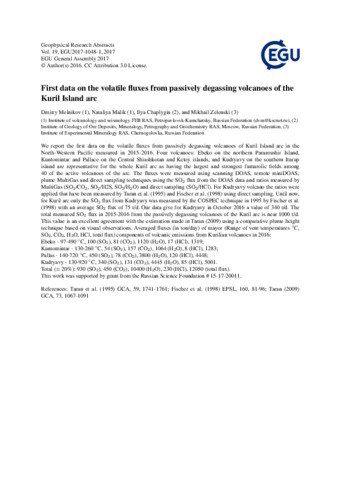
Melnikov Dmitry, Malik Nataliya, Chaplygin Ilya, Zelenski Mikhail First data on the volatile fluxes from passively degassing volcanoes of the Kuril Island arc // EGU General Assembly 2017. 2017. Vol. 19.
Melnikov Dmitry, Volynets Anna O. Remote sensing and petrological observations on the 2012–2013 fissure eruption at Tolbachik volcano, Kamchatka: Implications for reconstruction of the eruption chronology // Journal of Volcanology and Geothermal Research. 2015. Vol. 307. P. 89 - 97. https://doi.org/10.1016/j.jvolgeores.2015.09.025
Аннотация
Abstract We present a reconstruction of the chronological sequence of events that took place during the first days of the 2012–2013 Tolbachik fissure eruption using petrological data and remote sensing methods. We were forced to use this approach because bad weather conditions did not allow direct observations during the first two days of the eruption. We interpreted infrared images from the scanning radiometer {VIIRS} Suomi {NPP} and correlated the output with the results of the geochemical study, including comparison of the ash, deposited at the period from 27 to 29 November, with the samples of lava and bombs erupted from the Menyailov and Naboko vents. We argue that the compositional change observed in the eruption products (the decrease of SiO2 concentration and K2O/MgO ratio, increase of MgO concentration and Mg#) started approximately 24 h after the eruption began. At this time the center of activity moved to the southern part of the fissure, where the Naboko group of vents was formed; therefore, this timeframe also characterizes the timing of the Naboko vent opening. The Naboko group of vents remained active until the end of eruption in September 2013.
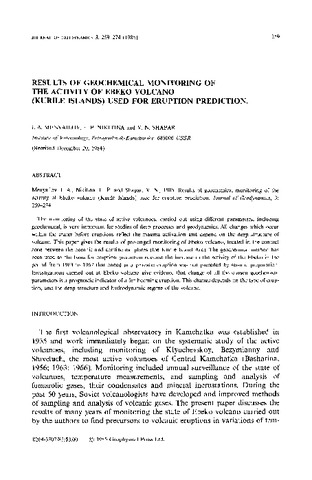
Menyailov I.A., Nikitina L.P., Shapar V.N. Results of geochemical monitoring of the activity of Ebeko volcano (Kurile Islands) used for eruption prediction // Journal of Geodynamics. 1985. Vol. 3. № 3-4. P. 259 - 274. https://doi.org/10.1016/0264-3707(85)90038-9
Аннотация
The monitoring of the state of active volcanoes, carried out using different parameters, including geochemical, is very important for studies of deep processes and geodynamics. All changes which occur within the crater before eruptions reflect the magma activation and depend on the deep structure of volcano. This paper gives the results of prolonged monitoring of Ebeko volcano, located in the contact zone between the oceanic and continental plates (the Kurile Island Arc). The geochemical method has been used as the basis for eruption prediction because the increase in the activity of the Ebeko in the period from 1963 to 1967 that ended in a phreatic eruption was not preceded by seismic preparation. Investigations carried out at Ebeko volcano give evidence that change of all the chosen geochemical parameters is a prognostic indicator of a forthcoming eruption. This change depends on the type of eruption, and the deep structure and hydrodynamic regime of the volcano.
Miller T.P., Kirianov V.Yu. Volcanic Ash Hazard along the North Pacific (NOPAC) Air Routs: Kurile Islands - Kamchatka - Alaska // Proc. of the 95 International workshop on Volcanoes Commemorating the 50-th Anniversary of the Mt. Shova-Shinzan: Short papers and Abstracts. 1995.
Mironov N.L., Portnyagin M.V. H2O and CO2 in parental magmas of Kliuchevskoi volcano inferred from study of melt and fluid inclusions in olivine // Russian Geology and Geophysics. 2011. Vol. 52. № 11. P. 1353 - 1367. https://doi.org/10.1016/j.rgg.2011.10.007
Аннотация
This paper reports new FTIR data on the H2O and CO2 concentrations in glasses of 26 naturally quenched and experimentally partially homogenized melt inclusions in olivine (Fo85–91) phenocrysts from rocks of the Kliuchevskoi volcano. Measured H2O concentrations in the inclusions range from 0.02 to 4 wt.%. The wide variations in the H2O content of the inclusions, which do not correlate with the host olivine composition and contents of major elements in the melts, are explained by the H2O escape from inclusions via diffusion through the host olivine during the magma eruption and the following cooling. The largest H2O loss is characteristic of inclusions from lava samples which cooled slowly after eruption. The minimal H2O loss is observed for inclusions from rapidly quenched pyroclastic rocks. Parental magmas of the Kliuchevskoi volcano are estimated to contain 3.5 wt.% H2O. The new data imply a 40 °C lower mantle temperatures than that estimated earlier for the Kliuchevskoi primary melts. The concentrations of CO2 in glasses range from <0.01 to 0.13 wt.% and do not correlate with the type of studied inclusions and their composition. The calculated pressures of melt equilibria with H2O–CO2 fluid inside the inclusions are lower than 270 MPa. They are significantly lower than a pressure of 500 MPa calculated from the density (~0.8 g/cm3) of cogenetic fluid inclusions in high-Fo olivine. The significant pressure drop inside the melt inclusions after their trapping in olivine might be due to the H2O loss and redistribution of CO2 from melt to daughter fluid phase. Compared with melt inclusions, cogenetic fluid inclusions provide independent information about the crystallization pressures of olivine and initial CO2 content in the Kliuchevskoi magma, which were estimated to be at least 500 MPa and 0.35 wt.%, respectively. The maximum CO2 concentrations in the primary Kliuchevskoi melts are estimated at 0.8–0.9 wt.%. The decompression crystallization of the Kliuchevskoi magmas starts at depths of 30–40 km and proceeds with a continuous decrease in CO2 content and an increase (up to 6–7 wt.%) and then a decrease (at <300 MPa) in H2O content in melts, which explains the origin of the whole spectrum of rocks and melt inclusions of the Kliuchevskoi volcano.
Moiseenko K.B., Malik N.A. Linear inverse problem for inferring eruption source parameters from sparse ash deposit data as viewed from an atmospheric dispersion modeling perspective // Bulletin of Volcanology. 2019. Vol. 81. № 3. P. 19. https://doi.org/10.1007/s00445-019-1281-1
Аннотация
Determination of the volcanic eruption source parameters—total grain-size distribution and vertical ash mass distribution (VMD) within the source—is carried out on a collection of measured-area samples and granulometry data. For this, the geophysical inverse methods and Hybrid Particle and Concentration Transport Model (HYPACT) driven by wind and turbulence fields simulated with the Regional Atmospheric Modeling System (RAMS) are used. A two-step inversion procedure is proposed to obtain approximate but physically meaningful solution when the total number of ashfall samples is small and it is not possible to make a good initial guess of the source parameters. First, a spectrum of particle fall velocities is estimated by selecting a best-fit subset of aerodynamically distinct subpopulations of free and aggregate particles from the trial set used to simulate a polycomponent ashfall. The singular value decomposition (SVD) analysis is then employed to identify spatial components of the ash emissions’ vertical distribution, as resolvable by the observations. Model validation experiments are conducted for the January 12, 2011, short-duration vulcanian explosion at Kizimen and paroxysmal phase of the December 24, 2006, sub-Plinian eruption at Bezymianny. The derived VMDs exhibit high variability in fine ash content (~ 60–100 wt%) as well as strong secondary maxima in the lower troposphere, likely reflecting the contribution of ash particles fallen out of co-pyroclastic flow ash clouds and partially collapsing eruption columns.
Muravyev Y.D., Fedotov S.A., Budnikov V.A., Ozerov A.Yu., Maguskin M.A., Dvigalo V.N., Andreev V.I., Ivanov V.V., Kartasheva L.A., Markov I.A. Activity in the Karymsky Center in 1996: Summit Eruption at Karymsky and Phreatomagmatic Eruption in the Akademii Nauk Caldera // Volcanology and Seismology. 1998. Vol. 19. № 5. P. 567-604.
Аннотация
Data are presented from studies of volcanoes in the Karymsky long-living volcanic center, Kamchatka in 1996. We examine the dynamics and rock composition for eruptions that started simultaneously on Karymsky Volcano and in the Akademia Nauk caldera. The effusive-explosive eruption of Karymsky Volcano was resumed after a 14-year repose period, producing about 30 million tons of andesite-dacite discharges through the summit vent. Long-continued eruptive activity of that volcano is supposed to go on during the near future. Simultaneously with this activity, typical of Karymsky Volcano, a subaquaceous explosive eruption was observed in the lake that occupies the Akademia Nauk caldera 6 km south of the volcano for the first time in Kamchatka during the historical period. An edifice arose in the northern part of Lake Karymsky during 18 hours of this eruption consisting of basaltic and basaltic andesite pyroclastic material surrounding a crater of diameter 650 m. The amount of erupted pyroclastic material is estimated as 0.04 km3, the total weight being over 70 million tons. A discussion is provided of the impact of these eruptions on the environment; we describe renewed hydrothermal activity and the formation of a new group of hot springs in the Akademia Nauk caldera, and estimate the possibility of breakthrough floods from Lake Karymsky etc.
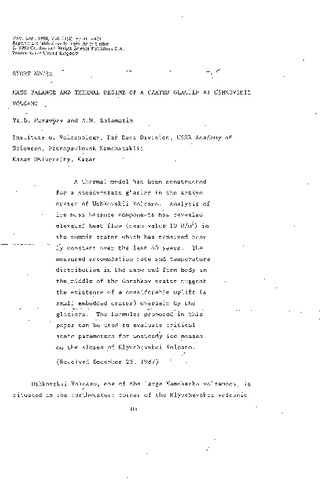
Muravyev Y.D., Salamatin A.N. Mass balance and thermal regime of a crater glacier at Ushkovskii volcano // Volcanology and Seismology. 1990. Vol. 11. № 3. P. 411-424.
Аннотация
A thermal model has been constructed for a steady-state glacier of Ushkovskii Volcano. Analysis of ice mass balance components has revealed elevated heat flow (mean valce 10 W/m2) in the summit crater wich has remained nearly constant over the last 40 years. The measured accumulation rate and temperature distribution in the snow and firn body in the middle of the Gorshkov crater suggest the existence of a considerable uplift (a small embedded crater) overlain by the glaciers. The formulas proposed in this paper can be used to evaluate critical state parameters for unsteady ice masses on the slopes of Klyuchevskoi Volcano.
Muravyev Y.D., Shiraiwa T. 400 years of climatic change in Kamchatka Peninsula, Russia: paleoglaciologic, tree-ring and ice-core evidance // Proceedings International Workshop. Matsuyama, Japan, 2002. 2002. P. 76-91.
Naboko S.I. Change in the fumarole regime of Kliuchevsky volcano // Bulletin Volcanologique. 1960. Vol. 23. Vol. 1. P. 135-140. 6 p. https://doi.org/10.1007/BF02596638