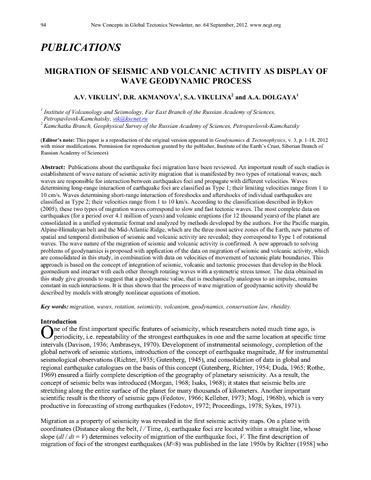
Vikulin A.V., Akmanova D.R., Vikulina S.A., Dolgaya A.A. Migration of seismic and volcanic activity as display of wave geodynamic process // New Concepts in Global Tectonics Newsletter. 2012. № 64. P. 94-110.
Аннотация
Publications about the earthquake foci migration have been reviewed. An important result of such studies is establishment of wave nature of seismic activity migration that is manifested by two types of rotational waves; such waves are responsible for interaction between earthquakes foci and propagate with different velocities. Waves determining long-range interaction of earthquake foci are classified as Type 1; their limiting velocities range from 1 to 10 cm/s. Waves determining short-range interaction of foreshocks and aftershocks of individual earthquakes are classified as Type 2; their velocities range from 1 to 10 km/s. According to the classification described in [Bykov, 2005], these two types of migration waves correspond to slow and fast tectonic waves. The most complete data on earthquakes (for a period over 4.1 million of years) and volcanic eruptions (for 12 thousand years) of the planet are consolidated in a unified systematic format and analyzed by methods developed by the authors. For the Pacific margin, Alpine-Himalayan belt and the Mid-Atlantic Ridge, which are the three most active zones of the Earth, new patterns of spatial and temporal distribution of seismic and volcanic activity are revealed; they correspond to Type 1 of rotational waves. The wave nature of the migration of seismic and volcanic activity is confirmed. A new approach to solving problems of geodynamics is proposed with application of the data on migration of seismic and volcanic activity, which are consolidated in this study, in combination with data on velocities of movement of tectonic plate boundaries. This approach is based on the concept of integration of seismic, volcanic and tectonic processes that develop in the block geomedium and interact with each other through rotating waves with a symmetric stress tensor. The data obtained in this study give grounds to suggest that a geodynamic value, that is mechanically analogous to an impulse, remains constant in such interactions. It is thus shown that the process of wave migration of geodynamic activity should be described by models with strongly nonlinear equations of motion.
Vinogradov V.N., Muravyev Y.D. Lava-Ice Interaction during the 1983 Klyuchevskoi Eruption // Volcanology and Seismology. 1988. Vol. 7. № 1. P. 39-62.
Vinogradov V.N., Muravyev Y.D., Nikitina I.M., Salamatin A.N. Production of phreatic explosions in the interaction of lava and ice // Volcanology and Seismology. 1990. Vol. 9. № 1. P. 89-98.
Аннотация
A matematical model is given of the formation of phreatic explosions in lava flows coming into contact with ice formations. Quantitative characteristics are derived for the various stages in the development of the explosion; by means of wich its strength and other parameters may be evaluated. The theoretical calculation results are in agreement with empirical data.
Vlodavets V.I., Naboko S.I., Fedotov S.A. 50 Years of Soviet Volcanology // Volcanology and Seismology. 1988. Vol. 7. № 4. P. 463-482.
Vlodavetz V.I. On the terms «ignimbrite» and «ignimbritic deposits» // Bulletin Volcanologique. 1966. Vol. 29. Vol. 1. P. 141-145. 5 p. doi:10.1007/BF02597149
Vlodavetz V.I., Naboko S.I., Piip B.I. Relations between the type of eruptions and the composition of lava as exemplified by Kamchatka and Kuriles Volcanoes // Bulletin Volcanologique. 1963. Vol. 26. Vol. 1. P. 100-111. https://doi.org/10.1007/BF02597279
Voight B., Komorowski J-C., Norton G. E., Belousov A. B., Belousova M., Boudon G., Francis P. W., Franz W., Heinrich P., Sparks R. S. J., Young S. R. The 26 December (Boxing Day) 1997 sector collapse and debris avalanche at Soufriere Hills Volcano, Montserrat // Geological Society, London, Memoirs. 2002. Vol. 21. № 1. P. 363-407. doi:10.1144/GSL.MEM.2002.021.01.17
Volkova Maria, Shapiro Nikolay, Melnik Oleg, Mikhailov Valentin, Plechov Pavel, Timoshkina Elena, Bergal-Kuvikas Olga Subsidence of the lava flows emitted during the 2012–2013 eruption of Tolbachik (Kamchatka, Russia): Satellite data and thermal model // Journal of Volcanology and Geothermal Research. 2022. https://doi.org/10.1016/j.jvolgeores.2022.107554
Volynets A.O., Melnikov D.V., Yakushev A.I. First data on composition of the volcanic rocks of the IVS 50th anniversary Fissure Tolbachik eruption (Kamchatka) // Doklady Earth Sciences. 2013. Vol. 452. № 1. P. 953-957. doi:10.1134/S1028334X13090201
Аннотация
First data on major, minor and trace element (XRF. ICP-MS) concentrations in the volcanic rocks of the IVS 50th anniversary Fissure Tolbachik eruption are reported for the period from 27.11.2012 to 25.01.2013; scheme of lava flows distribution by March 2013 is made. The volcanic rocks of the new eruption are substantially different from the other studied volcanic rocks of Tolbachinsky Dol by their higher alkalis and incompatible elements content. The rocks of the first three days of eruption (Menyailov Vent) have higher silica and alkalis content than all previously reported volcanic rocks of Tolbachinsky Dol. Volcanic rocks of the Naboko Vent, at silica content similar to high-Al basalts of Tolbachinsky Dol, have different concentrations of trace elements and some major elements (K2O, CaO, TiO2, P2O5). REE and other incompatible element concentrations in the rocks of the Menyailov Vent are higher than in the rocks of the Naboko Vent at the same element ratios. The differences of the volcanic rocks of the two vents of the new eruption may be caused by the fact that the erupted lavas came from the different levels of the same magma chamber.
Volynets Anna O., Edwards Benjamin R., Melnikov Dmitry, Yakushev Anton, Griboedova Irina Monitoring of the volcanic rock compositions during the 2012–2013 fissure eruption at Tolbachik volcano, Kamchatka // Journal of Volcanology and Geothermal Research. 2015. Vol. 307. P. 120 - 132. https://doi.org/10.1016/j.jvolgeores.2015.07.014
Аннотация
Abstract Here we present the results from monitoring of the composition of rocks produced during the 2012–2013 fissure eruption at Tolbachik volcano (FTE). Major and trace element concentrations in 75 samples are reported. Products of this eruption are represented by high alumina basaltic trachyandesites with higher alkalis and titanium contents than in all previously studied rocks of the Tolbachik monogenetic volcanic field. Rocks erupted during the first three days (27–30 November) from the northern (also called Menyailov) group of vents are the most silica- and alkali-rich (SiO2 concentrations up to 55.35 wt. and {K2O} up to 2.67 wt.). From December onwards, when the eruptive activity switched from the Menyailov vents to the southern (Naboko) group of vents, silica content dropped by 2 wt., concentrations of MgO, FeO, TiO2 and Mg# increased, and {K2O} and Na2O concentrations and K2O/MgO ratio decreased. For the rest of the eruption the compositions of rocks remained constant and homogeneous; no systematic compositional differences between lava, bombs and scoria samples are evident. Trace element distributions in the rocks of the Menyailov and Naboko vent lavas are relatively uniform; Menyailov lavas have slightly higher Th, Nb, Hf, Y, and {HREE} concentrations than the Naboko vent lavas at more or less constant element ratios. We explain the initial change in geochemistry by tapping of a slightly cooler and fractionated (~ 3 Mt and 8 Cpx) upper part of the magma storage zone before the main storage area began to feed the eruption. Thermodynamic constraints show that apparent liquidus temperatures varied from 1142 °C to 1151 °C, and thermodynamic modeling shows that variations in compositions are consistent with a high degree of low pressure (100–300 MPa), nominally anhydrous fractionation of a parent melt compositionally similar to the 1975 Northern Breakthrough high-Mg basalt. Geochemistry, petrological observations and modeling are in agreement with the newly erupted material being derived from remnant high-Al magma from the 1975–76 Southern Breakthrough eruption with only slight amounts of cooling (less than 1 °C per year) during the intervening 36 years.