MONITORING AND REPORTING OF KAMCHATKAN VOLCANIC ERUPTIONS (2004)
Gordeev E.I., Senyukov S.L., Girina O.A. MONITORING AND REPORTING OF KAMCHATKAN VOLCANIC ERUPTIONS // Proceedings of the 2nd International Conference on Volcanic Ash and Aviation Safety, June 21-24, 2004, Session 2. Alexandria, Virginia (USA): 2004. P. 43.
Magma Chambers beneath the Klyuchevskoy Volcanic Group (2007)
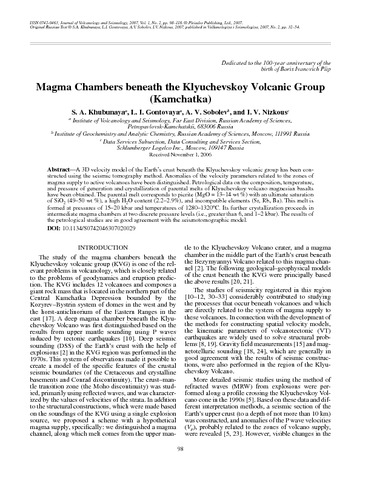
Khubunaya S.A., Gontovaya L.I., Sobolev A.V., Nizkous I.V. Magma Chambers beneath the Klyuchevskoy Volcanic Group // Journal of Volcanology and Seismology. 2007. Vol. 1. № 2. P. 98-118. https://doi.org/0.1134/S0742046307020029
Annotation
Поступила в редакцию 1. 11. 2006 г.
Методом сейсмической томографии построена объемная скоростная модель земной коры под Ключевской группой вулканов. Выделены аномалии скоростных параметров связанных с зонами магматического питания активных вулканов. Получены петрологические данные о составе, температуре и давлении генерации и кристаллизации родоначальных расплавов магнезиальных базальтов Ключевского вулкана. Родоначальный расплав отвечает пикриту (MgO=13-14%,мас) с предельным насыщением SiO2 (49-50%, мас.), высоким содержанием H2O (2,2-2.9%) и несовместимыми элементами (Sr, Rb, Ba, Hf). Он образуется при давлениях 15-20 кбар и температурах 1280-13200С. Его дальнейшая кристаллизация проходит в промежуточных магматических камерах при двух дискретных уровнях давлений (более 6 и 1-2 кбар). Результаты петрологических исследований находятся в хорошем соответствии с сейсмотомографической моделью.
Magma compositions of Bezymianny, Shiveluch and Karymsky volcanoes according to the data on study of glass inclusions (Kamchatka) (2000)
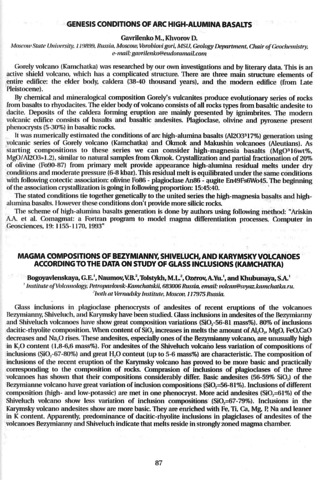
Bogoyavlenskaya G.E., Naumov V.B., Tolstykh M.L., Ozerov A.Yu., Khubunaya S.A. Magma compositions of Bezymianny, Shiveluch and Karymsky volcanoes according to the data on study of glass inclusions (Kamchatka) // Abstracts of IAVCEI General Assembly, 18-22 July 2000. Bali, Indonesia. 2000. P. 87.
Magma fracking and production reservoirs beneath and adjacent to Mutnovsky volcano based on seismic data and hydrothermal activity (2022)
Kiryukhin A.V., Polyakov A.Y., Voronin P.O., Zhuravlev N.B., Usacheva O.O., Solomatin A.V., Kiryukhin P.A. Magma fracking and production reservoirs beneath and adjacent to Mutnovsky volcano based on seismic data and hydrothermal activity // Geothermics. 2022. Vol. 105. № 102474. 1 p. doi:10.1016/j.geothermics.2022.102474
Annotation
Mutnovsky geothermal area in Kamchatka, Russia where 62 MWe GeoPP installed - is a source of geothermal electricity supply, as well as a hazard volcanic area. We used local seismicity micro-earthquakes (MEQ’s) data from 2009 to 2021 to define seismogenic faults beneath and adjacent to Mutnovsky volcano, which interpreted as magma injections in form of dykes and sills. Magma fracking beneath Mutnovsky volcano pointed on shear mode low angle dykes in northeast sector and opening mode geomechanical conditions at -3000 m, where sills in area of 62 km2 are suggested to be formed. Low angle dykes injections were reproduced by hydromechanical simulation using CFRAC, modeling results matches with MEQ’s statistics observed.
Mutnovsky GeoPP steam collection system shows sensitivity to non-condensable gasses (NCG) content (partial gas pressure) variations (2019—2020), that is used as indicator of magmatic gasses recharge via magma fracking volcano system to production geothermal reservoir. Partial gas pressure measured at GeoPP condenser unit. Magma injections associated with NCG (CO2) release in production reservoirs seems to be synchronize with partial NCG pressure excursions at GeoPP condenser. Some signs of magma fracking events were also revealed using discreet observations (2016–2021) on a blowing wells on a foothills of Mutnovsky volcano. Magma fracking beneath Mutnovsky volcano is associate with small and medium hydrothermal explosions and landslide (2009–2021). Magma fracking distributions pointed on a new potentially production geothermal reservoir beneath northeast foothills of Mutnovsky volcano (depth range from -4000 to -2000 m, accessible area of 30 km2).
Magma migration at the onset of the 2012–13 Tolbachik eruption revealed by Seismic Amplitude Ratio Analysis (2015)
Caudron Corentin, Taisne Benoit, Kugaenko Yulia, Saltykov Vadim Magma migration at the onset of the 2012–13 Tolbachik eruption revealed by Seismic Amplitude Ratio Analysis // Journal of Volcanology and Geothermal Research. 2015. Vol. 307. P. 60 - 67. https://doi.org/10.1016/j.jvolgeores.2015.09.010
Annotation
Abstract In contrast of the 1975–76 Tolbachik eruption, the 2012–13 Tolbachik eruption was not preceded by any striking change in seismic activity. By processing the Klyuchevskoy volcano group seismic data with the Seismic Amplitude Ratio Analysis (SARA) method, we gain insights into the dynamics of magma movement prior to this important eruption. A clear seismic migration within the seismic swarm, started 20 hours before the reported eruption onset (05:15 UTC, 26 November 2012). This migration proceeded in different phases and ended when eruptive tremor, corresponding to lava flows, was recorded (at ~ 11:00 UTC, 27 November 2012). In order to get a first order approximation of the magma location, we compare the calculated seismic intensity ratios with the theoretical ones. As expected, the observations suggest that the seismicity migrated toward the eruption location. However, we explain the pre-eruptive observed ratios by a vertical migration under the northern slope of Plosky Tolbachik volcano followed by a lateral migration toward the eruptive vents. Another migration is also captured by this technique and coincides with a seismic swarm that started 16–20 km to the south of Plosky Tolbachik at 20:31 {UTC} on November 28 and lasted for more than 2 days. This seismic swarm is very similar to the seismicity preceding the 1975–76 Tolbachik eruption and can be considered as a possible aborted eruption.
Magma mixing and degassing processes in the magma chamber of Gorely volcano (Kamchatka): evidence from wholerock and olivine chemistry (2015)
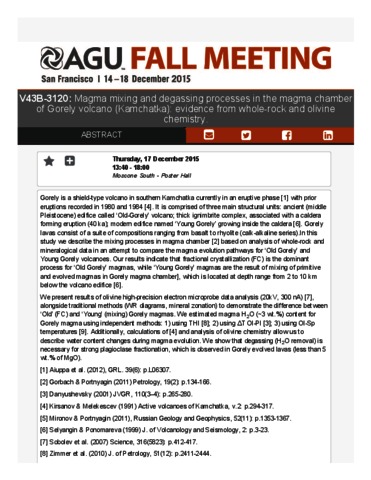
Gavrilenko M., Ozerov A., Kyle P., Carr M., Nikulin A. Magma mixing and degassing processes in the magma chamber of Gorely volcano (Kamchatka): evidence from wholerock and olivine chemistry, Abstract V43B-3120 presented at 2015 Fall Meeting, AGU, San Francisco, Calif., 14-18 Dec.. 2015.
Magma rates in feeding conduits of different volcanic centres (1981)
Fedotov S.A. Magma rates in feeding conduits of different volcanic centres // Journal of Volcanology and Geothermal Research. 1981. Vol. 9. № 4. P. 379-394. doi:10.1016/0377-0273(81)90045-7
Annotation
A quasi-stationary magma flow rate in asthenospheric and crustal conduits of central type volcanoes and volcanic centres was studied analytically under the following conditions. Magma rises through cylindrical channels in which the magma temperature does not change with time, but the wall rocks are gradually heated. The magma rates were calculated for basaltic, andesitic and dacitic volcanoes using the “continental” and “oceanic” geotherms. It follows from these calculations that the magma supply rate may determine the kind of activity of a volcanic centre, being constant for large and very active volcanoes, intermittent for usual volcanic centres of island arcs or sporadic for volcamic fields, clusters of cinder cones and areal volcanism. Theoretical conclusions are consistent with observational data.
Magma storage, ascent and recharge history prior to the 1991 eruption at Avachinsky Volcano, Kamchatka, Russia: Inferences on the plumbing system geometry (2012)
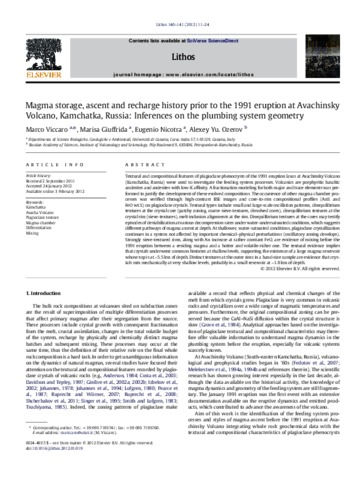
Viccaro Marco, Giuffrida Marisa, Nicotra Eugenio, Ozerov Alexey Yu. Magma storage, ascent and recharge history prior to the 1991 eruption at Avachinsky Volcano, Kamchatka, Russia: Inferences on the plumbing system geometry // Lithos. 2012. Vol. 140–14. P. 11 - 24. https://doi.org/10.1016/j.lithos.2012.01.019
Annotation
Textural and compositional features of plagioclase phenocrysts of the 1991 eruption lavas at Avachinsky Volcano (Kamchatka, Russia) were used to investigate the feeding system processes. Volcanics are porphyritic basaltic andesites and andesites with low-K affinity. A fractionation modeling for both major and trace elements was performed to justify the development of these evolved compositions. The occurrence of other magma chamber processes was verified through high-contrast BSE images and core-to-rim compositional profiles (An and FeO wt.) on plagioclase crystals. Textural types include small and large-scale oscillation patterns, disequilibrium textures at the crystal core (patchy zoning, coarse sieve-textures, dissolved cores), disequilibrium textures at the crystal rim (sieve-textures), melt inclusion alignments at the rim. Disequilibrium textures at the cores may testify episodes of destabilization at various decompression rates under water-undersaturated conditions, which suggests different pathways of magma ascent at depth. At shallower, water-saturated conditions, plagioclase crystallization continues in a system not affected by important chemical-physical perturbations (oscillatory zoning develops). Strongly sieve-textured rims, along with An increase at rather constant FeO, are evidence of mixing before the 1991 eruption between a residing magma and a hotter and volatile-richer one. The textural evidence implies that crystals underwent common histories at shallow levels, supporting the existence of a large magma reservoir whose top is at ~ 5.5 km of depth. Distinct textures at the outer rims in a hand-size sample are evidence that crystals mix mechanically at very shallow levels, probably in a small reservoir at ~ 1.8 km of depth.
Magmatic Activity of Mutnovsky Volcano and the Formation of a Crater at the Place of the Blowing Well 022 (2025)
Kiryukhin A.V., Polyakov A.Y., Sergeeva A.V., Nuzhdaev I.A., Zhuravlev N.B., Voronin P.O., Usacheva O.O., Puzankov M.Yu. Magmatic Activity of Mutnovsky Volcano and the Formation of a Crater at the Place of the Blowing Well 022 // Journal of Volcanology and Seismology. 2025. Vol. 19. № 4. P. 303-318. https://doi.org/10.1134/S0742046325700216
Annotation
Mutnovsky Volcano is characterized by predominantly magmatic activity for the last 4 thousand years in the northern sector where the Mutnovsky geothermal field lies. Magmatic activity is identified using the Frac-Digger method based on seismic data as reported by the KB FRC UGS RAS. The most significant sequence of shallow dikes striking northeast has been manifested at the surface by blowing two-phase geothermal wells. Dike emplacement in March 2024 was synchronized with a hydrothermal explosion producing a crater of volume reaching 0.36 million m3 at the place of well 022 (Crater 022+). Unaltered fragments due to the explosion indicate a lithoclastic character in the gas-enriched head of the dike. The bottom of the explosion crater is a hydrothermally altered (opal, zeolite) 160 × 75 m2 in area. The mechanism of the hydrothermal explosion is treated as resulting from hydraulic fracturing by means of a shallow dike, with subsequent increase in pressure in the shallow geothermal reservoir near the well with a closed wellhead control-valve.
Magmatic System of Shiveluch Volcano from Seismic Data with Geomechanical Interpretation (2026)
Kiryukhin A.V., Bergal-Kuvikas O.V., Lemzikov M.V. Magmatic System of Shiveluch Volcano from Seismic Data with Geomechanical Interpretation // Journal of Volcanology and Seismology. 2026. Vol. 20. № 2. P. 136-164. https://doi.org/10.1134/S0742046326700077