Evolution and genesis of volcanic rocks from Mutnovsky Volcano, Kamchatka (2014)
Simon A., Yogodzinski G.M., Robertson K., Smith E., Selyangin O., Kiryukhin A., Mulcahy S.R., Walker J.D. Evolution and genesis of volcanic rocks from Mutnovsky Volcano, Kamchatka // Journal of Volcanology and Geothermal Research. 2014. Vol. 286. P. 116 - 137. https://doi.org/10.1016/j.jvolgeores.2014.09.003
Аннотация
This study presents new geochemical data for Mutnovsky Volcano, located on the volcanic front of the southern portion of the Kamchatka arc. Field relationships show that Mutnovsky Volcano is comprised of four distinct stratocones, which have grown over that past 80 ka. The youngest center, Mutnovsky IV, has produced basalts and basaltic andesites only. The three older centers (Mutnovsky I, II, III) are dominated by basalt and basaltic andesite (60–80 by volume), but each has also produced small volumes of andesite and dacite. Across centers of all ages, Mutnovsky lavas define a tholeiitic igneous series, from 48–70 SiO2. Basalts and basaltic andesites have relatively low K2O and Na2O, and high FeO* and Al2O3 compared to volcanic rocks throughout Kamchatka. The mafic lavas are also depleted in the light rare earth elements (REEs), with chondrite-normalized La/Sm < 1.0. Andesites have generally higher REE abundances and are more enriched in light REEs, some showing negative Eu anomalies. All samples are depleted in field strength elements (HFSEs) relative to similarly incompatible REEs (e.g., low La/Ta, Nd/Hf compared to MORB), similar to island arc volcanic rocks worldwide. Radiogenic isotope ratios (Sr, Nd, Pb, Hf) are similar for samples from all four eruptive centers, and indicate that all samples were produced by melting of a similar source mixture. No clear age-progressive changes are evident in the compositions of Mutnovsky lavas. Mass balance and assimilation-fractional crystallization (AFC) modeling of major and rare earth elements (REEs) indicate that basaltic andesites were produced by FC of plagioclase, clinopyroxene and olivine from a parental basalt, combined with assimilation of a melt composition similar to dacite lavas present at Mutnovsky. This modeling also indicates that andesites were produced by FC of plagioclase from basaltic andesite, combined with assimilation of dacite. Dacites erupted from Mutnovsky I and II have low abundances of REEs, and do not appear to be related to mafic magmas by FC or AFC processes. These dacites are modeled as the products of dehydration partial melting at mid-crustal levels of a garnet-free, amphibole-bearing basaltic rock, which itself formed in the mid-crust by emplacement of magma that originated from the same source as all Mutnovsky magmas. Lead isotope data indicate that subducted sediment is likely present in the source beneath Mutnovsky and most Kamchatka volcanoes, but uniformly radiogenic Hf and Nd in mafic samples (εNd = 8.7–9.3, εHf = 15.4–15.9), and significant variation in trace element ratios at nearly constant εNd and εHf, indicate that sediment plays a minor roll in controlling subduction trace element patterns in Mutnovsky lavas. Mafic lavas with Ba/Th > 450 require an aqueous fluid source component from subducting oceanic crust, but mixing patterns in isotope versus trace element ratio plots for Hf and the REEs (εNd and εHf vs. ratios with Ce, Nd and Hf) demonstrate that a source component with radiogenic Nd and Hf, and fractionated (arc-type) trace element ratios must be present in the source of Mutnovsky lavas. This source component, which is interpreted to be a partial melt of subducted basalt in the eclogite facies (eclogite melt source component), appears to be present in the source of all Kamchatka volcanoes. Cross-arc geochemical patterns at Mutnovsky and in other arc systems (Isu-Bonin, Tonga-Kermadec) suggest that the aqueous fluid component diminishes and the eclogite melt component is increased from volcanoes at the arc front compared to those in rear-arc positions.
Evolution of Quaternary Volcanism and Tectonics in the Western Part of the Pacific Ring (1972)
Erlich E.N., Melekestsev I.V. Evolution of Quaternary Volcanism and Tectonics in the Western Part of the Pacific Ring // Pacific Geology. 1972. № 4. P. 1-22.
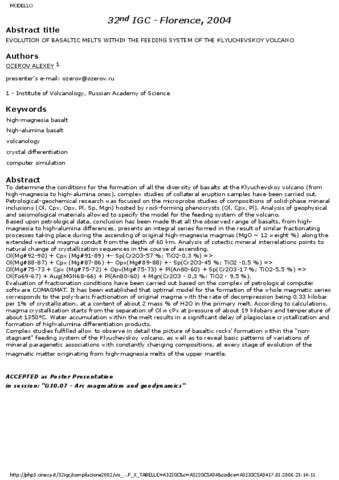
Evolution of basaltic melts within the feeding system of the Klyuchevskoy volcano (2004)
Ozerov A.Yu. Evolution of basaltic melts within the feeding system of the Klyuchevskoy volcano // 32nd International Geological Congress. Florence, Italy. 2004, Abstracts. 2004. Vol. Part 1. P. 407.
Evolution of the crater lake of Maly Semyachik volcano, Kamchatka (1965–2020) (2021)
Taran Yuri, Kalacheva Elena, Dvigalo Viktor, Melnikov Dmitri, Voloshina Ekaterina Evolution of the crater lake of Maly Semyachik volcano, Kamchatka (1965–2020) // Journal of Volcanology and Geothermal Research. 2021. Vol. 418. P. 107351. https://doi.org/10.1016/j.jvolgeores.2021.107351
Аннотация
Significant variations in temperature, water chemistry and volume of the lake in the crater of Maly Semyachik volcano, Kamchatka, in 1965–2020 can be divided in three main stages. The first stage, until about the mid-1980s, was characterized by intense volcanic-hydrothermal activity, high (above 40 °C) temperature, high salinity (up to 40 g/l) and an increase in the level (and volume) of the lake. During the second stage, which lasted 25–30 years, since the mid-1980s until the mid-2000s, the lake cooled down, until freezing in winter, the mineralization decreased (up to 1.6 g/l), and the volume of the lake remained almost constant. After the mid-2000s until present, there is a period of activation of the Maly Semyachik volcano, which is expressed in an increase in temperature, mineralization and a sharp increase in the volume of the crater lake. The water balance of the lake and the input and composition of the thermal acid chloride solution are estimated based on the analysis of changes in chemical and physical parameters over time, using a box model.
Evolution of the magmatic melts at Gorely volcano (Kamchatka) (2009)
Gavrilenko M., Ozerov A. Evolution of the magmatic melts at Gorely volcano (Kamchatka) // 2009 Portland Geological Society of America Annual Meeting (18-21 October 2009). Abstracts with Programs. 2009. Vol. 41. № 7. P. 645.
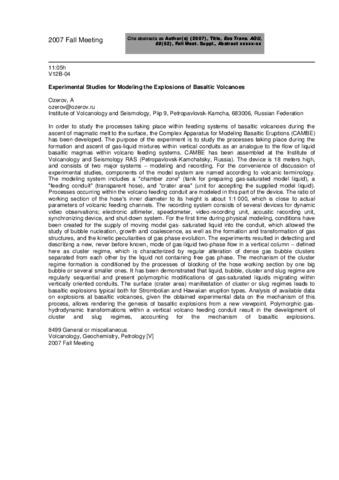
Experimental Studies for Modeling the Explosions of Basaltic Volcanoes (2007)
Ozerov A.Yu. Experimental Studies for Modeling the Explosions of Basaltic Volcanoes / Volcanism and Subduction: The Kamchatka Region. // AGU Fall Meeting 2007. Eos Trans. AGU, 88(52), Fall Meet. Suppl., Abstracts. 2007. P. V12B-04.
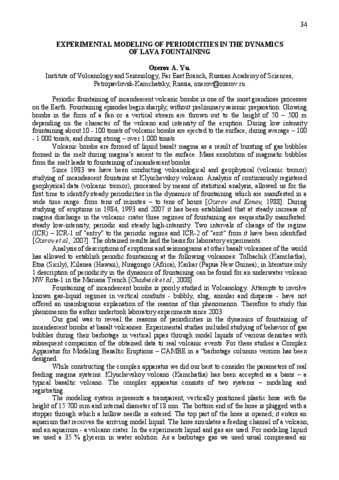
Experimental modeling of periodicities in the dynamics of lava fountaining (2011)
Ozerov A.Yu. Experimental modeling of periodicities in the dynamics of lava fountaining // 7th Biennual workshop on Japan-Kamchatka-Alaska subduction processes: mitigating risk through international volcano, earthquake, and tsunami science (JKASP-2011). Petropavlovsk-Kamchatsky, Russia. August 25-30, 2011. 2011. P. 34-35.
Experimental modeling of the basaltic eruptions mechanism (2010)
Ozerov A.Yu. Experimental modeling of the basaltic eruptions mechanism / International Conference Fluxes and Structures in Fluids: Physics of Geospheres – 2009, Selected Papers. 2010. P. 269-278.
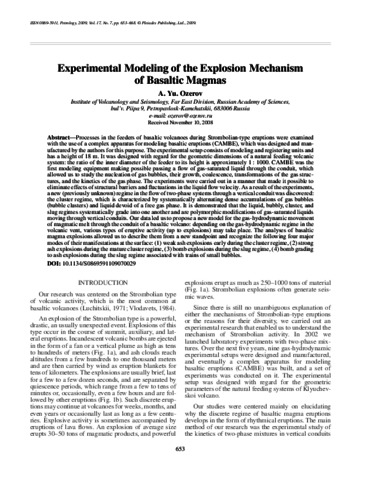
Experimental modeling of the explosion mechanism of basaltic magmas (2009)
Ozerov A. Yu. Experimental modeling of the explosion mechanism of basaltic magmas // Petrology. 2009. Vol. 17. № 7. P. 653-668. doi:10.1134/S0869591109070029