Bindeman I.N., Leonov V.L., Izbekov P.E., Ponomareva V.V., Watts K.E., Shipley N.K., Perepelov A.B., Bazanova L.I., Jicha B.R., Singer B.S., Schmitt A.K., Portnyagin M.V., Chen C.H. Large-volume silicic volcanism in Kamchatka: Ar–Ar and U–Pb ages, isotopic, and geochemical characteristics of major pre-Holocene caldera-forming eruptions // Journal of Volcanology and Geothermal Research. 2010. Vol. 189. № 1-2. P. 57-80. doi:10.1016/j.jvolgeores.2009.10.009
Аннотация
The Kamchatka Peninsula in far eastern Russia represents the most volcanically active arc in the world in terms of magma production and the number of explosive eruptions. We investigate large-scale silicic volcanism in the past several million years and present new geochronologic results from major ignimbrite sheets exposed in Kamchatka. These ignimbrites are found in the vicinity of morphologically-preserved rims of partially eroded source calderas with diameters from ∼ 2 to ∼ 30 km and with estimated volumes of eruptions ranging from 10 to several hundred cubic kilometers of magma. We also identify and date two of the largest ignimbrites: Golygin Ignimbrite in southern Kamchatka (0.45 Ma), and Karymshina River Ignimbrites (1.78 Ma) in south-central Kamchatka. We present whole-rock geochemical analyses that can be used to correlate ignimbrites laterally. These large-volume ignimbrites sample a significant proportion of remelted Kamchatkan crust as constrained by the oxygen isotopes. Oxygen isotope analyses of minerals and matrix span a 3‰ range with a significant proportion of moderately low-δ18O values. This suggests that the source for these ignimbrites involved a hydrothermally-altered shallow crust, while participation of the Cretaceous siliceous basement is also evidenced by moderately elevated δ18O and Sr isotopes and xenocryst contamination in two volcanoes. The majority of dates obtained for caldera-forming eruptions coincide with glacial stages in accordance with the sediment record in the NW Pacific, suggesting an increase in explosive volcanic activity since the onset of the last glaciation 2.6 Ma. Rapid changes in ice volume during glacial times and the resulting fluctuation of glacial loading/unloading could have caused volatile saturation in shallow magma chambers and, in combination with availability of low-δ18O glacial meltwaters, increased the proportion of explosive vs effusive eruptions. The presented results provide new constraints on Pliocene–Pleistocene volcanic activity in Kamchatka, and thus constrain an important component of the Pacific Ring of Fire.
Blokh Yu. I., Bondarenko V. I., Dolgal’ A. S., Novikova P. N., Petrova V. V., Pilipenko O. V., Rashidov V. A., Trusov A. A. The Rikord Submarine Volcanic Massif, Kuril Island Arc // Journal of Volcanology and Seismology. 2018. Vol. 12. № 4. P. 252-267. doi:10.1134/S0742046318040024
Аннотация
This paper reports a study of the Rikord volcanic massif. The massif consists of four volcanic edifices that coalesce in their bases, and is most likely Quaternary. The massif discharged basaltic and basaltic andesite lavas during its earlier life. The observed high natural remanent magnetization that was found in dredged rocks is due to high concentrations of single-domain and pseudo-single-domain grains of titanomagnetite and magnetite. We have identified the directions of the conduits and the presence of peripheral magma chambers. A 3D model has been developed for the central part of the Rikord volcanic massif; the model includes ten large disturbing magnetic blocks that are most likely cooled, nearly vertical, conduits.
Bocharnikov R.E., Shmulovich K I., Tkachenko S.I., Korzhinskii M.A., Steinberg G.S. Gas metasomatism: Experiments on natural Fumaroles of Kudryavyi Volcano, Iturup, Kuril Islands // Geochemistry International. 2000. Vol. 38. P. 186-193.
Аннотация
Direct experiments on high-temperature (910 and 620°C) fumaroles of Kudryavy Volcano have demonstrated that low-density volcanic gas interacts with rock-forming and ore minerals (12 minerals were studied). The mechanism of the interaction is determined by gas metasomatism reactions: (a) at given conditions, sphalerite, calcite, barite, and gypsum are either dissolved and removed by gas or replaced with other minerals (calcite → anhydrite); (b) reactions with silicates (feldspars, olivine, and biotite) proceed owing to diffusion cation exchange. Structural rearrangements in biotite are possible due to dehydration and loss of alkalis and aluminum. The kinetics of interaction between hot gas and silicates is governed by the rate of cation diffusion in the mineral at given conditions. Precipitation of sublimates on the surfaces of minerals does not affect much the process of reactions. Interaction between volcanic gas and minerals results in albitization of feldspars and ferruginization of olivine and biotite. The scale of metasomatism in the crystalline rocks of Kudryavyi Volcano has been estimated as about 3 mm in 115 years.
Bogatikov O.A., Melekestsev I.V., Gurbanov A.G., Katov D.M., Puriga A.I. The Catastrophic Paleolahars of the Elbrus Volcano, Northern Caucasus // Doklady Earth Sciences. 1998. Vol. 362. № 7. P. 951-954.
Bogatikov O.A., Melekestsev I.V., Gurbanov A.G., Katov D.M., Puriga A.I. The Elbrus caldera in the northern Caucasus // Doklady Earth Sciences. 1998. Vol. 363 A. № 9. P. 1202-1204.
Bogatikov O.A., Melekestsev I.V., Gurbanov A.G., Sulerzhitskii L.D., Katov D.M., Puriga A.I. Radiocarbon dating of holocene eruptions of the Elbrus Volcano in the northern Caucasus, Russia // Doklady Earth Sciences. 1998. Vol. 363. № 8. P. 1093-1095.
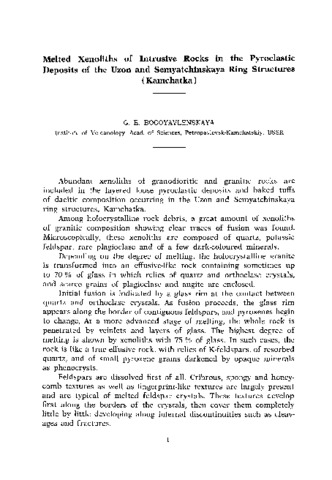
Bogoyavlenskaya G.E. Melted xenoliths of intrusive rocks in the pyroclastic deposits of the Uzon and Semyatchinskaya ring structures (Kamchatka) // Bulletin Volcanologique. 1972. Vol. 36. Vol. 3. P. 443-445. 3 p. doi:10.1007/BF02597119
Bogoyavlenskaya G.E., Braitseva O.A., Melekestsev I.V., Kirianov V.Yu., Dan Miller C. Catastrophic eruptions of the directed-blast type at Mount St. Helens, Bezymianny and Shiveluch volcanoes // Journal of Geodynamics. 1985. Vol. 3. № 3-4. P. 189-218. doi:10.1016/0264-3707(85)90035-3
Аннотация
This paper describes catastrophic eruptions of Mount St. Helens (1980), Bezymianny (1955–1956), and Shiveluch (1964) volcanoes. A detailed description of eruption stages and their products, as well as the quantitative characteristics of the eruptive process are given. The eruptions under study belong to the directed-blast type. This type is characterized by the catastrophic character of the climatic stage during which a directed blast, accompanied by edifice destruction, the profound ejection of juvenile pyroclastics and the formation of pyroclastic flows, occur. The climatic stage of all three eruptions has similar characteristics, such as duration, kinetic energy of blast (10^17−10^18 J), the initial velocity of debris ejection, morphology and size of newly-formed craters. But there are also certain differences. At Mount St. Helens the directed blast was preceeded by failure of the edifice and these events produced separable deposits, namely debris avalanche and directed blast deposits which are composed of different materials and have different volumes, thickness and distribution. At Bezymianny, failure did not precede the blast and the whole mass of debris of the old edifice was outburst only by blast. The resulting deposits, represented by the directed blast agglomerate and sand facies, have characteristics of both the debris avalanche and the blast deposit at Mount St. Helens. At Shiveluch directed-blast deposits are represented only by the directed-blast agglomerate; the directed-blast sand facies, or blast proper, seen at Mount St. Helens is absent. During the period of Plinian activity, the total volumes of juvenile material erupted at Mount St. Helens and at Besymianny were roughly comparable and exceeded the volume of juvenile material erupted at Shiveluch, However, the volume of pyroclastic-flow deposits erupted at Mount St. Helens was much less.
The heat energy of all three eruptions is comparable: 1.3 × 10^18, 3.8−4.8 × 10^18 and 1 × 10^17 J for Shiveluch, Bezymianny, and Mount St. Helens, respectively.
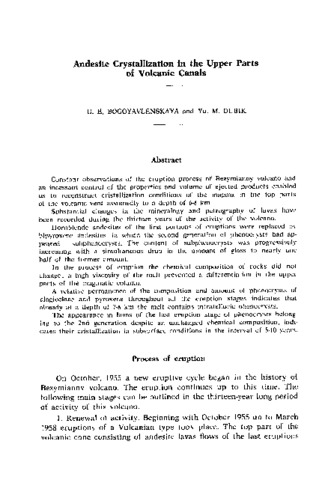
Bogoyavlenskaya G.E., Dubik Y.M. Andesite crystallization in the upper parts of volcanic canals // Bulletin Volcanologique. 1969. Vol. 33. Vol. 4. P. 1269-1273. 20 p. https://doi.org/10.1007/BF02597721
Аннотация
Constant observations of the eruption process of Bezymianny volcano and an incessant control of the properties and volume of ejected products enabled us to reconstruct cristallization conditions of the magma in the top parts of the volcanic vent assumedly to a depth of 6–8 km.
Substantial changes in the mineralogy and petrography of lavas have been recorded during the thirteen years of the activity of the volcano.
Hornblende andesites of the first portions of eruptions were replaced by bipyroxene andesites, in which the second generation of phenocrysts had appeared — subphenocrysts. The content of subphenocrysts was progressively increasing with a simultaneous drop in the amount of glass to nearly one half of the former amount.
In the process of eruption the chemical composition of rocks did not change: a high viscosity of the melt prevented a differentiation in the upper parts of the magmatic column.
A relative permanence of the composition and amount of phenocrysts of plagioclase and pyroxene throughout all the eruption stages indicates that already at a depth of 7–8 km the melt contains intratelluric phenocrysts.
The appearance in lavas of the last eruption stage of phenocrysts belonging to the 2nd generation despite an unchanged chemical composition, indicates their cristallization in subsurface conditions in the interval of 5–10 years.