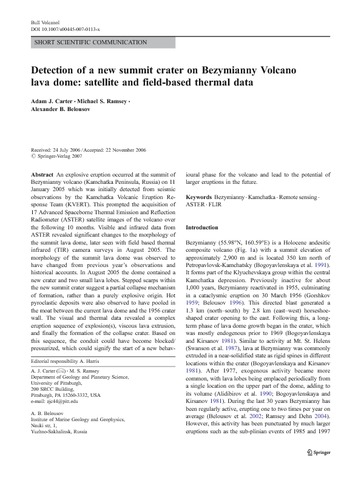
Carter Adam J., Ramsey Michael S., Belousov Alexander B. Detection of a new summit crater on Bezymianny Volcano lava dome: satellite and field-based thermal data // Bulletin of Volcanology. 2007. Vol. 69. № 7. P. 811-815. doi:10.1007/s00445-007-0113-x
Caudron Corentin, Taisne Benoit, Kugaenko Yulia, Saltykov Vadim Magma migration at the onset of the 2012–13 Tolbachik eruption revealed by Seismic Amplitude Ratio Analysis // Journal of Volcanology and Geothermal Research. 2015. Vol. 307. P. 60 - 67. https://doi.org/10.1016/j.jvolgeores.2015.09.010
Аннотация
Abstract In contrast of the 1975–76 Tolbachik eruption, the 2012–13 Tolbachik eruption was not preceded by any striking change in seismic activity. By processing the Klyuchevskoy volcano group seismic data with the Seismic Amplitude Ratio Analysis (SARA) method, we gain insights into the dynamics of magma movement prior to this important eruption. A clear seismic migration within the seismic swarm, started 20 hours before the reported eruption onset (05:15 UTC, 26 November 2012). This migration proceeded in different phases and ended when eruptive tremor, corresponding to lava flows, was recorded (at ~ 11:00 UTC, 27 November 2012). In order to get a first order approximation of the magma location, we compare the calculated seismic intensity ratios with the theoretical ones. As expected, the observations suggest that the seismicity migrated toward the eruption location. However, we explain the pre-eruptive observed ratios by a vertical migration under the northern slope of Plosky Tolbachik volcano followed by a lateral migration toward the eruptive vents. Another migration is also captured by this technique and coincides with a seismic swarm that started 16–20 km to the south of Plosky Tolbachik at 20:31 {UTC} on November 28 and lasted for more than 2 days. This seismic swarm is very similar to the seismicity preceding the 1975–76 Tolbachik eruption and can be considered as a possible aborted eruption.
Chaplygin Ilya, Yudovskaya Marina, Vergasova Lidiya, Mokhov Andrey Native gold from volcanic gases at Tolbachik 1975–76 and 2012–13 Fissure Eruptions, Kamchatka // Journal of Volcanology and Geothermal Research. 2015. Vol. 307. P. 200 - 209. https://doi.org/10.1016/j.jvolgeores.2015.08.018
Аннотация
Abstract Aggregates and euhedral crystals of native gold were found in sublimates formed during New Tolbachik Fissure Eruption in 2012–2013 (NTFE). Gold-bearing sublimate samples were taken from a red-hot (690 °C) degassing fracture in the roof of an active lava tunnel 1.5 km from active Naboko cinder cone in May 2013. The gas condensate collected at 690 °C in this site contains 16 ppb Au, 190 ppb Ag and 1180 ppm Cu compared to 3 ppb Au, 39 ppb Ag and 9.7 ppm Cu in the condensate of pristine magmatic gas sampled at 1030 °C. The 690 °C volcanic gas is most likely a mix of magmatic gas and local snow buried under the lava flows as indicated by oxygen and hydrogen isotope compositions of the condensate. The lower-temperature gas enrichment in gold, copper and chlorine is resulted from evaporation of the 690 °C condensate during forced gas pumping at sampling. Native gold was also found in fumarolic encrustations collected from caverns in basalt lava flows with temperature up to 600 °C in June 2014, in a year after eruption finished. The native gold precipitation in newly formed Cu-rich sublimates together with the well known gold occurrences in cinder cones of 1975–1976 Large Tolbachik Fissure Eruption manifest a transport capability of oxidized volcanic gas.
Cherkashin Roman, Bergal-Kuvikas Olga, Chugaev Andrey, Larionova Yulia, Bindeman Ilya, Khomchanovsky Anton, Plutahina Ekaterina Conditions and Magmas Sources of the Summit and Flank Eruptions of Klyuchevskoy Volcano in 2020–2021: Isotope (Sr–Nd–Pb–O)-geochemical data // Petrology. 2023. Vol. 31. № 3. https://doi.org/10.1134/S0869591123030037
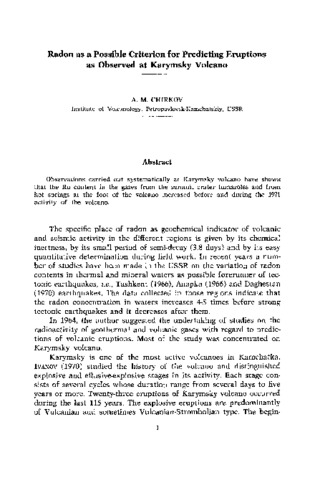
Chirkov A.M. Radon as a possible criterion for predicting eruptions as observed at Karymsky volcano // Bulletin Volcanologique. 1975. Vol. 39. Vol. 1. P. 126-131. 6 p. doi:10.1007/BF02596952
Chubarova O.S., Gorelchik V.I., Garbuzova V.T. Seismic Activity of Bezymyannyi Volcano in 1975-1979 // Volcanology and Seismology. 1983. № 3. P. 303-314.
Churikova T., Dorendorf F., Wörner G. Sources and Fluids in the Mantle Wedge below Kamchatka, Evidence from Across-arc Geochemical Variation // Journal of Petrology. 2001. Vol. 42. № 8. P. 1567-1593. doi:10.1093/petrology/42.8.1567
Аннотация
Major and trace element and Sr–Nd–Pb isotopic variations in mafic volcanic rocks hve been studied in a 220 km transect across the Kamchatka arc from the Eastern Volcanic Front, over the Central Kamchatka Depression to the Sredinny Ridge in the back-arc. Thirteen volcanoes and lava fields, from 110 to 400 km above the subducted slab, were sampled. This allows us to characterize spatial variations and the relative amount and composition of the slab fluid involved in magma genesis. Typical Kamchatka arc basalts, normalized for fractionation to 6% MgO, display a strong increase in large ion lithophile, light rare earth and high field strength elements from the arc front to the back-arc. Ba/Zr and Ce/Pb ratios, however, are nearly constant across the arc, which suggests a similar fluid input for Ba and Pb. La/Yb and Nb/Zr increase from the arc front to the back-arc. Rocks from the Central Kamchatka Depression range in 87Sr/86Sr from 0·70334 to 0·70366, but have almost constant Nd isotopic compositions (143Nd/144Nd 0·51307–0·51312). This correlates with the highest U/Th ratios in these rocks. Pb-isotopic ratios are mid-ocean ridge basalt (MORB)-like but decrease slightly from the volcanic front to the back-arc. The initial mantle source ranged from N-MORB-like in the volcanic front and Central Kamchatka Depression to more enriched in the back-arc. This enriched component is similar to an ocean-island basalt (OIB) source. Variations in (CaO)6·0–(Na2O)6·0 show that degree of melting decreases from the arc front to the Central Kamchatka Depression and remains constant from there to the Sredinny Ridge. Calculated fluid compositions have a similar trace element pattern across the arc, although minor differences are implied. A model is presented that quantifies the various mantle components (variably depleted N-MORB-mantle and enriched OIB-mantle) and the fluid compositions added to this mantle wedge. The amount of fluid added ranges from 0·7 to 2·1%. The degree of melting changes from ∼20% at the arc front to <10% below the back-arc region. The rocks from volcanoes of the northern part of the Central Kamchatka Depression—to the north of the transect considered in this study—are significantly different in their trace element compositions compared with the other rocks of the transect and their source appears to have been enriched by a component derived from melting of the edge of the ruptured slab.
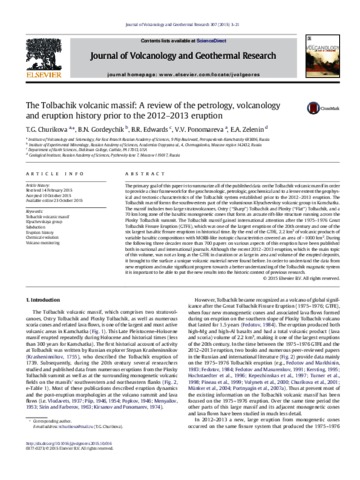
Churikova T.G., Gordeychik B.N., Edwards B.R., Ponomareva V.V., Zelenin E.A. The Tolbachik volcanic massif: A review of the petrology, volcanology and eruption history prior to the 2012–2013 eruption // Journal of Volcanology and Geothermal Research. 2015. Vol. 307. P. 3 - 21. https://doi.org/10.1016/j.jvolgeores.2015.10.016
Аннотация
The primary goal of this paper is to summarize all of the published data on the Tolbachik volcanic massif in order to provide a clear framework for the geochronologic, petrologic, geochemical and to a lesser extent the geophysical and tectonic characteristics of the Tolbachik system established prior to the 2012–2013 eruption. The Tolbachik massif forms the southwestern part of the voluminous Klyuchevskoy volcanic group in Kamchatka. The massif includes two large stratovolcanoes, Ostry (“Sharp”) Tolbachik and Plosky (“Flat”) Tolbachik, and a 70 km long zone of the basaltic monogenetic cones that form an arcuate rift-like structure running across the Plosky Tolbachik summit. The Tolbachik massif gained international attention after the 1975–1976 Great Tolbachik Fissure Eruption (GTFE), which was one of the largest eruptions of the 20th century and one of the six largest basaltic fissure eruptions in historical time. By the end of the GTFE, 2.2 km3 of volcanic products of variable basaltic compositions with MORB-like isotopic characteristics covered an area of > 1000 km2. During the following three decades more than 700 papers on various aspects of this eruption have been published both in national and international journals. Although the recent 2012–2013 eruption, which is the main topic of this volume, was not as long as the {GTFE} in duration or as large in area and volume of the erupted deposits, it brought to the surface a unique volcanic material never found before. In order to understand the data from new eruptions and make significant progress towards a better understanding of the Tolbachik magmatic system it is important to be able to put the new results into the historic context of previous research.
Churikova T.G., Ivanov B.V., Eichelberger J., Wörner G., Browne B., Izbekov P. Major and trace element zoning in plagioclase from Kizimen Volcano (Kamchatka): Insights into magma-chamber processes // Journal of Volcanology and Seismology. 2013. Vol. 7. № 2. P. 112-130. doi:10.1134/S0742046313020024
Аннотация
The data on the geochemistry of the rocks of Kizimen Volcano and results of microprobe studies of major and trace elements in plagioclase grains from acid lavas and basalt inclusions are presented. The characteristics of the Kizimen Volcano are the following: (1) basalt inclusions are abundant in acid lavas; (2) banded, mixed lavas occur; (3) the distribution curves of rare earth elements of acidic lavas and basalt inclusions intersect; (4) Sr–Nd isotope systematics of the rocks and inclusions do not indicate mixture with crustal material; (5) plagioclase phenocrysts are of direct and reverse zonation; (6) olivine and hornblende, as well as acid and mafic plagioclases, coexist in the rocks. The studies revealed that the rocks are of a hybrid nature and originated in the course of repeated mixture of acid and mafic melts either with chemical and ther mal interaction of melts or exclusively thermal ones. Study of the major and trace element distribution in zonal minerals provides an informative tool for understanding the history of the generation and evolution of melts in a magma chamber
Churikova Tatiana G., Gordeychik Boris N., Ivanov Boris V., Wörner Gerhard Relationship between Kamen Volcano and the Klyuchevskaya group of volcanoes (Kamchatka) // Journal of Volcanology and Geothermal Research. 2013. Vol. 263. P. 3 - 21. https://doi.org/10.1016/j.jvolgeores.2013.01.019
Аннотация
Abstract Data on the geology, petrography, mineralogy, and geochemistry of rocks from Kamen Volcano (Central Kamchatka Depression) are presented and compared with rocks from the neighbouring active volcanoes. The rocks from Kamen and Ploskie Sopky volcanoes differ systematically in major elemental and mineral compositions and could not have been produced from the same primary melts. The compositional trends of Kamen stratovolcano lavas and dikes are clearly distinct from those of Klyuchevskoy lavas in all major and trace element diagrams as well as in mineral composition. However, lavas of the monogenetic cones on the southwestern slope of Kamen Volcano are similar to the moderately high-Mg basalts from Klyuchevskoy and may have been derived from the same primary melts. This means that the monogenetic cones of Kamen Volcano represent the feeding magma for Klyuchevskoy Volcano. Rocks from Kamen stratovolcano and Bezymianny form a common trend on all major element diagrams, indicating their genetic proximity. This suggests that Bezymianny Volcano inherited the feeding magma system of extinct Kamen Volcano. The observed geochemical diversity of rocks from the Klyuchevskaya group of volcanoes can be explained as the result of both gradual depletion over time of the mantle N-MORB-type source due to the intense previous magmatic events in this area, and the addition of distinct fluids to this mantle source.