|
Записей: 389
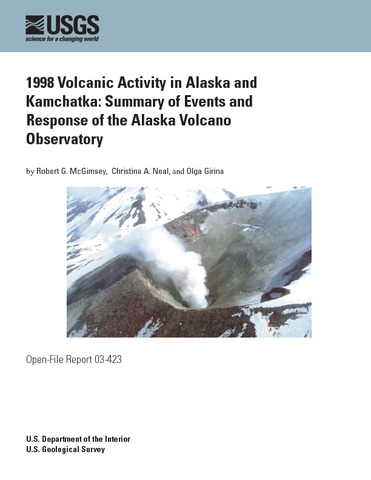
McGimsey R.G., Neal C.A., Girina O.A. 1998 Volcanic Activity in Alaska and Kamchatka: Summary of Events and Response of the Alaska Volcano Observatory Open-File Report 2004-1033. 2003. 35 p.
Аннотация
In 1998 the Alaska Volcano Observatory responded to eruptive activity or suspect volcanic activity at 7 volcanic centers--Shrub mud, Augustine, Becharof Lake area, Chiginagak, Shishaldin, Akutan, and Korovin.
In addition to responding to eruptive activity at Alaska volcanoes, AVO also disseminated information for the Kamchatkan Volcanic Eruption Response Team about the 1998 activity of 4 Russian volcanoes-Sheveluch, Klyuchevskoy, Bezymianny, and Karymsky.
|
McGimsey R.G., Neal C.A., Girina O.A. 1999 Volcanic Activity in Alaska and Kamchatka: Summary of Events and Response of The Alaska Volcano Observatory Open-File Report 2004-1033. 2004. 45 p.
|
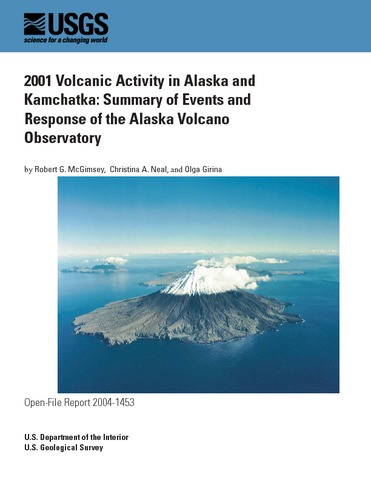
McGimsey R.G., Neal C.A., Girina O.A. 2001 Volcanic Activity in Alaska and Kamchatka: Summary of Events and Response of the Alaska Volcano Observatory Open-File Report 2004-1453. 2004. 53 p.
|
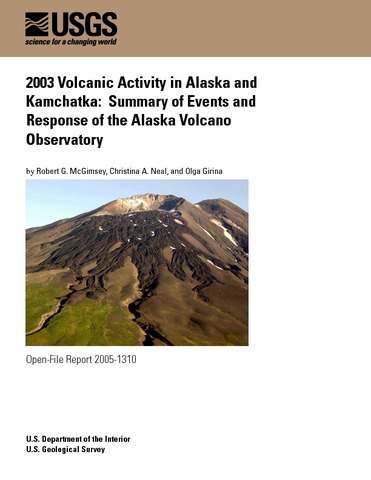
McGimsey R.G., Neal C.A., Girina O.A. 2003 Volcanic Activity in Alaska and Kamchatka: Summary of Events and Response of the Alaska Volcano Observatory Open-File Report 2005-1310. 2005. 58 p.
|
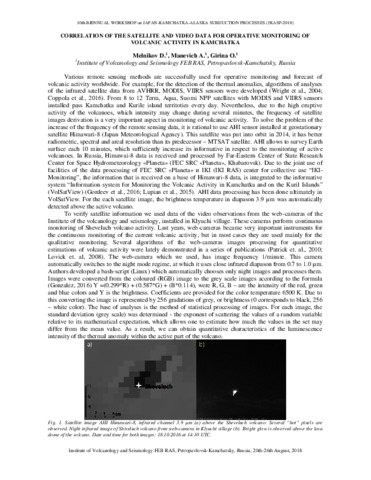
Melnikov D.V., Manevich A.G., Girina O.A. Correlation of the satellite and video data for operative monitoring of volcanic activity in Kamchatka // JKASP-2018. Petropavlovsk-Kamchatsky: IVS FEB RAS. 2018.
|
National Report for the International Association of Volcanology and Chemistry of the Earth’s Interior of the International Union of Geodesy and Geophysics 2011–2014. Presented to the XXVI General Assembly of the IUGG Geoinf. Res. Papers, 3, BS3011. / Ed. Churikova T.G., Gordeychik B.N., Fedotov S.A. Moscow: GCRAS Publ. 2015. 185 p. https://doi.org/10.2205/2015IUGG-RU-IAVCEI
Аннотация
In the present National Report, major results are given of research conducted by Russian scientists in 2011–2014 on the topics of the International Association of Volcanology and Chemistry of the Earth’s Interior (IAVCEI) of the International Union of Geodesy and Geophysics. Kamchatka Peninsula with its famous Klyuchevskaya Group of volcanoes is the most volcanically active area in Russia and one of the most active in the world. Majority of researches and scientific results on Volcanology and Geochemistry of the Earth’s Interior during 2011–2014 were achieved in this region including recent data on new Tolbachik fissure eruption in 2012–2013. Besides it, the scientific results on the magmatism outside Russia, which were achieved by Russian scientists, are also included in this review. Major achievements in the chemistry of the Earth, geothermy, geodynamics, geochronology and deep mantle structure are featured. The studies as for the single volcanoes as well the regional observations are outlined. The theoretical and applied efforts connected to the volcanological processes are considered. The main conclusions are illustrated by summarized figures. All the required references are given.


|
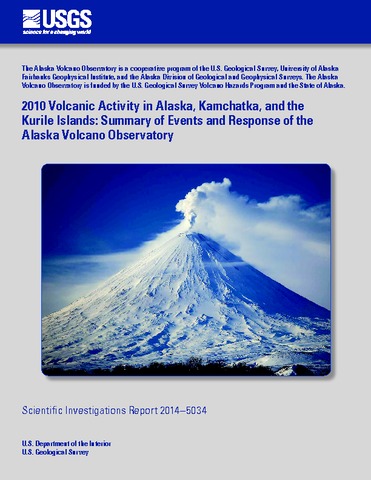
Neal C.A., Herrick J.A., Girina O.A., Chibisova M.V., Rybin A.V., McGimsey R.G., Dixon J. 2010 Volcanic activity in Alaska, Kamchatka, and the Kurile Islands: Summary of events and response of the Alaska Volcano Observatory. 2014. 76 p.
Аннотация
The Alaska Volcano Observatory (AVO) responded to eruptions, possible eruptions, volcanic unrest or suspected unrest at 12 volcanic centers in Alaska during 2010. The most notable volcanic activity consisted of intermittent ash emissions from long-active Cleveland volcano in the Aleutian Islands. AVO staff also participated in hazard communication regarding eruptions or unrest at seven volcanoes in Russia as part of an ongoing collaborative role in the Kamchatka and Sakhalin Volcanic Eruption Response Teams.
|
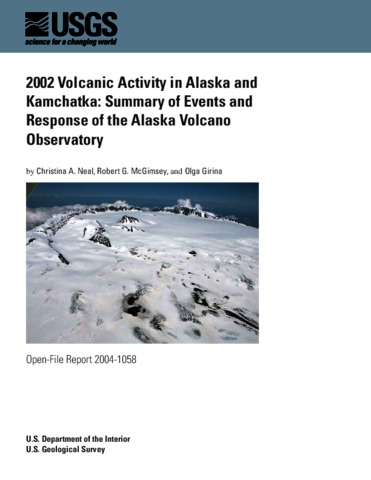
Neal C.A., McGimsey R.G., Girina O.A. 2002 Volcanic Activity in Alaska and Kamchatka: Summary of Events and Response of the Alaska Volcano Observatory Open-File Report 2004-1058. 2004. 55 p.
|
Nekrylov Nikolay, Kamenetsky V.S., Savelyev D.P., Gorbach N.V., Kontonikas-Charos Alkiviadis, Palesskii Stanislav V., Shcherbakov Vasily D., Kutyrev Anton V., Savelyeva O.L., Korneeva Alina, Kozmenko Olga A., Zelenski Michael E. Platinum-group elements in Late Quaternary high-Mg basalts of eastern Kamchatka: Evidence for minor cryptic sulfide fractionation in primitive arc magmas // Lithos. 2022. Vol. 412. № 106838. P. 1-14. https://doi.org/10.1016/j.lithos.2022.106608
Аннотация
The geochemical variations of magmas across and along supra-subduction zones (SSZ) have been commonly attributed to profound changes in the phase and chemical compositions of the mantle source and subduction-derived melt and fluid fluxes, as well as the physical parameters (e.g. depth, temperature, oxygen fugacity etc) of slab dehydration, mineral breakdown and melting. Here we test the variability of the Late Quaternary primitive magmas in the southern and northern parts of the meridionally oriented Eastern Volcanic Belt (EVB) of Kamchatka, with a slab depth varying from 60 to 160 km. Eight high-Mg (Mg# > 60 mol%) basalts were characterized for major, trace and platinum-group element (PGE) abundances, as well as the compositions of olivine phenocrysts and olivine-hosted spinel inclusions. The basalts in our study are geochemically typical of SSZ magmas and contain similar liquidus assemblages of forsteritic olivine (Mg# 78–92 mol%), low-Ti Cr-spinel and clinopyroxene. Although the absolute abundances of major and trace elements, and their ratios, in the basalts fluctuate to some extent, the observed variability cannot be correlated with any of considered parameters in the geometry of the Kamchatka SSZ and conditions of melting. This unexpected result led to the evaluation of the platinum-group element (PGE) systematics against the lithophile and chalcophile trace element geochemistry and the compositions of phenocrysts. Total whole-rock PGE content varies from 2.3 to 11.7 ppb, whereas the normalized PGE concentration patterns are typical for supra-subduction zones magmas and broadly similar in all studied samples. They are enriched in Rh, Pd and Pt relative to mid-ocean ridge basalts (MORB) and have nearly identical concentrations of Ir-group PGE. The only parameter that correlates well with PGE contents is the average Mg# of olivine phenocrysts from 84 to 90.3 mol%. This is interpreted to result from minor cryptic fractionation of sulfide melt, together with primitive olivine, in low-to-mid crustal conditions. Negative Ru anomalies on chondrite-normalized diagrams correspond to the Fe2+/Fe3+ ratios in spinel (a proxy for magma redox conditions), which reflects a replacement of monosulfide solid solution by laurite in the mantle wedge during oxidation.
|
Ozerov A.Yu., Girina O.A., Zharinov N.A., Belousov A.B., Demyanchuk Yu.V. Eruptions in the Northern Group of Volcanoes, in Kamchatka, during the Early 21st Century // Journal of Volcanology and Seismology. 2020. Vol. 14. P. 1-17. https://doi.org/10.1134/S0742046320010054
Аннотация
The early 21st century saw increased eruption activity of major volcanoes in the Northern Group of Kamchatka, namely, Sheveluch, Klyuchevskoy, Bezymianny, and the Tolbachik Fissure Zone. The growth of an extrusive dome on Sheveluch andesitic volcano has occurred, with the dome reaching a height of 600 m after 38 years of nearly uninterrupted eruption activity. An 8-year period of relative quiet was followed by ten summit eruptions and two lateral vent openings on the Klyuchevskoy basaltic volcano. Explosive–effusive eruptions were observed nearly every year on the Bezymianny andesitic volcano. A 36-year quiet period gave way to a new eruption in the Tolbachik regional fissure zone.
|
|