|
Записей: 368
Girina O.A., Melnikov D.V., Manevich A.G., Nuzhdaev A.A., Petrova E.G. The 2019 Activity of Kamchatka and Kurile Islands Volcanoes and Danger to Aviation // Japan Geoscience Union Meeting 2020. Japan, Chiba: JpGU. 2020. № HDS10-P01.
|
Girina O.A., Melnikov D.V., Manevich A.G., Nuzhdaev A.A., Romanova I.M., Loupian E.A., Sorokin A.A. The 2020 Activity of Kamchatkan Volcanoes and Danger to Aviation // EGU General Assembly 2021. 2021. https://doi.org/10.5194/egusphere-egu21-1448.
|
Girina O.A., Nuzhdaev A.A. On Some Features Peculiar to the September 22, 2005 Eruption of Young Shiveluch Volcano, Kamchatka // Journal of Volcanology and Seismology. 2014. Vol. 8. № 4. P. 218-227. https://doi.org/10.1134/S0742046314040034.
Аннотация
An explosive eruption of Young Shiveluch Volcano occurred on September 22, 2005, discharging a pyroclastic flow about 20 km long in the Baidarnaya River valley and an ashfall in the area of the Northern group of volcanoes.
|
Girina O.A., Rumyantseva N.A. Microstructure of Tephra from Shiveluch Volcano // Volcanology and Seismology. 1994. Vol. 15. № 5. P. 549-564.
Аннотация
Study is made for the first time on morphological peculiarities of microstructure of three samples from the unbroken marker ash layers of the Shiveluch volcano. In this paper we give the qualitative analysis of tephra structure, i.e. size and shape of particles and type of microstructure, describe structural relationships between deposit components, etc. and make the quantitative analysis of porosity of Sh2 and Sh1 tephra at magnification of 200 and 1,000. Hollow globules of volcanic glass were found for the first time in Sh2 ashes.
|
Girina O.A., Senyukov S.L., Demyanchuk Yu.V., Khubunaya S.A., Ushakov S.V. The eruption of Sheveluch volcano, Kamchatka, on May 10, 2004 // 4rd International Biennial Workshop on Subduction Processes emphasizing the Japan-Kurile-Kamchatka-Aleutian Arcs, Petropavlovsk-Kamchatsky, August 21-27, 2004. Petropavlovsk-Kamchatsky: IVS FED RAS. 2004. P. 17-18.
|
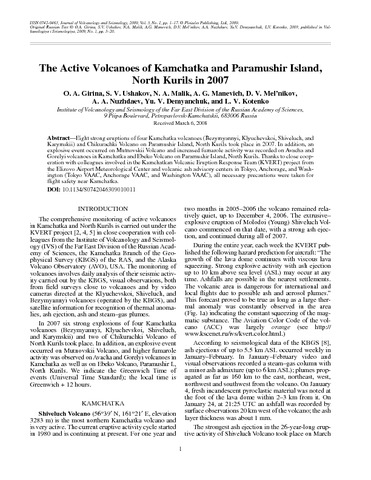
Girina O.A., Ushakov S.V., Malik N.A., Manevich A.G., Melnikov D.V., Nuzhdaev A.A., Demyanchuk Yu.V., Kotenko L.V. The active volcanoes of Kamchatka and Paramushir Island, North Kurils in 2007 // Journal of Volcanology and Seismology. 2009. Vol. 3. № 1. P. 1-17. https://doi.org/10.1134/S0742046309010011.
Аннотация
Eight strong eruptions of four Kamchatka volcanoes (Bezymyannyi, Klyuchevskoi, Shiveluch, and Karymskii) and Chikurachki Volcano on Paramushir Island, North Kurils took place in 2007. In addition, an explosive event occurred on Mutnovskii Volcano and increased fumarole activity was recorded on Avacha and Gorelyi volcanoes in Kamchatka and Ebeko Volcano on Paramushir Island, North Kurils. Thanks to close cooperation with colleagues involved in the Kamchatkan Volcanic Eruption Response Team (KVERT) project from the Elizovo Airport Meteorological Center and volcanic ash advisory centers in Tokyo, Anchorage, and Washington (Tokyo VAAC, Anchorage VAAC, and Washington VAAC), all necessary precautions were taken for flight safety near Kamchatka.


|
Global Volcanism Program. Volcanoes of the World, v. 4.11.0 (08 Jun 2022). 2013. doi: 10.5479/si.GVP.VOTW4-2013.
Аннотация
The Volcanoes of the World database is a catalog of Holocene and Pleistocene volcanoes, and eruptions from the past 12,000 years.
|
Goltz A.E., Krawczynsky M.J., Gavrilenko M.G, Gorbach N.V., Ruprecht Ph. Evidence for Superhydrous Primitive Arc Magmas from Mafic Enclaves at Shiveluch Volcano, Kamchatka // Contributions to Mineralogy and Petrology. 2020. Vol. 175. P. 115 https://doi.org/10.1007/s00410-020-01746-5.
Аннотация
Mafic enclaves preserve a record of deep differentiation of primitive magmas in arc settings. We analyze the petrology and geochemistry of mafic enclaves from Shiveluch volcano in the Kamchatka peninsula to determine the differentiation histories of primitive magmas and to estimate their pressures, temperatures, and water contents. Amphibole inclusions in high forsterite olivine suggest that the primitive melt was superhydrous (i.e. >8 wt% H2O) and was fractionating amphibole and olivine early on its liquid line of descent. We find that the hydrous primitive melt had liquidus temperatures of 1062±48°C and crystallized high Mg# amphibole at depths of 23.6-28.8 km and water contents of 10-14 wt% H2O. The major and trace element whole rock chemistry of enclaves and of published analyses of andesites suggest that they are related through fractionation of amphibole-bearing assemblages. Quantitative models fractionating olivine, clinopyroxene, and amphibole reproduce geochemical trends defined by enclaves and andesites in variation diagrams. These models estimate 0.2%-12.2% amphibole fractionated from the melt to reproduce the full range of enclave compositions, which overlaps with estimates of the amount of amphibole fractionated from parental melts based on whole rock dysprosium contents. This contribution extends the published model of shallow processes at Shiveluch to greater depths. It provides evidence that primitive magmas feeding arc volcanoes may be more hydrous than estimated from other methods, and that amphibole is an important early fractionating phase on the liquid line of descent of superhydrous, primitive mantle-derived melts.
|
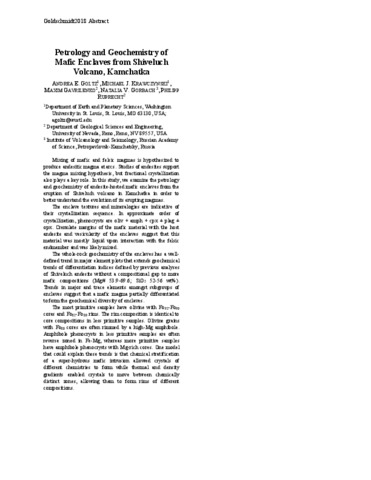
Goltz A.E., Krawczynsky M.J., Gavrilenko M.G, Gorbach N.V., Ruprecht Ph. Petrology and geochemistry of mafic enclaves from Shiveluch volcano, Kamchatka // Goldschmidt2018 Abstract. Boston, USA: 2018.
|
Gorbach N.V., Philosofova T.M, Portnyagin M.V. Amphibole record of 1964 plinian and following dome-forming eruptions of Shiveluch volcano, Kamchatka // Journal of Volcanology and Geothermal Research. 2020. Vol. 407. № 107108. doi: 10.1016/j.jvolgeores.2020.107108.
Аннотация
Shiveluch is one of the most active explosive volcanoes worldwide. During the last рlinian eruption in 1964 and the following (1980-current time) dome-forming eruptions Shiveluch has produced andesites and dacites (SiO2~60-64 wt.%) containing variably zoned, compositionally and texturally diverse amphibole phenocrysts. In this work, we attempt to decode the complex zoning of the amphibole crystals in the 55-year series of pumice, dome rocks and mafic enclaves in order to reconstruct the most recent evolution of the volcano plumbing system.
The amphibole zoning in Shiveluch andesites reveals correlation with the style and date of eruption. High-Al cores mantled by low-Al rims in amphiboles from the 1964 plinian eruption record a drastic decrease of pressure and rapid magma ascent from the lower crust to the shallow magma chamber. Typically unzoned and often opacitized low-Al crystals from the early dome-building episodes in 1980-1981 and 1993-1995 reflect magma crystallization in the shallow magma chamber. Complexly zoned amphiboles from andesites erupted in 2000s indicate replenishment of the shallow magma chamber with mafic magma and syn-eruptive mixing processes. Amphibole-based barometric calculations obtained by different approaches indicate that the Shiveluch plumbing system is complex and comprises two, mafic and silicic magma storage zones at ~15-20 km and ~5-6 km depths. We suggest that both episodes of the plinian eruption in 1964 and the extensive dome growth in 2001-2016 were driven by influx of mafic magma in the shallow storage zone beneath Shiveluch. The mafic replenishment likely preceded the 1964 plinian eruption and repeatedly occurred during the period of extensive dome growth in 2001-2016. The variable styles of the recent Shiveluch eruptions may be controlled by the relative volume of the mafic recharges and their thermal and viscosity effects on the efficiency of magma mixing.
|
|