Control on the organization of the plumbing system of subduction volcanoes: the role of volatiles and edifice load (2017)
Roman Alberto, Bergal-Kuvikas Olga, Shapiro Nikolay M., Gordeev E.I., Taisne Benoit, Jaupart Claude Control on the organization of the plumbing system of subduction volcanoes: the role of volatiles and edifice load // AGU Fall Meeting Abstracts. 2017.
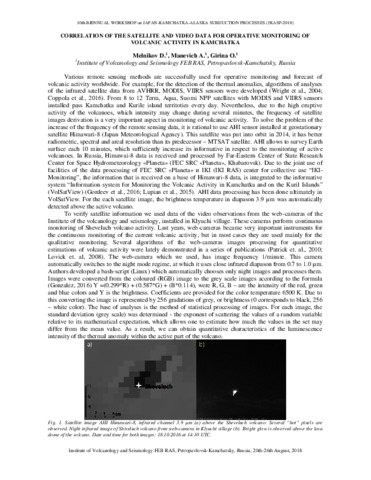
Correlation of the satellite and video data for operative monitoring of volcanic activity in Kamchatka (2018)
Melnikov D.V., Manevich A.G., Girina O.A. Correlation of the satellite and video data for operative monitoring of volcanic activity in Kamchatka // JKASP-2018. Petropavlovsk-Kamchatsky: IVS FEB RAS. 2018.
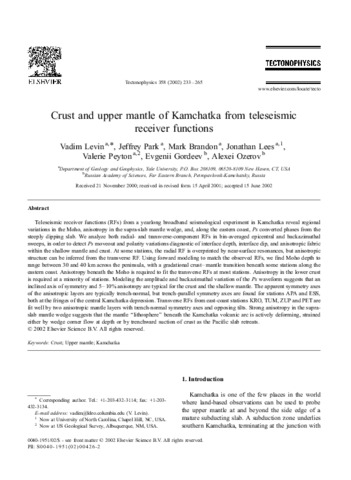
Crust and upper mantle of Kamchatka from teleseismic receiver functions (2002)
Levin V., Park J., Brandon M., Lees J., Peyton V., Gordeev E., Ozerov A. Crust and upper mantle of Kamchatka from teleseismic receiver functions // Tectonophysics. 2002. № 358. P. 233-256.
Annotation
Teleseismic receiver functions (RFs) from a yearlong broadband seismological experiment in Kamchatka reveal regional variations in the Moho, anisotropy in the supra-slab mantle wedge, and, along the eastern coast, Ps converted phases from the steeply dipping slab. We analyze both radial- and transverse-component RFs in bin-averaged epicentral and backazimuthal sweeps, in order to detect Ps moveout and polarity variations diagnostic of interface depth, interface dip, and anisotropic fabric within the shallow mantle and crust. At some stations, the radial RF is overprinted by near-surface resonances, but anisotropic structure can be inferred from the transverse RF. Using forward modeling to match the observed RFs, we find Moho depth to range between 30 and 40 km across the peninsula, with a gradational crust –mantle transition beneath some stations along the eastern coast. Anisotropy beneath the Moho is required to fit the transverse RFs at most stations. Anisotropy in the lower crust is required at a minority of stations. Modeling the amplitude and backazimuthal variation of the Ps waveform suggests that an inclined axis of symmetry and 5 – 10% anisotropy are typical for the crust and the shallow mantle. The apparent symmetry axes of the anisotropic layers are typically trench-normal, but trench-parallel symmetry axes are found for stations APA and ESS, both at the fringes of the central Kamchatka depression. Transverse RFs from east-coast stations KRO, TUM, ZUP and PET are fit well by two anisotropic mantle layers with trench-normal symmetry axes and opposing tilts. Strong anisotropy in the supraslab mantle wedge suggests that the mantle ‘‘lithosphere’’ beneath the Kamchatka volcanic arc is actively deforming, strained either by wedge corner flow at depth or by trenchward suction of crust as the Pacific slab retreats.
Crustal Deformations Related to the Formation of New Tolbachik Volcanoes in 1975-1976, Kamchatka (1980)
Fedotov S.A. Crustal Deformations Related to the Formation of New Tolbachik Volcanoes in 1975-1976, Kamchatka // Bulletin Volcanologique. 1980. Vol. 43. Vol. 1. P. 35-45. https://doi.org/10.1007/BF02597609
Annotation
The paper discusses the results of geodetic investigations performed in the region of the large 1975-1976 Tolbachik fissure eruption in Kamchatka. Using data from repeated triangu-lation and trigonometric levelings, horizontal and vertical displacements have been detected in an area of 3,500 km2. Two zones have been recognized: the tension and uplift zone that is probably due to magma intrusion from depths to the surface along the line of new cones and the extensive compensative subsidence zone located at a distance of 20-50 km from the nearest newly-formed cones.??Measurements made with small distance measuring device showed the dynamics of feeding basalt dykes intrusion and made it possible to determine their width (a little greater than 1 m) and magma and gas overpressure (50-250 bar). Data have been obtained on dimensions and growth of cones and on vertical ground deformation in the area of new cones during and after the eruption.??
Cервис-ориентированный программный интерфейс доступа к удаленным источникам данных для проведения междисциплинарных исследований вулканов Камчатки (2016)
Королев С.П., Сорокин А.А., Урманов И.П., Гирина О.А., Романова И.М. Cервис-ориентированный программный интерфейс доступа к удаленным источникам данных для проведения междисциплинарных исследований вулканов Камчатки // Сборник тезисов докладов. Четырнадцатая Всероссийская Открытая конференция «Современные проблемы дистанционного зондирования Земли из космоса», ИКИ РАН 14–18 ноября 2016 г. М.: ИКИ РАН. 2016. С. 94.
Dacitic Ash from the Andesitic Sheveluch Volcano, Kamchatka (2026)
Tolstykh M.L., Melnikov D.V., Babansky A.D. Dacitic Ash from the Andesitic Sheveluch Volcano, Kamchatka // Journal of Volcanology and Seismology. 2026. Vol. 20. № 1. P. 31-50. https://doi.org/10.1134/S0742046325700642
Annotation
Sheveluch Volcano is one of the most productive volcanoes in Kamchatka, characterized during the Holocene by alternating periods of predominantly extrusive and explosive activity. New data on the volumetric parameters of fine ash emissions have been obtained, indicating that the mass of erupted material of dacitic composition during a single moderate-strength eruption can exceed 2 million tons. In those years when gas and ash cloud eruptions were particularly frequent (sometimes more than twenty per month), the total mass of fine dacitic ash can be comparable to the annual discharge of andesitic material (extrusive lavas and tephra), providing a new perspective on the genesis of andesites.
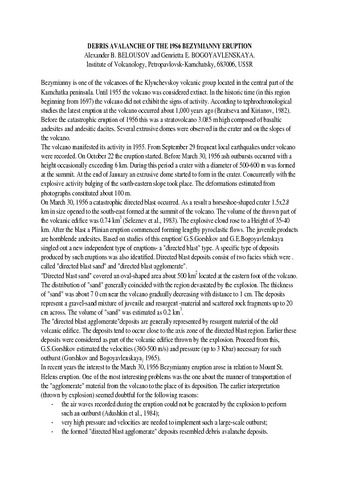
Debris avalanche of the 1956 Bezymianny eruption (1988)
Белоусов А.Б., Богоявленская Г.Е. Debris avalanche of the 1956 Bezymianny eruption // Kagoshima International Conference on Volcanoes: Proceedings of the International Conference on Volcanoes, Japan, Kagoshima, 19-23 July 1988. Kagoshima: Kagoshima Prefectural Government. 1988. P. 460-462.