Mineralogical and Geochemical Characteristics of High-Magnesian Basalts of Gorely volcano (Southern Kamchatka): Implication for Mantle Source (2011)
Gavrilenko M., Ozerov A. Mineralogical and Geochemical Characteristics of High-Magnesian Basalts of Gorely volcano (Southern Kamchatka): Implication for Mantle Source // Abstract V43C-2584 presented at 2011 Fall Meeting, AGU, San Francisco, Calif., 5-9 Dec.. 2011.
Mineralogy and petrology of Kamen volcano rocks, Kamchatka (2009)
Churikova T., Gordeychik B., Wörner G., Ivanov B., Maximov A. Mineralogy and petrology of Kamen volcano rocks, Kamchatka // Mitigating natural hazards in active arc environments. Linkages among tectonism, earthquakes, magma genesis and eruption in volcanic arcs, with a special focus on hazards posed by arc volcanism and great earthquakes. June 22-26, 2009, Fairbanks, Alaska. 2009. P. 117-118.
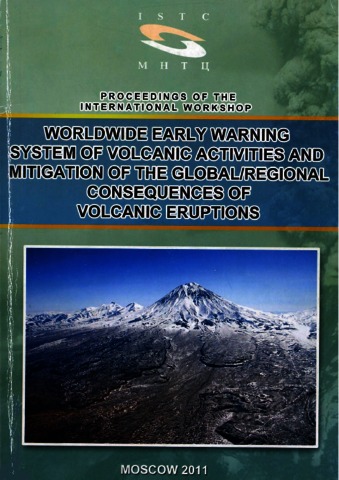
Mitigation of risks of planes collision with ash clouds in the Northern part of the Pacific region (2011)
Girina O.A. Mitigation of risks of planes collision with ash clouds in the Northern part of the Pacific region // Materials of ISTC International Workshop “Worldwide early warning system of volcanic activities and mitigation of the global/regional consequences of volcanic eruptions”, Moscow, Russia, July 8-9, 2010. Moscow: ISTC. 2011. P. 95-101.
Modeling Strombolian eruptions of Karymsky volcano, Kamchatka, Russia (2003)
Ozerov A., Ispolatov I., Lees J. Modeling Strombolian eruptions of Karymsky volcano, Kamchatka, Russia // Journal of Volcanology and Geothermal Research. 2003. Vol. 122. № 3–4. P. 265 - 280. https://doi.org/10.1016/S0377-0273(02)00506-1
Annotation
A model is proposed to explain temporal patterns of activity in a class of periodically exploding Strombolian-type andesite volcanoes. These patterns include major events (explosions) which occur every 3–30 min and subsequent tremor with a typical period of 1 s. This two-periodic activity is thought to be caused by two distinct mechanisms of accumulation of the elastic energy in the moving magma column: compressibility of the magma in the conduit and viscoelastic response of the almost solid magma plug on the top. A release of the elastic energy occurs during a stick–slip dynamic phase transition in a boundary layer along the walls of the conduit; this phase transition is driven by the shear stress accumulated in the boundary layer. The intrinsic hysteresis of this first-order phase transition explains the long periods of inactivity in the explosion cycle. Temporal characteristics of the model are found to be qualitatively similar to the acoustic and seismic signals recorded at Karymsky volcano in Kamchatka.
Modeling a Potential Collapse on Koryaksky Volcano and Assessing the Volcanic Hazard for the Elizovo–Petropavlovsk Agglomeration, Kamchatka (2024)
Dolgaya A.A., Bergal-Kuvikas Olga Modeling a Potential Collapse on Koryaksky Volcano and Assessing the Volcanic Hazard for the Elizovo–Petropavlovsk Agglomeration, Kamchatka // Journal of Volcanology and Seismology. 2024. № 18. P. 261-274. https://doi.org/10.1134/S0742046324700568
Models of Volcanic Ash Propagation for the Exploration of Explosive Eruptions of Kamchatka Volcanoes (2018)
Malkovsky S.I., Sorokin A.A., Korolev S.P., Girina O.A., Loupian E.A. Models of Volcanic Ash Propagation for the Exploration of Explosive Eruptions of Kamchatka Volcanoes // JKASP-2018. Petropavlovsk-Kamchatsky: IVS FEB RAS. 2018.
Ozerov A.Yu., Gordeev E.I., Dvigalo V.N. Modern volcanism of Kamchatka, Russia // Proceeding of the 3-rd International symposium. Jeju Volcanological Institute. Korea. 2005. С. 33-41.
Monitoring of 2010-2011 Kizimen Volcano Eruption and Prediction of Danger for Aviation (2011)
Girina O.A., Manevich A.G., Nuzhdaev A.A., Konovalova O.A., Ushakov S.V., Melnikov D.V. Monitoring of 2010-2011 Kizimen Volcano Eruption and Prediction of Danger for Aviation // EGU General Assembly. April 3-8. Vienna, 2011. Abstract. EGU2011-5432. 2011. Vol. 13.
Monitoring of the volcanic rock compositions during the 2012–2013 fissure eruption at Tolbachik volcano, Kamchatka (2015)
Volynets Anna O., Edwards Benjamin R., Melnikov Dmitry, Yakushev Anton, Griboedova Irina Monitoring of the volcanic rock compositions during the 2012–2013 fissure eruption at Tolbachik volcano, Kamchatka // Journal of Volcanology and Geothermal Research. 2015. Vol. 307. P. 120 - 132. https://doi.org/10.1016/j.jvolgeores.2015.07.014
Annotation
Abstract Here we present the results from monitoring of the composition of rocks produced during the 2012–2013 fissure eruption at Tolbachik volcano (FTE). Major and trace element concentrations in 75 samples are reported. Products of this eruption are represented by high alumina basaltic trachyandesites with higher alkalis and titanium contents than in all previously studied rocks of the Tolbachik monogenetic volcanic field. Rocks erupted during the first three days (27–30 November) from the northern (also called Menyailov) group of vents are the most silica- and alkali-rich (SiO2 concentrations up to 55.35 wt. and {K2O} up to 2.67 wt.). From December onwards, when the eruptive activity switched from the Menyailov vents to the southern (Naboko) group of vents, silica content dropped by 2 wt., concentrations of MgO, FeO, TiO2 and Mg# increased, and {K2O} and Na2O concentrations and K2O/MgO ratio decreased. For the rest of the eruption the compositions of rocks remained constant and homogeneous; no systematic compositional differences between lava, bombs and scoria samples are evident. Trace element distributions in the rocks of the Menyailov and Naboko vent lavas are relatively uniform; Menyailov lavas have slightly higher Th, Nb, Hf, Y, and {HREE} concentrations than the Naboko vent lavas at more or less constant element ratios. We explain the initial change in geochemistry by tapping of a slightly cooler and fractionated (~ 3 Mt and 8 Cpx) upper part of the magma storage zone before the main storage area began to feed the eruption. Thermodynamic constraints show that apparent liquidus temperatures varied from 1142 °C to 1151 °C, and thermodynamic modeling shows that variations in compositions are consistent with a high degree of low pressure (100–300 MPa), nominally anhydrous fractionation of a parent melt compositionally similar to the 1975 Northern Breakthrough high-Mg basalt. Geochemistry, petrological observations and modeling are in agreement with the newly erupted material being derived from remnant high-Al magma from the 1975–76 Southern Breakthrough eruption with only slight amounts of cooling (less than 1 °C per year) during the intervening 36 years.
Monitoring the Thermal Activity of Kamchatkan Volcanoes during 2015–2022 Using Remote Sensing (2023)
Girina O.A., Manevich A.G., Loupian E.A., Uvarov I.A., Korolev S.P., Sorokin A.A., Romanova I.M., Kramareva L.S., Burtsev M.A. Monitoring the Thermal Activity of Kamchatkan Volcanoes during 2015–2022 Using Remote Sensing // Remote Sensing. 2023. Vol. 15. Vol. 19. № 4775. https://doi.org/10.3390/rs15194775
Annotation
The powerful explosive eruptions with large volumes of volcanic ash pose a great danger to the population and jet aircraft. Global experience in monitoring volcanoes and observing changes in the parameters of their thermal anomalies is successfully used to analyze the activity of volcanoes and predict their danger to the population. The Kamchatka Peninsula in Russia, with its 30 active volcanoes, is one of the most volcanically active regions in the world. The article considers the thermal activity in 2015–2022 of the Klyuchevskoy, Sheveluch, Bezymianny, and Karymsky volcanoes, whose rock composition varies from basaltic andesite to dacite. This study is based on the analysis of the Value of Temperature Difference between the thermal Anomaly and the Background (the VTDAB), obtained by manual processing of the AVHRR, MODIS, VIIRS, and MSU-MR satellite data in the VolSatView information system. Based on the VTDAB data, the following “background activity of the volcanoes” was determined: 20 °C for Sheveluch and Bezymianny, 12 °C for Klyuchevskoy, and 13–15 °C for Karymsky. This study showed that the highest temperature of the thermal anomaly corresponds to the juvenile magmatic material that arrived on the earth’s surface. The highest VTDAB is different for each volcano; it depends on the composition of the eruptive products produced by the volcano and on the character of an eruption. A joint analysis of the dynamics of the eruption of each volcano and changes in its thermal activity made it possible to determine the range of the VTDAB for different phases of a volcanic eruption.