|
Записей: 228
Ionov D.A., Bénard A., Plechov P.Yu., Shcherbakov V.D. Along-arc variations in lithospheric mantle compositions in Kamchatka, Russia: First trace element data on mantle xenoliths from the Klyuchevskoy Group volcanoes // Journal of Volcanology and Geothermal Research. 2013. Vol. 263. P. 122 - 131. https://doi.org/10.1016/j.jvolgeores.2012.12.022
Аннотация
Abstract We provide results of a detailed study of the first peridotite xenoliths of proven mantle origin reported from Bezymyanny volcano in the Klyuchevskoy Group, northern Kamchatka arc. The xenoliths are coarse spinel harzburgites made up mainly of Mg-rich olivine as well as subhedral orthopyroxene (opx) and Cr-rich spinel, and also contain fine-grained interstitial pyroxenes, amphibole and feldspar. The samples are unique in preserving the evidence for both initial arc mantle substrate produced by high-degree melt extraction and subsequent enrichment events. We show that the textures, modal and major oxide compositions of the Bezymyanny xenoliths are generally similar to those of spinel harzburgite xenoliths from Avacha volcano in southern Kamchatka. However, coarse opx from the Bezymyanny harzburgites has higher abundances of light and medium rare earth elements and other highly incompatible elements than coarse opx from the Avacha harzburgites. We infer that (1) the sub-arc lithospheric mantle beneath both Avacha and Bezymyanny (and possibly between these volcanoes) consists predominantly of harzburgitic melting residues, which experienced metasomatism by slab-related fluids or low-fraction, fluid-rich melts and (2) the degrees of metasomatism are higher beneath Bezymyanny. By contrast, xenolith suites from Shiveluch and Kharchinsky volcanoes 50–100 km north of the Klyuchevskoy Group include abundant cumulates and products of reaction of mantle rocks with silicate melts at high melt/rock ratios. The high melt flux through the lithospheric mantle beneath Shiveluch and Kharchinsky may be related to the asthenospheric flow around the northern edge of the sinking Pacific plate; lateral propagation of fluids in the mantle wedge south of the plate edge may contribute to metasomatism in the mantle lithosphere beneath the Klyuchevskoy Group volcanoes.

|
Ishimaru Satoko, Arai Shoji Highly silicic glasses in peridotite xenoliths from Avacha volcano, Kamchatka arc; implications for melting and metasomatism within the sub-arc mantle // Lithos. 2009. Vol. 107. № 1–2. P. 93 - 106. https://doi.org/10.1016/j.lithos.2008.07.005
Аннотация
Silicate glasses in peridotite xenoliths from Avacha volcano have high SiO2 (up to 72 wt.) and highly SiO2-oversaturated characteristics; normative quartz content is up to 50 wt.. The glasses represent secondary melts solidified after interaction with mantle peridotite, i.e. crystallization of secondary orthopyroxene at the expense of olivine. We identified two kinds of silicate glasses in Avacha peridotites; one is higher in K2O and enriched in Rb, Ba, U, and Pb than the other. The glasses show basically similar chemical characteristics to the host basaltic andesite to andesite of the Avacha volcano. These chemical characteristics are inherited from slab-derived fluids/melts, which metasomatize the mantle wedge and induce partial melting. The differences of chemical features among the Avacha glasses are attributed to chemical difference of the slab-derived fluids/melts, possibly due to the difference of sediments/basalt ratio of the relevant slab. The low-degree partial melt of peridotite assisted by these fluids/melts, is primarily SiO2-oversaturated, and can conduct silicate metasomatism, evolving through interaction with surrounding mantle peridotite, i.e. formation of orthopyroxene at the expense of olivine. Highly silicic glasses, also reported from peridotite xenoliths from oceanic hotspots and continental rift zones, mostly result from assimilation of orthopyroxene by SiO2-undersaturated melts, which crystallize clinopyroxene and olivine. The glasses also show similar trace-element patterns to their host alkali basaltic magmas, as in the case of arc glasses/calc-alkali magmas. If the glasses in peridotite xenoliths are of silicate metasomatism origin, they are similar in chemistry to host magmas. Reaction between carbonatite melts and peridotites shows the same petrographical feature as that of SiO2-undersaturated silicate melts with peridotites. The glasses originated from carbonatite metasomatism, however, exhibit clearly different trace-element patterns from their host alkali basaltic magmas.
|
Ishimaru Satoko, Arai Shoji, Shukuno Hiroshi Metal-saturated peridotite in the mantle wedge inferred from metal-bearing peridotite xenoliths from Avacha volcano, Kamchatka // Earth and Planetary Science Letters. 2009. Vol. 284. № 3–4. P. 352 - 360. https://doi.org/10.1016/j.epsl.2009.04.042
Аннотация
Lithospheric mantle is inferred to be more oxidized than the asthenosphere, and mantle-wedge peridotites are characterized by high oxidation state relative to abyssal and continental peridotites due to addition of slab-derived fluids or melts. We found metals (native Ni, Fe silicides, native Fe and possible native Ti) from otherwise oxidized sub-arc mantle peridotite xenoliths from Avacha volcano, Kamchatka. This is contrary to the consensus and experimental results that the metals are stable only in deeper parts of the mantle (> 250 km). The metals from Avacha are different in chemistry and petrography from those in serpentinized peridotites. The Avacha metals are characteristically out of chemical equilibrium between individual grains as well as with surrounding peridotite minerals. This indicates their independent formation from different fluids. Some of the Avacha metals form inclusion trails with fluids and pyroxenes, leading to the inference that very local metal saturation resulted from rapid supply (‘flashing’) of reducing fluids from deeper levels. The fluids, possibly rich in H2, are formed by serpentinization at the cold base of the mantle wedge just above the slab, and they reduce overlying peridotites. We propose a metal-saturated peridotite layer, underlying the main oxidized portion, within the mantle wedge beneath the volcanic front to fore-arc region.
|
Kirianov V.Yu. Assessment of Kamchatkan Ash Hazard to Airlines // Volcanology and Seismology. 1993. Vol. 14. № 3. P. 246-269.
|
Kirianov V.Yu. Volcanic Ash in Kamchatka as a Source of Potential Hazard to Air Traffic // Volcanic Ash and Aviation Safety: Proc. First Intern. Symp. on Volcanic Ash and Aviation safety. US Geological Survey Bull. US Geological Survey. 1994. Vol. 2047. P. 57-63. https://doi.org/10.3133/b2047
|
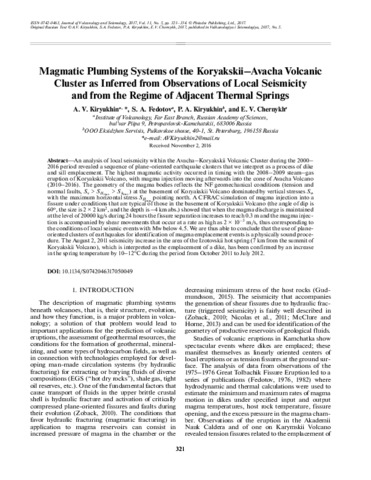
Kiryukhin A.V., Fedotov S.A., Kiryukhin P.A., Chernykh E.V. Magmatic plumbing systems of the Koryakskii–Avacha Volcanic Cluster as inferred from observations of local seismicity and from the regime of adjacent thermal springs // Journal of Volcanology and Seismology. 2017. Vol. 11. № 5. P. 321-334. doi:10.1134/S0742046317050049
Аннотация
An analysis of local seismicity within the Avacha–Koryakskii Volcanic Cluster during the 2000–2016 period revealed a sequence of plane-oriented earthquake clusters that we interpret as a process of dike and sill emplacement. The highest magmatic activity occurred in timing with the 2008–2009 steam–gas eruption of Koryakskii Volcano, with magma injection moving afterwards into the cone of Avacha Volcano (2010–2016). The geometry of the magma bodies reflects the NF geomechanical conditions (tension and normal faults, Sv >SHmax >Shmin ) at the basement of Koryakskii Volcano dominated by vertical stresses Sv, with the maximum horizontal stress SHmax pointing north. A CFRAC simulation of magma injection into a fissure under conditions that are typical of those in the basement of Koryakskii Volcano (the angle of dip is 60о, the size is 2 × 2 km2, and the depth is –4 km abs.) showed that when the magma discharge is maintained at the level of 20000 kg/s during 24 hours the fissure separation increases to reach 0.3 m and the magma injection is accompanied by shear movements that occur at a rate as high as 2 × 10⁻³ m/s, thus corresponding to the conditions of local seismic events with Mw below 4.5. We are thus able to conclude that the use of planeoriented clusters of earthquakes for identification of magma emplacement events is a physically sound procedure. The August 2, 2011 seismicity increase in the area of the Izotovskii hot spring (7 km from the summit of Koryakskii Volcano), which is interpreted as the emplacement of a dike, has been confirmed by an increase in the spring temperature by 10–12°С during the period from October 2011 to July 2012.


|
Kopylova G.N., Boldina S.V. Groundwater Pressure Changes Due to Magmatic Activation: Case Study of The E-1 Well, Kamchatka Peninsula, Russia // Geothermal Volcanology Workshop 2020. September 03-09, 2020, Petropavlovsk-Kamchatsky, Institute of Volcanology and Seismology. 2020.
|
Koulakov I.Yu., Bergal-Kuvikas Olga, Maria Voronova, Andrey Jakovlev Deep magma sources beneath Central Kamchatka inferred from teleseismic tomography // Scientific Reports. 2025. Vol. 16691. № 5. https://doi.org/10.1038/s41598-025-01298-3
|
Koulakov Ivan, Jaxybulatov Kayrly, Shapiro Nikolay M., Abkadyrov Ilyas, Deev Evgeny, Jakovlev Andrey, Kuznetsov Pavel, Gordeev Evgeny, Chebrov Viktor Asymmetric caldera-related structures in the area of the Avacha group of volcanoes in Kamchatka as revealed by ambient noise tomography and deep seismic sounding // Journal of Volcanology and Geothermal Research. 2014. Vol. 285. P. 36 - 46. https://doi.org/10.1016/j.jvolgeores.2014.08.012
Аннотация
Avacha group includes two active and potentially dangerous volcanoes, Avachinsky and Koryaksky, located close to Petropavlovsk-Kamchatsky, the main city of Kamchatka. We present the results of two independent seismic studies of shallow crustal structures beneath the Avacha group based on passive and active source observations. The first study is based on the analysis of continuous recording by 11 seismic stations installed over the Avacha group in 2012 and 7 permanent stations in the same region. We present a series of 2D Rayleigh-wave group velocity maps based on correlation of ambient noise, that were then converted into 3D distribution of shear wave velocity. The second work was based on the reprocessing of an active source deep seismic sounding profile across the Avachinsky volcano that was shot in 1982–1984. We made the analysis of travel times of refracted waves using a 2D tomography inversion. The resulting seismic models appear to be consistent with each other and show clear low-velocity zone to the SW of the Avachinsky volcano and high velocity structures to NE. These observations also agree with the existing gravity and magnetotelluric measurements. Based on the obtained seismic models we identify two large buried calderas and large lava flows that are thought to be related to a series of large eruption episodes of Avachinsky occurred within the last 30,000 years.
|
Kyle Philip R., Ponomareva Vera V., Rourke Schluep Rachelle Geochemical characterization of marker tephra layers from major Holocene eruptions, Kamchatka Peninsula, Russia // International Geology Review. 2011. Vol. 53. № 9. P. 1059-1097. doi:10.1080/00206810903442162
Аннотация
Kamchatka Peninsula is one of the most active volcanic regions in the world. Many Holocene explosive eruptions have resulted in widespread dispersal of tephra-fall
deposits. The largest layers have been mapped and dated by the 14C method. The tephra provide valuable stratigraphic markers that constrain the age of many geological
events (e.g. volcanic eruptions, palaeotsunamis, faulting, and so on). This is the first systematic attempt to use electron microprobe (EMP) analyses of glass to characterize
individual tephra deposits in Kamchatka. Eighty-nine glass samples erupted from 11 volcanoes, representing 27 well-identified Holocene key-marker tephra layers, were analysed. The glass is rhyolitic in 21 tephra, dacitic in two, and multimodal in three.
Two tephra are mixed with glass compositions ranging from andesite/dacite to rhyolite. Tephra from the 11 eruptive centres are distinguished by their glass K2O,
CaO, and FeO contents. In some cases, individual tephra from volcanoes with multiple eruptions cannot be differentiated. Trace element compositions of 64 representative
bulk tephra samples erupted from 10 volcanoes were analysed by instrumental neutron activation analysis (INAA) as a pilot study to further refine the geochemical haracteristics; tephra from these volcanoes can be characterized using Cr and Th contents and La/Yb ratios.
Unidentified tephra collected at the islands of Karaginsky (3), Bering (11), and Attu (5) as well as Uka Bay (1) were correlated to known eruptions. Glass compositions and
trace element data from bulk tephra samples show that the Karaginsky Island and Uka Bay tephra were all erupted from the Shiveluch volcano. The 11 Bering Island tephra
are correlated to Kamchatka eruptions. Five tephra from Attu Island in the Aleutians are tentatively correlated with eruptions from the Avachinsky and Shiveluch volcanoes.
|
|