|
Записей: 228
Ozerov A.Yu., Bakhmatova Ya.A., Melnikov D.V., Nuzhdaev I.A., Frolov V.I. Multiparametric Monitoring of the Avachinsky Volcano to Ensure the Safety of Densely Populated Areas of Kamchatka // Journal of Volcanology and Seismology. 2025. Vol. 19. № S1. P. S72-S74. https://doi.org/10.1134/S0742046325700551
Аннотация
Avachinsky volcano (Kamchatka, Russia) is an active andesite volcano that poses a significant threat to nearby settlements. There is a high probability of it erupting in the near future. A project to create a pilot volcanological research ground for monitoring the state of the volcano and forecasting eruption scenarios is presented.
|
Ponomareva V.V., Churikova T., Melekestsev I.V., Braitseva O.A., Pevzner M., Sulerzhitskii L. Late Pleistocene-Holocene Volcanism on the Kamchatka Peninsula, Northwest Pacific Region / Volcanism and Subduction: The Kamchatka Region. Washington, D. C.: American Geophysical Union. 2007. Vol. 172. P. 165-198. https://doi.org/10.1029/172GM15
Аннотация
Late Pleistocene-Holocene volcanism in Kamchatka results from the subduction of the
Pacific Plate under the peninsula and forms three volcanic belts arranged in en echelon manner
from southeast to northwest. The cross-arc extent of recent volcanism exceeds 250 km and
is one of the widest worldwide. All the belts are dominated by mafic rocks. Eruptives with
SiO2>57% constitute ~25% of the most productive Central Kamchatka Depression belt and
~30% of the Eastern volcanic front, but <10% of the least productive Sredinny Range belt.
All the Kamchatka volcanic rocks exhibit typical arc-type signatures and are represented
by basalt-rhyolite series differing in alkalis. Typical Kamchatka arc basalts display a strong
increase in LILE, LREE and HFSE from the front to the back-arc. La/Yb and Nb/Zr increase
from the arc front to the back arc while B/Li and As, Sb, B, Cl and S concentrations decrease.
The initial mantle source below Kamchatka ranges from N-MORB-like in the volcanic front
and Central Kamchatka Depression to more enriched in the back arc. Rocks from the Central
Kamchatka Depression range in 87Sr/86Sr ratios from 0.70334 to 0.70366, but have almost
constant Nd isotopic ratios (143Nd/144Nd 0.51307–0.51312). This correlates with the highest
U/Th ratios in these rocks and suggest the highest fluid-flux in the source region.
Holocene large eruptions and eruptive histories of individual Holocene volcanoes have been
studied with the help of tephrochronology and 14C dating that permits analysis of time-space
patterns of volcanic activity, evolution of the erupted products, and volcanic hazards.


|
Ponomareva Vera V., Melekestsev Ivan V., Dirksen Oleg V. Sector collapses and large landslides on Late Pleistocene–Holocene volcanoes in Kamchatka, Russia // Journal of Volcanology and Geothermal Research. 2006. Vol. 158. № 1-2. P. 117-138. doi:10.1016/j.jvolgeores.2006.04.016
Аннотация
On Kamchatka, detailed geologic and geomorphologic mapping of young volcanic terrains and observations on historical eruptions reveal that landslides of various scales, from small (0.001 km3) to catastrophic (up to 20–30 km3), are widespread. Moreover, these processes are among the most effective and most rapid geomorphic agents. Of 30 recently active Kamchatka volcanoes, at least 18 have experienced sector collapses, some of them repetitively. The largest sector collapses identified so far on Kamchatka volcanoes, with volumes of 20–30 km3 of resulting debris-avalanche deposits, occurred at Shiveluch and Avachinsky volcanoes in the Late Pleistocene. During the last 10,000 yr the most voluminous sector collapses have occurred on extinct Kamen' (4–6 km3) and active Kambalny (5–10 km3) volcanoes. The largest number of repetitive debris avalanches (> 10 during just the Holocene) has occurred at Shiveluch volcano. Landslides from the volcanoes cut by ring-faults of the large collapse calderas were ubiquitous. Large failures have happened on both mafic and silicic volcanoes, mostly related to volcanic activity. Orientation of collapse craters is controlled by local tectonic stress fields rather than regional fault systems.
Specific features of some debris avalanche deposits are toreva blocks — huge almost intact fragments of volcanic edifices involved in the failure; some have been erroneously mapped as individual volcanoes. One of the largest toreva blocks is Mt. Monastyr' — a ∼ 2 km3 piece of Avachinsky Somma involved in a major sector collapse 30–40 ka BP.
Long-term forecast of sector collapses on Kliuchevskoi, Koriaksky, Young Cone of Avachinsky and some other volcanoes highlights the importance of closer studies of their structure and stability.

|
Puzankov M.Yu., Bazanova L.I., Maximov A.P., Moskalyova S.V. The initial plinian basic andesite eruptions of the young cone, Avachinsky volcano (Kamchatka) // IV International Biennial Workshop on Subduction Processes emphasizing the Japan-Kurile-Kamchatka-Aleutian Arcs. August 21-27, 2004, Petropavlovsk-Kamchatsky. 2004. P. 158-160.
|
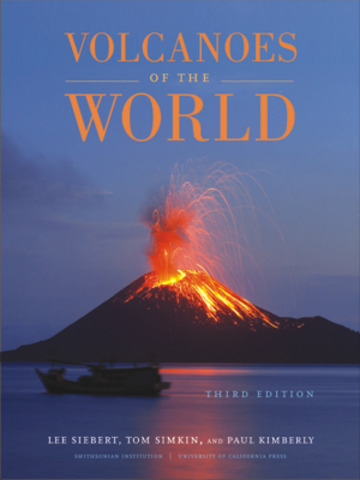
Siebert L., Simkin T., Kimberly P. Volcanoes of the World. Berkeley: University of California Press. 2010. 568 p.
Аннотация
This impressive scientific resource presents up-to-date information on ten thousand years of volcanic activity on Earth. In the decade and a half since the previous edition was published new studies have refined assessments of the ages of many volcanoes, and several thousand new eruptions have been documented. This edition updates the book's key components: a directory of volcanoes active during the Holocene; a chronology of eruptions over the past ten thousand years; a gazetteer of volcano names, synonyms, and subsidiary features; an extensive list of references; and an introduction placing these data in context. This edition also includes new photographs, data on the most common rock types forming each volcano, information on population densities near volcanoes, and other features, making it the most comprehensive source available on Earth's dynamic volcanism.
|
VONA/KVERT Information Releases. 2005.
|
Viccaro Marco, Giuffrida Marisa, Nicotra Eugenio, Ozerov Alexey Yu. Magma storage, ascent and recharge history prior to the 1991 eruption at Avachinsky Volcano, Kamchatka, Russia: Inferences on the plumbing system geometry // Lithos. 2012. Vol. 140–14. P. 11 - 24. https://doi.org/10.1016/j.lithos.2012.01.019
Аннотация
Textural and compositional features of plagioclase phenocrysts of the 1991 eruption lavas at Avachinsky Volcano (Kamchatka, Russia) were used to investigate the feeding system processes. Volcanics are porphyritic basaltic andesites and andesites with low-K affinity. A fractionation modeling for both major and trace elements was performed to justify the development of these evolved compositions. The occurrence of other magma chamber processes was verified through high-contrast BSE images and core-to-rim compositional profiles (An and FeO wt.) on plagioclase crystals. Textural types include small and large-scale oscillation patterns, disequilibrium textures at the crystal core (patchy zoning, coarse sieve-textures, dissolved cores), disequilibrium textures at the crystal rim (sieve-textures), melt inclusion alignments at the rim. Disequilibrium textures at the cores may testify episodes of destabilization at various decompression rates under water-undersaturated conditions, which suggests different pathways of magma ascent at depth. At shallower, water-saturated conditions, plagioclase crystallization continues in a system not affected by important chemical-physical perturbations (oscillatory zoning develops). Strongly sieve-textured rims, along with An increase at rather constant FeO, are evidence of mixing before the 1991 eruption between a residing magma and a hotter and volatile-richer one. The textural evidence implies that crystals underwent common histories at shallow levels, supporting the existence of a large magma reservoir whose top is at ~ 5.5 km of depth. Distinct textures at the outer rims in a hand-size sample are evidence that crystals mix mechanically at very shallow levels, probably in a small reservoir at ~ 1.8 km of depth.

|
Volcano observatory notification to aviation (VONA/KVERT). 2011.
|
Waltham Tony A guide to the volcanoes of southern Kamchatka, Russia // Proceedings of the Geologists' Association. 2001. Vol. 112. № 1. P. 67 - 78. https://doi.org/10.1016/S0016-7878(01)80051-1
Аннотация
The remote sub-arctic wilderness of Kamchatka contains a line of active volcanoes above the Pacific Ocean plate subduction zone. This guide is based on the itinerary of the 1999 GA excursion to sites around Petropavlovsk. Descriptions cover the Uzon caldera and its Valley of Geysers, and the volcanoes of Avacha, Karimsky, Gorely and Mutnovsky.
|
Zubov A.G., Ananyev V.V. Testing of the Titanomagnetite Method to Detect Magmatic Chamber Depth at Avachinsky Stratovolcano and Tolbachik Fissure Eruption // 10th International Conference “PROBLEMS OF GEOCOSMOS”. Book of Abstracts. St. Petersburg, Petrodvorets, October 6-10, 2014. St. Peterburg: Физфак СПбГУ. 2014. P. 81.
Аннотация
Two volcanoes were tested using the titanomagnetite method in order to detect the magma chamber depth. Curie temperature of andesite tephra shows that the magmatic chamber was situated on the depth of 18±7 km under Avachinsky Volcano ~5 Ka ago, but one of the basalt-andesite tephra from Avachinsky results the chamber depth of 32±6 km ~3 Ka ago. This method applied to the lava from Tolbachik Fissure Eruption (TFE) shows a chamber depth of 47±5 km. This result is inconsistent slightly with the depth of 35±6 km obtained by our microzond analysing of element composition of titanomagnetite grains into lava sample from earlier phase of the same eruption. This two different results between TFE lava samples may occur from magma differentiation or this is a methodical or occasional error. To know true it needs a sample statistics. At present, more microzond data from Tolbachik Fissure Eruption are being analyzed.

|
|