|
Записей: 546
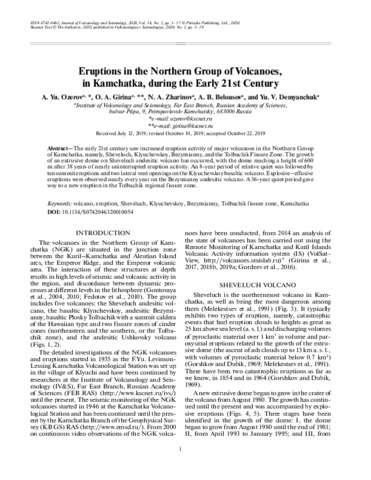
Ozerov A.Yu., Girina O.A., Zharinov N.A., Belousov A.B., Demyanchuk Yu.V. Eruptions in the Northern Group of Volcanoes, in Kamchatka, during the Early 21st Century // Journal of Volcanology and Seismology. 2020. Vol. 14. P. 1-17. https://doi.org/10.1134/S0742046320010054
Аннотация
The early 21st century saw increased eruption activity of major volcanoes in the Northern Group of Kamchatka, namely, Sheveluch, Klyuchevskoy, Bezymianny, and the Tolbachik Fissure Zone. The growth of an extrusive dome on Sheveluch andesitic volcano has occurred, with the dome reaching a height of 600 m after 38 years of nearly uninterrupted eruption activity. An 8-year period of relative quiet was followed by ten summit eruptions and two lateral vent openings on the Klyuchevskoy basaltic volcano. Explosive–effusive eruptions were observed nearly every year on the Bezymianny andesitic volcano. A 36-year quiet period gave way to a new eruption in the Tolbachik regional fissure zone.
|
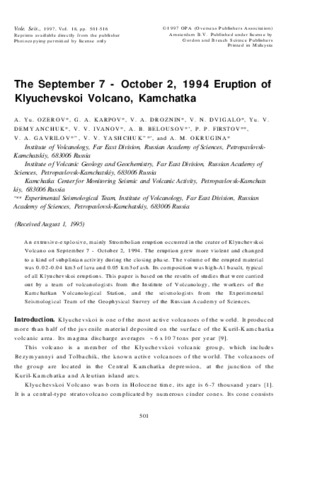
Ozerov A.Yu., Karpov G.A., Droznin V.A., Dvigalo V.N., Demyanchuk Yu.V., Ivanov V.V., Belousov A.B., Firstov P.P., Gavrilov V.A., Yaschuk V.V., Okrugina A.I. The September 7 - October 2, 1994 Eruption of Klyuchevskoi Volcano, Kamchatka // Volcanology and Seismology. 1997. № 18. P. 501-516.
|
Ozerov A.Yu., Khubunaya S.A. High-magnesian olivines and pyroxens as a criterion of petrogenetic relationship of calc-alkaline magmas from Klyuchevskoy volcano // Abstracts of 29th International Geological Congress. Kyoto: 1992. P. 639.
|
Ozerov A.Yu., Konov A.S. Regularities in the dynamics of the Klyuchevskoy volcano eruptions // Proceeding Kagoshima International Conference on Volcanoes. Japan: 1988. P. 63-65.
|
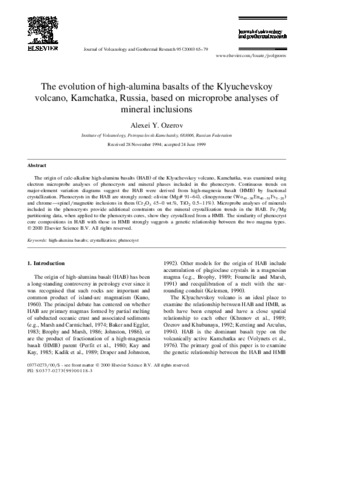
Ozerov Alexei Y. The evolution of high-alumina basalts of the Klyuchevskoy volcano, Kamchatka, Russia, based on microprobe analyses of mineral inclusions // Journal of Volcanology and Geothermal Research. 2000. Vol. 95. № 1–4. P. 65 - 79. https://doi.org/10.1016/S0377-0273(99)00118-3
Аннотация
The origin of calc-alkaline high-alumina basalts (HAB) of the Klyuchevskoy volcano, Kamchatka, was examined using electron microprobe analyses of phenocrysts and mineral phases included in the phenocrysts. Continuous trends on major-element variation diagrams suggest the HAB were derived from high-magnesia basalt (HMB) by fractional crystallization. Phenocrysts in the HAB are strongly zoned: olivine (Mg# 91–64), clinopyroxene (Wo45–38En40–51Fs5–20) and chrome—spinel/magnetite inclusions in them (Cr2O3 45–0 wt.%, TiO2 0.5–11%). Microprobe analyses of minerals included in the phenocrysts provide additional constraints on the mineral crystallization trends in the HAB. Fe/Mg partitioning data, when applied to the phenocrysts cores, show they crystallized from a HMB. The similarity of phenocryst core compositions in HAB with those in HMB strongly suggests a genetic relationship between the two magma types.


|
Ozerova N., Ozerov A. Atmochemical halos of mercury (Hg) within the area of active volcanic edifices in Kamchatka // IAVCEI 2008 - General Assembly, Reykjavik, Iceland. Abstracts. 2008. P. 7.
|
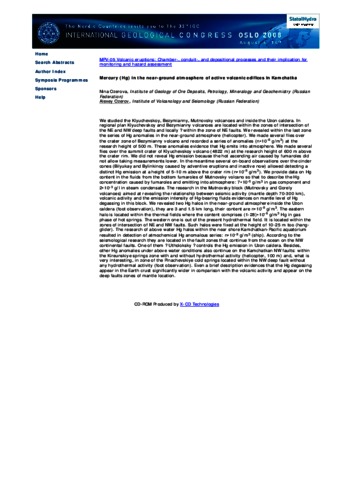
Ozerova N., Ozerov A. Mercury (Hg) in the near-ground atmosphere of active volcanic edifices in Kamchatka // 33rd International Geological Congress. Oslo, Norway. Abstracts. 2008.
|
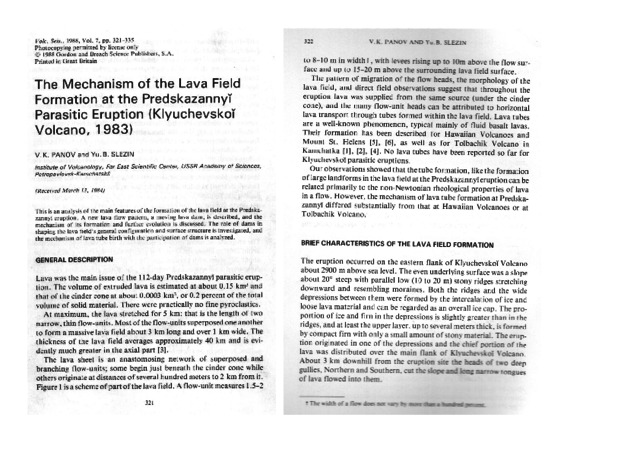
Panov V.K., Slezin Yu.B. The mechanism of the lava field formation at the Predskazanny parasitic eruption (Klyuchevskoy volcano, 1983) // Volcanology and Seismology. 1988. Vol. 7. P. 321-335.
|
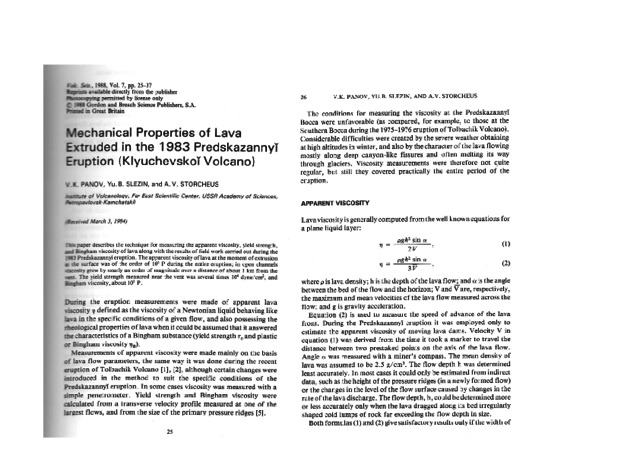
Panov V.K., Slezin Yu.B., Storcheus A.V. Mechanical properties of lava extruded in the 1983 Predskazanny eruption (Klyuchevskoi volcano) // Volcanology and Seismology. 1988. Vol. 7. P. 25-37.
|
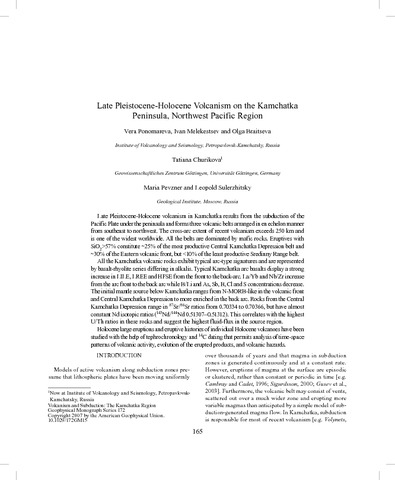
Ponomareva V.V., Churikova T., Melekestsev I.V., Braitseva O.A., Pevzner M., Sulerzhitskii L. Late Pleistocene-Holocene Volcanism on the Kamchatka Peninsula, Northwest Pacific Region / Volcanism and Subduction: The Kamchatka Region. Washington, D. C.: American Geophysical Union. 2007. Vol. 172. P. 165-198. https://doi.org/10.1029/172GM15
Аннотация
Late Pleistocene-Holocene volcanism in Kamchatka results from the subduction of the
Pacific Plate under the peninsula and forms three volcanic belts arranged in en echelon manner
from southeast to northwest. The cross-arc extent of recent volcanism exceeds 250 km and
is one of the widest worldwide. All the belts are dominated by mafic rocks. Eruptives with
SiO2>57% constitute ~25% of the most productive Central Kamchatka Depression belt and
~30% of the Eastern volcanic front, but <10% of the least productive Sredinny Range belt.
All the Kamchatka volcanic rocks exhibit typical arc-type signatures and are represented
by basalt-rhyolite series differing in alkalis. Typical Kamchatka arc basalts display a strong
increase in LILE, LREE and HFSE from the front to the back-arc. La/Yb and Nb/Zr increase
from the arc front to the back arc while B/Li and As, Sb, B, Cl and S concentrations decrease.
The initial mantle source below Kamchatka ranges from N-MORB-like in the volcanic front
and Central Kamchatka Depression to more enriched in the back arc. Rocks from the Central
Kamchatka Depression range in 87Sr/86Sr ratios from 0.70334 to 0.70366, but have almost
constant Nd isotopic ratios (143Nd/144Nd 0.51307–0.51312). This correlates with the highest
U/Th ratios in these rocks and suggest the highest fluid-flux in the source region.
Holocene large eruptions and eruptive histories of individual Holocene volcanoes have been
studied with the help of tephrochronology and 14C dating that permits analysis of time-space
patterns of volcanic activity, evolution of the erupted products, and volcanic hazards.

|
|