|
Записей: 546
Krasheninnikov Stepan, Portnyagin Maxim, Ponomareva V.V., Bergal-Kuvikas Olga, Mironov Nikita Periodic volcanic activity of Klyuchevskoy and Ushkovsky volcanoes during the early Holocene inferred from tephra study 2009.
|
Lees J., Symons N., Chubarova O., Gorelchik V., Ozerov A. Tomographic Images of Klyuchevskoy Volcano P-Wave Velocity / Volcanism and Subduction: The Kamchatka Region. Geophysical Monograph Series. Washington, D. C.: American Geophysical Union. 2007. Vol. 172. P. 293-302.
Аннотация
Three-dimensional structural images of the P-wave velocity below the edifice of the great Klyuchevskoy group of volcanoes in central Kamchatka are derived via tomographic inversion. The structures show a distinct low velocity feature extending from around 20 km depth to 35 km depth, indicating evidence of magma ponding near the Moho discontinuity. The extensive low velocity feature represents, at least to some degree, the source of the large volume of magma currently erupting at the surface near the Klyuchevskoy group.
|
Manevich A.G., Girina O.A., Melnikov D.V., Nuzhdaev A.A. 2016-2017 explosive eruptions of Kamchatka volcanoes based on KVERT data // JKASP-2018. Petropavlovsk-Kamchatsky: IVS FEB RAS. 2018.
|
Marhinin E.K., Stratula D.S. Relationship between chemical composition of volcanic rocks and depth of the seismofocal layer as shown by the Kliuchevskaya volcanic Grup (Kamchatka) and the Kurile-Kamchatka Island arc // Bulletin Volcanologique. 1973. Vol. 37. Vol. 2. P. 175-182. 8 p. doi:10.1007/BF02597129
|
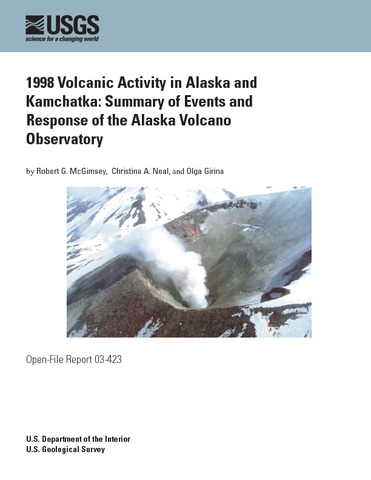
McGimsey R.G., Neal C.A., Girina O.A. 1998 Volcanic Activity in Alaska and Kamchatka: Summary of Events and Response of the Alaska Volcano Observatory Open-File Report 2004-1033. 2003. 35 p.
Аннотация
In 1998 the Alaska Volcano Observatory responded to eruptive activity or suspect volcanic activity at 7 volcanic centers--Shrub mud, Augustine, Becharof Lake area, Chiginagak, Shishaldin, Akutan, and Korovin.
In addition to responding to eruptive activity at Alaska volcanoes, AVO also disseminated information for the Kamchatkan Volcanic Eruption Response Team about the 1998 activity of 4 Russian volcanoes-Sheveluch, Klyuchevskoy, Bezymianny, and Karymsky.
|
McGimsey R.G., Neal C.A., Girina O.A. 1999 Volcanic Activity in Alaska and Kamchatka: Summary of Events and Response of The Alaska Volcano Observatory Open-File Report 2004-1033. 2004. 45 p.
|
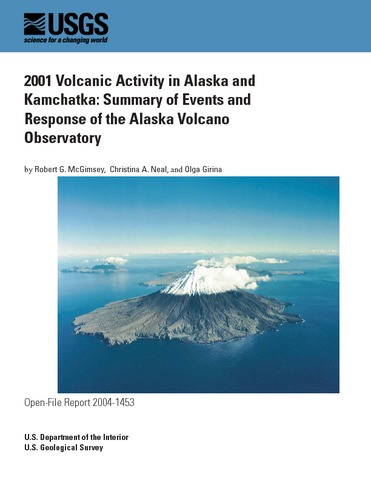
McGimsey R.G., Neal C.A., Girina O.A. 2001 Volcanic Activity in Alaska and Kamchatka: Summary of Events and Response of the Alaska Volcano Observatory Open-File Report 2004-1453. 2004. 53 p.
|
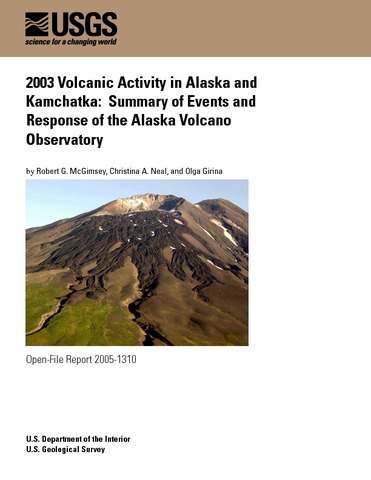
McGimsey R.G., Neal C.A., Girina O.A. 2003 Volcanic Activity in Alaska and Kamchatka: Summary of Events and Response of the Alaska Volcano Observatory Open-File Report 2005-1310. 2005. 58 p.
|
Melnik O., Lyakhovsky V., Shapiro Nikolay M., Galina N., Bergal-Kuvikas Olga Deep long period volcanic earthquakes generated by degassing of volatile-rich basaltic magmas // Nature Communications. 2020. Vol. 11. № 3918. https://doi.org/10.1038/s41467-020-17759-4
Аннотация
Deep long-period (DLP) earthquakes observed beneath active volcanoes are sometimes considered as precursors to eruptions. Their origin remains, however, unclear. Here, we present a possible DLP generating mechanism related to the rapid growth of gas bubbles in response to the slow decompression of over-saturated magma. For certain values of the gas and bubble content, the elastic deformation of surrounding rocks forced by the expanding bubbly magma can be fast enough to generate seismic waves. We show that amplitudes and frequencies of DLP earthquakes observed beneath the Klyuchevskoy volcano (Kamchatka, Russia) can be predicted by our model when considering pressure changes of ~107 Pa in a volume of ~103–104 m3 and realistic magma compositions. Our results show importance of the deep degassing in the generation of volcanic seismicity and suggest that the DLP swarms beneath active volcanoes might be related to the pulses of volatile-rich basaltic magmas rising from the mantle.


|
Mironov N.L., Portnyagin M.V. H2O and CO2 in parental magmas of Kliuchevskoi volcano inferred from study of melt and fluid inclusions in olivine // Russian Geology and Geophysics. 2011. Vol. 52. № 11. P. 1353 - 1367. https://doi.org/10.1016/j.rgg.2011.10.007
Аннотация
This paper reports new FTIR data on the H2O and CO2 concentrations in glasses of 26 naturally quenched and experimentally partially homogenized melt inclusions in olivine (Fo85–91) phenocrysts from rocks of the Kliuchevskoi volcano. Measured H2O concentrations in the inclusions range from 0.02 to 4 wt.%. The wide variations in the H2O content of the inclusions, which do not correlate with the host olivine composition and contents of major elements in the melts, are explained by the H2O escape from inclusions via diffusion through the host olivine during the magma eruption and the following cooling. The largest H2O loss is characteristic of inclusions from lava samples which cooled slowly after eruption. The minimal H2O loss is observed for inclusions from rapidly quenched pyroclastic rocks. Parental magmas of the Kliuchevskoi volcano are estimated to contain 3.5 wt.% H2O. The new data imply a 40 °C lower mantle temperatures than that estimated earlier for the Kliuchevskoi primary melts. The concentrations of CO2 in glasses range from <0.01 to 0.13 wt.% and do not correlate with the type of studied inclusions and their composition. The calculated pressures of melt equilibria with H2O–CO2 fluid inside the inclusions are lower than 270 MPa. They are significantly lower than a pressure of 500 MPa calculated from the density (~0.8 g/cm3) of cogenetic fluid inclusions in high-Fo olivine. The significant pressure drop inside the melt inclusions after their trapping in olivine might be due to the H2O loss and redistribution of CO2 from melt to daughter fluid phase. Compared with melt inclusions, cogenetic fluid inclusions provide independent information about the crystallization pressures of olivine and initial CO2 content in the Kliuchevskoi magma, which were estimated to be at least 500 MPa and 0.35 wt.%, respectively. The maximum CO2 concentrations in the primary Kliuchevskoi melts are estimated at 0.8–0.9 wt.%. The decompression crystallization of the Kliuchevskoi magmas starts at depths of 30–40 km and proceeds with a continuous decrease in CO2 content and an increase (up to 6–7 wt.%) and then a decrease (at <300 MPa) in H2O content in melts, which explains the origin of the whole spectrum of rocks and melt inclusions of the Kliuchevskoi volcano.

|
|