Detecting Volcano Thermal Activity in Night Images Using Machine Learning and Computer Vision (2023)
Korolev S.P., Urmanov I.P., Sorokin A.A., Girina O.A. Detecting Volcano Thermal Activity in Night Images Using Machine Learning and Computer Vision // Remote Sensing. 2023. Vol. 15. Vol. 19. № 4815. https://doi.org/10.3390/rs15194815
Аннотация
One of the most important tasks when studying volcanic activity is to monitor their thermal radiation. To fix and assess the evolution of thermal anomalies in areas of volcanoes, specialized hardware-thermal imagers are usually used, as well as specialized instruments of modern satellite systems. The data obtained with their help contain information that makes it relatively easy to track changes in temperature and the size of a thermal anomaly. At the same time, due to the high cost of such complexes and other limitations, thermal imagers sometimes cannot be used to solve scientific problems related to the study of volcanoes. In the current paper, day/night video cameras with an infrared-cut filter are considered as an alternative to specialized tools for monitoring volcanoes’ thermal activity. In the daytime, a camera operated in the visible range, and at night the filter was removed, increasing the camera’s light sensitivity by allowing near-infrared light to hit the sensor. In that mode, a visible thermal anomaly could be registered on images, as well as other bright glows, flares, and other artifacts. The purpose of this study is to detect thermal anomalies on night images, separate them from other bright areas, and find their characteristics, which could be used for volcano activity monitoring. Using the image archive of the Sheveluch volcano as an example, this article presents the results of developing a computer algorithm that makes it possible to find and classify thermal anomalies on video frames with an accuracy of 98%. The test results are presented, along with their validation based on thermal activity data obtained from satellite systems.
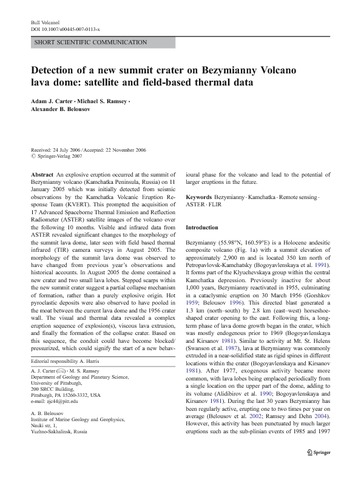
Detection of a new summit crater on Bezymianny Volcano lava dome: satellite and field-based thermal data (2007)
Carter Adam J., Ramsey Michael S., Belousov Alexander B. Detection of a new summit crater on Bezymianny Volcano lava dome: satellite and field-based thermal data // Bulletin of Volcanology. 2007. Vol. 69. № 7. P. 811-815. doi:10.1007/s00445-007-0113-x
Determination of the explosion energy in some volcanoes according to barograms (1960)
Gorshkov G.S. Determination of the explosion energy in some volcanoes according to barograms // Bulletin Volcanologique. 1960. Vol. 23. Vol. 1. P. 141-144. https://doi.org/10.1007/BF02596639
Developing the Methods for Multidisciplinary Morphometric Analysis of Relief for Assessing the Tectonic Fragmentation of the Interior (2024)
Sobisevich A.L., Agibalov A.O., Bergal-Kuvikas Olga, Zaitsev V.A., Zykov D.S., Makeev V.M., Poleshchuk A.V., Sentsov A.A., Shevchenko A.V. Developing the Methods for Multidisciplinary Morphometric Analysis of Relief for Assessing the Tectonic Fragmentation of the Interior // Journal of Volcanology and Seismology. 2024. № 18. P. 251-260. https://doi.org/10.1134/S074204632470057X
Dike model for the 2012–2013 Tolbachik eruption constrained by satellite radar interferometry observations (2015)
Lundgren Paul, Kiryukhin Alexey, Milillo Pietro, Samsonov Sergey Dike model for the 2012–2013 Tolbachik eruption constrained by satellite radar interferometry observations // Journal of Volcanology and Geothermal Research. 2015. Vol. 307. P. 79 - 88. https://doi.org/10.1016/j.jvolgeores.2015.05.011
Аннотация
Abstract A large dike intrusion and fissure eruption lasting 9 months began on November 27, 2013, beneath the south flank of Tolbachik Volcano, Kamchatka, Russia. The eruption was the most recent at Tolbachik since the Great Tolbachik Eruption from 1975 to 1976. The 2012 eruption was preceded by more than 6 months of seismicity that clustered beneath the east flank of the volcano along a NW–SE trend. Seismicity increased dramatically before the eruption, with propagation of the seismicity from the central volcano conduit in the final hours. We use interferometric synthetic aperture radar (InSAR) to compute relative displacement images (interferograms) for {SAR} data pairs spanning the eruption. We use satellite {SAR} data from the Canadian Space Agency's RADARSAT-2 and from the Italian Space Agency's COSMO-SkyMed missions. Data are modeled first through a Markov Chain Monte Carlo solution for a single tensile dislocation (dike). We then use a boundary element method that includes topography to model a distributed dike-opening model. We find the best-fitting dike dips 80° to the {WNW} with maximum opening of 6–8 m, localized in the near surface and more broadly distributed in distinct regions up to 3 km beneath the surface, which varies from 1 to 2 km elevation for the eruptive fissures. The distribution of dike opening and its correspondence with co-diking seismicity suggests that the dike propagated radially from Tolbachik's central conduit.
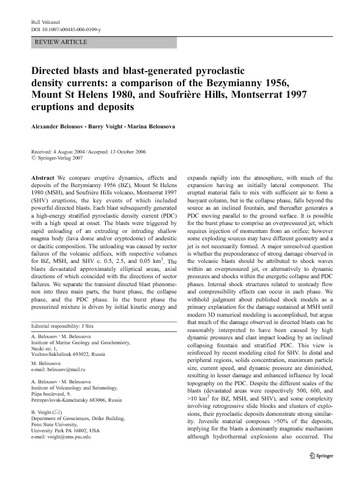
Directed blasts and blast-generated pyroclastic density currents: a comparison of the Bezymianny 1956, Mount St Helens 1980, and Soufrière Hills, Montserrat 1997 eruptions and deposits (2007)
Belousov Alexander, Voight Barry, Belousova Marina Directed blasts and blast-generated pyroclastic density currents: a comparison of the Bezymianny 1956, Mount St Helens 1980, and Soufrière Hills, Montserrat 1997 eruptions and deposits // Bulletin of Volcanology. 2007. Vol. 69. № 7. P. 701-740. doi:10.1007/s00445-006-0109-y
Discovery of a pure rhenium mineral at Kudriavy volcano (1994)
Korzhinsky M. A., Tkachenko S. I., Shmulovich K. I., Taran Y. A., Steinberg G. S. Discovery of a pure rhenium mineral at Kudriavy volcano // Nature. 1994. Vol. 369. P. 51-52. https://doi.org/10.1038/369051a0
Аннотация
KUDRIAVY volcano on Iturup island in the Kuril arc is an active calc-alkaline volcano. It has not erupted this century; its current volcanic activity is characterized by hot (up to 910oC) gas jets which have been stable for at least 30 years. The composition of the gaseous emissions is typical of high-temperature fumaroles, but we report here the discovery of unusual subsurface sublimates associated with one gas jet—a sulphide mineral containing rhenium as the only cation. To our knowledge, this is the first reported occurrence of a pure rhenium mineral. The concentration of rhen-ium in the fumarole gas is only 2–10 p.p.b., so the condensation of pure rhenium sulphide from this gas requires both enrichment of rhenium by eight orders of magnitude and remarkable selectivity. Rhenium is generally believed to exist in only trace amounts at the Earth's surface, but our findings demonstrate that it can be readily mobilized, dispersed and concentrated by degassing magmas.
Discriminations in Generation of pyroclastic deposit types from andesitic volcanoes of Kamchatka (in the Bezymianny volcano case) (1995)
Bogoyavlenskaya G.E., Girina O.A. Discriminations in Generation of pyroclastic deposit types from andesitic volcanoes of Kamchatka (in the Bezymianny volcano case) // IUGG. XXI General Assembly. Colorado. 1995. P. B 410.
Distribution and eruptive mechanism of maars in the Kamchatka Peninsula (2006)
Belousov A. B. Distribution and eruptive mechanism of maars in the Kamchatka Peninsula // Doklady Earth Sciences. 2006. Vol. 406. № 1. P. 24-27. doi:10.1134/S1028334X06010077