Geochemical and geo-electrical study of mud pools at the Mutnovsky volcano (South Kamchatka, Russia): Behavior of elements, structures of feeding channels and a model of origin (2012)
Bessonova E.P., Bortnikova S.B., Gora M.P., Manstein Yu.A., Shevko A.Ya., Panin G.L., Manstein A.K. Geochemical and geo-electrical study of mud pools at the Mutnovsky volcano (South Kamchatka, Russia): Behavior of elements, structures of feeding channels and a model of origin // Applied Geochemistry. 2012. Vol. 27. № 9. P. 1829 - 1843. https://doi.org/10.1016/j.apgeochem.2012.02.018
Аннотация
This study presents data on the geochemical composition of boiling mud pools at the Mutnovsky volcano. The physicochemical characteristics of the pools and the concentrations of major, minor and trace elements in pool solutions vary widely. A comparison of the geochemical compositions of host rocks and solutions indicates that leaching from rocks is not the only source of chemicals in thermal solutions. Geophysical studies reveal the inner structure of thermal fields, which reflect the shapes of the underground reservoirs and feed channels. Using geophysical methods (electrical resistivity tomography and frequency domain investigations), it was shown that the vertical structure and complex geochemical zonation of the feed channels leads to a high contrast in the compositions of the mud solutions. These findings answer questions about the origin and composition of surface manifestations. To elucidate the mechanisms of solution formation, an attempt was made to describe the magmatic fluid evolution and the resulting mixing of waters by physical and mathematical models. The model illustrates fluid migration from a magma chamber to the surface. It is shown that the formation of brines corresponding to the mud pool composition is possible during secondary boiling.
Geochemical characterization of marker tephra layers from major Holocene eruptions, Kamchatka Peninsula, Russia (2011)
Kyle Philip R., Ponomareva Vera V., Rourke Schluep Rachelle Geochemical characterization of marker tephra layers from major Holocene eruptions, Kamchatka Peninsula, Russia // International Geology Review. 2011. Vol. 53. № 9. P. 1059-1097. doi:10.1080/00206810903442162
Аннотация
Kamchatka Peninsula is one of the most active volcanic regions in the world. Many Holocene explosive eruptions have resulted in widespread dispersal of tephra-fall
deposits. The largest layers have been mapped and dated by the 14C method. The tephra provide valuable stratigraphic markers that constrain the age of many geological
events (e.g. volcanic eruptions, palaeotsunamis, faulting, and so on). This is the first systematic attempt to use electron microprobe (EMP) analyses of glass to characterize
individual tephra deposits in Kamchatka. Eighty-nine glass samples erupted from 11 volcanoes, representing 27 well-identified Holocene key-marker tephra layers, were analysed. The glass is rhyolitic in 21 tephra, dacitic in two, and multimodal in three.
Two tephra are mixed with glass compositions ranging from andesite/dacite to rhyolite. Tephra from the 11 eruptive centres are distinguished by their glass K2O,
CaO, and FeO contents. In some cases, individual tephra from volcanoes with multiple eruptions cannot be differentiated. Trace element compositions of 64 representative
bulk tephra samples erupted from 10 volcanoes were analysed by instrumental neutron activation analysis (INAA) as a pilot study to further refine the geochemical haracteristics; tephra from these volcanoes can be characterized using Cr and Th contents and La/Yb ratios.
Unidentified tephra collected at the islands of Karaginsky (3), Bering (11), and Attu (5) as well as Uka Bay (1) were correlated to known eruptions. Glass compositions and
trace element data from bulk tephra samples show that the Karaginsky Island and Uka Bay tephra were all erupted from the Shiveluch volcano. The 11 Bering Island tephra
are correlated to Kamchatka eruptions. Five tephra from Attu Island in the Aleutians are tentatively correlated with eruptions from the Avachinsky and Shiveluch volcanoes.
Geochemical diversity and tectinic relationships in monogenetic volcanic fields: a case study of the Sredinny Range, Kamchatka (2023)
Volynets Anna, Nekrylov Nikolay, Gorbach N.V., Ovsyannikov A.A., Tolstykh M.L., Pevzner M.M., Zelenin Egor, Shcherbakov V.D., Lebedev V.A., Plechova A.A., Babansky A.D. Geochemical diversity and tectinic relationships in monogenetic volcanic fields: a case study of the Sredinny Range, Kamchatka // Lithos. 2023. Vol. 456. https://doi.org/10.1016/j.lithos.2023.107306
Аннотация
We report, here, the composition and Ksingle bondAr ages of a representative collection of volcanic rocks that erupted within three monogenetic volcanic fields in the active fault zone of the Sredinny Range of Kamchatka: Tigilsky Dol, Mount Oxi massif and Anaunsky Dol. The studied rocks display a wide range of compositions (medium-K, moderate-Mg, high-K, high-Ti and high-Mg basalts, and high-LREE picrobasalts); the high-Mg varieties are confined to faults. Five main periods of volcanic activity were investigated, 4.3–3, 2, 1.5, 1 Ma and from 0.3 to <0.05 Ma. Primitive lavas first emerged on the surface at 3.5 Ma. There was a massive outpouring of high-Mg lavas at 1.5–1 and 0.3 Ma, which could have been related to the formation of the fault zone. This is the first report of rocks in Kamchatka with a high-LREE picrobasaltic composition (1.5 Ma). The Fo content of the olivine phenocrysts reaches 93.2 mol%, which is the highest value known for Quaternary Kamchatka basalts. A very heterogeneous source, even for individual eruptions is indicated by the minor element contents in the olivine (Ni, Mn and Ca); Cr-spinel – olivine paragenesis show that all the rocks studied crystallized in the same temperature range (1111–1292 °C), whereas the oxygen fugacity for the different samples varied from ΔQFM +0.7 to +2.0 log. units. A melt inclusion study showed that the Mg basalts of the Mt. Oxi massif and the high-LREE picrobasalts of Tigilsky Dol had different fluid sources that were enriched and depleted in water and Cl, respectively. We argue that the fluid source for the Mt. Oxi massif was likely the remains of the Pacific slab under the Sredinny Range, whereas, for the high-LREE picrobasalts of Tigilsky Dol, it was the lithospheric lithologies. The low content of S and high content of Cu in the oxidized high-LREE basalts provide additional evidence that they originated from the re-melting of sulfur-poor lithospheric lithologies. Both the fault zone and the lithosphere re-activation in the region are likely linked to the regional stress field.
Geochemical effect of Bezymianny volcano eruption (1959)
Gorshkov G.S., Tovarova I.I. Geochemical effect of Bezymianny volcano eruption // Bulletin of the Volcanological Society of Japan. 1959. Vol. 3. № 2. P. 157-158.
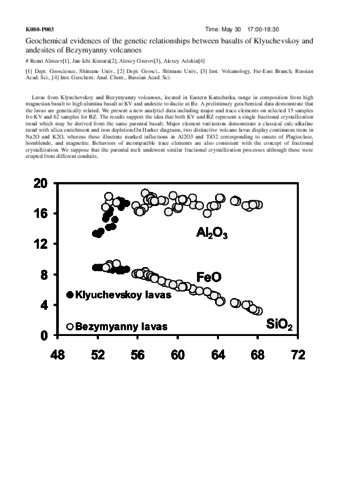
Geochemical evidences of the genetic relationships between basalts of Klyuchevskoy and andesites of Bezymyanny volcanoes (2002)
Almeev R.R., Kimura J.I., Ozerov A.Yu., Ariskin A.A. Geochemical evidences of the genetic relationships between basalts of Klyuchevskoy and andesites of Bezymyanny volcanoes // The Japan Earth and Planetary Science Joint Meeting: Tokyo, Japan. 2002. P. K080-P003.
Geochemical evolution of Bolshaya Udina, Malaya Udina, and Gorny Zub volcanoes, Klyuchevskaya Group (Kamchatka) (2017)
Churikova Tatiana, Gordeychik Boris, Wörner Gerhard, Flerov Gleb, Hartmann Gerald, Simon Klaus Geochemical evolution of Bolshaya Udina, Malaya Udina, and Gorny Zub volcanoes, Klyuchevskaya Group (Kamchatka) // Geophysical Research Abstracts. 2017. Vol. 19. P. EGU2017-10691.
Аннотация
The Klyuchevskaya group of volcanoes (KGV) located in the northern part of Kamchatka has the highest magma production rate for any arc worldwide and several of its volcanoes have been studied in considerable detail [e.g. Kersting & Arculus, 1995; Pineau et al., 1999; Dorendorf et al., 2000; Ozerov, 2000; Churikova et al., 2001, 2012, 2015; Mironov et al., 2001; Portnyagin et al., 2007, 2015; Turner et al., 2007]. However, some volcanoes of the KGV including Late-Pleistocene volcanoes Bolshaya Udina, Malaya Udina, Ostraya Zimina, Ovalnaya Zimina, and Gorny Zub were studied only on a reconnaissance basis [Timerbaeva, 1967; Ermakov, 1977] and the modern geochemical studies have not been carried out at all. Among the volcanoes of KGV these volcanoes are closest to the arc trench and may hold information on geochemical zonation with respect to across arc source variations. We present the first major and trace element data on rocks from these volcanoes as well as on their basement. All rocks are medium-calc-alkaline basaltic andesites to dacites except few low-Mg basalts from Malaya Udina volcano. Phenocrysts are mainly olivine, pyroxene, plagioclase and magnetite, Hb-bearing andesites and dacites are rarely found only in subvolcanic intrusions at Bolshaya Udina volcano. Lavas are geochemically similar to the active Bezymianny volcano, however, individual variations for each volcano exist in both major and trace elements. Trace element geochemistry is typical of island arc volcanism. Compared to KGV lavas all studied rocks form very narrow trends in all major element diagrams, which almost do not overlap with the fields of other KGV volcanoes. The lavas are relatively poor in alkalis, TiO2, P2O5, FeO, Ni, Zr, and enriched in SiO2 compared to other KGV volcanics and show greater geochemical and petrological evidence of magmatic differentiation during shallow crustal processing. Basement samples of the Udinskoe plateau lavas to the east of Bolshaya Udina volcano have similar geochemical composition (trace element enriched high-K basaltic andesites and andesites) and similar eruption age of 274 ka [Calkins et al., 2004] as typical plateau lavas below the northern KGV. This research was supported by RFBR-DFG grant # 16-55-12040.
Geochemical features of the rocks of the Great Tolbachik Fissure Eruption 1975–1976 in relation to petrogenesis (1983)
Volynets O.N., Flerov G.B., Andreev V.N., Popolitov E.I., Abramov V.A., Petrov L.L., Shcheka S.A., Selivanova G.I. Geochemical features of the rocks of the Great Tolbachik Fissure Eruption 1975–1976 in relation to petrogenesis / The Great Tolbachik Fissure Eruption. Cambridge: Cambridge University Press. Cambridge: Cambridge University Press. 1983. P. 116-140.
Geochemical similarities between the pre-caldera and modern evolutionary series of eruptive products from Gorely volcano, Kamchatka (2010)
Gavrilenko M.G, Ozerov A.Yu. Geochemical similarities between the pre-caldera and modern evolutionary series of eruptive products from Gorely volcano, Kamchatka // 2010 Fall Meeting, AGU, San Francisco, Calif., 13-17 Dec.. 2010. P. V21B-2333.
Geochemical studies of volcanic rocks from the northern part of Kuril-Kamchatka arc: Tectonic and structural constraints on the origin and evolution of arc magma (2015)
Bergal-Kuvikas Olga Geochemical studies of volcanic rocks from the northern part of Kuril-Kamchatka arc: Tectonic and structural constraints on the origin and evolution of arc magma. 2015. Дисс. канд. геол.-мин. наук.
Geochemistry and solute fluxes of volcano-hydrothermal systems of Shiashkotan, Kuril Islands (2015)
Kalacheva Elena, Taran Yuri, Kotenko Tatiana Geochemistry and solute fluxes of volcano-hydrothermal systems of Shiashkotan, Kuril Islands // Journal of Volcanology and Geothermal Research. 2015. Vol. 296. P. 40-54. doi:10.1016/j.jvolgeores.2015.03.010
Аннотация
Shiashkotan Island belongs to the Northern Kuril island arc and consists of two joined volcanoes, Sinarka and
Kuntomintar, with about 18 km of distance between the summits. Both volcanoes are active, with historic
eruptions, and both emit fumarolic gases. Sinarka volcano is degassing through the extrusive domewith inaccessible
strong and hot (N400 °C) fumaroles. A large fumarolic field of the Kuntomintar volcano situated in a wide
eroded caldera-like crater hosts many fumarolic vents with temperatures from boiling point to 480 °C. Both
volcanoes are characterized by intense hydrothermal activity discharging acid SO4-Cl waters, which are drained
to the Sea of Okhotsk by streams. At least 4 groups of near-neutral Na-Mg-Ca-Cl-SO4 springs with temperatures in
the range of 50–80 °C are located at the sea level,within tide zones and discharge slightly altered diluted seawater.
Volcanic gas of Kuntomintar as well as all types of hydrothermal manifestations of both volcanoes were collected
and analyzed for major and trace elements and water isotopes. Volcanic gases are typical for arc volcanoes
with 3He/4He corrected for air contamination up to 6.4 Ra (Ra=1.4 ×10⁻⁶, the air ratio) and δ13C (CO2) within
−10‰to−8‰VPDB. Using a saturation indices approach it is shown that acid volcanic waters are formed at a
shallow level, whereas waters of the coastal springs are partially equilibrated with rocks at ~180 °C. Trace
element distribution and concentrations and the total REE depend on the water type, acidity and Al+Fe concentration.
The REE pattern for acidic waters is unusual but similar to that found in some acidic crater lake waters.
The total hydrothermal discharge of Cl and S from the island associated with volcanic activity is estimated at
ca. 20 t/d and 40 t/d, respectively, based on the measurements of flow rates of the draining streams and
their chemistry. The chemical erosion of the island by surface and thermal waters is estimated at 27 and 140
ton/km2/year, respectively, which is 2–3 times lower than chemical erosion of tropical volcanic islands.