An eruption of the Veer cone as a volcanic event during the increase of volcanic activity in Kamchatka at the beginning of the Christian Era (2010)
Dirksen O.V., Bazanova L.I. An eruption of the Veer cone as a volcanic event during the increase of volcanic activity in Kamchatka at the beginning of the Christian Era // Journal of Volcanology and Seismology. 2010. Vol. 4. № 6. P. 378-384. https://doi.org/10.1134/S0742046310060023
Аннотация
Tephrochronologic studies conducted in the Levaya Avacha River valley helped determine the true age of the Veer cinder cone, which formed approximately in 470 AD (1600 14C BP). These data refute the existing idea that it was generated in 1856. The monogenetic Veer cone should be cancelled from the catalogs of historical eruptions and active volcanoes in Kamchatka. The eruption of this cone was a reflection of the all-Kamchatkan increase in the activity of endogenous processes that occurred in 0–650 AD.
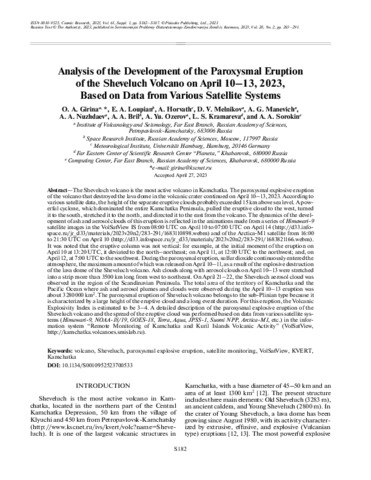
Analysis of the Development of the Paroxysmal Eruption of the Sheveluch Volcano on April 10–13, 2023, Based on Data from Various Satellite Systems (2023)
Girina O.A., Loupian E.A., Horváth Á, Melnikov D.V., Manevich A.G., Nuzhdaev A.A., Bril A.A., Ozerov A.Yu., Kramareva L.S., Sorokin A.A. Analysis of the Development of the Paroxysmal Eruption of the Sheveluch Volcano on April 10–13, 2023, Based on Data from Various Satellite Systems // Cosmic Research. 2023. Vol. 61. Vol. 1. P. S182-S187. https://doi.org/10.1134/S0010952523700533
Аннотация
The Sheveluch volcano is the most active volcano in Kamchatka. The paroxysmal explosive eruption of the volcano that destroyed the lava dome in the volcanic crater continued on April 10–13, 2023. According to various satellite data, the height of the separate eruptive clouds probably exceeded 15 km above sea level. A powerful cyclone, which dominated the entire Kamchatka Peninsula, pulled the eruptive cloud to the west, turned it to the south, stretched it to the north, and directed it to the east from the volcano. The dynamics of the development of ash and aerosol clouds of this eruption is reflected in the animations made from a series of Himawari-9 satellite images in the VolSatView IS from 08:00 UTC on April 10 to 07:00 UTC on April 14 (http://d33.infospace.ru/jr_d33/materials/2023v20n2/283-291/1683110898.webm) and of the Arctica-M1 satellite from 16:00 to 21:30 UTC on April 10 (http://d33.infospace.ru/jr_d33/materials/2023v20n2/283-291/1683821166.webm). It was noted that the eruptive column was not vertical: for example, at the initial moment of the eruption on April 10 at 13:20 UTC, it deviated to the north–northeast; on April 11, at 12:00 UTC to the northwest; and, on April 12, at 7:00 UTC to the southwest. During the paroxysmal eruption, sulfur dioxide continuously entered the atmosphere, the maximum amount of which was released on April 10–11, as a result of the explosive destruction of the lava dome of the Sheveluch volcano. Ash clouds along with aerosol clouds on April 10–13 were stretched into a strip more than 3500 km long from west to northeast. On April 21–22, the Sheveluch aerosol cloud was observed in the region of the Scandinavian Peninsula. The total area of the territory of Kamchatka and the Pacific Ocean where ash and aerosol plumes and clouds were observed during the April 10–13 eruption was about 3280000 km2. The paroxysmal eruption of Sheveluch volcano belongs to the sub-Plinian type because it is characterized by a large height of the eruptive cloud and a long event duration. For this eruption, the Volcanic Explosivity Index is estimated to be 3–4. A detailed description of the paroxysmal explosive eruption of the Sheveluch volcano and the spread of the eruptive cloud was performed based on data from various satellite systems (Himawari-9, NOAA-18/19, GOES-18, Terra, Aqua, JPSS-1, Suomi NPP, Arctica-M1, etc.) in the information system “Remote Monitoring of Kamchatka and Kuril Islands Volcanic Activity” (VolSatView, http://kamchatka.volcanoes.smislab.ru).
Andesite crystallization in the upper parts of volcanic canals (1969)
Bogoyavlenskaya G.E., Dubik Y.M. Andesite crystallization in the upper parts of volcanic canals // Bulletin Volcanologique. 1969. Vol. 33. Vol. 4. P. 1269-1273. 20 p. https://doi.org/10.1007/BF02597721
Аннотация
Constant observations of the eruption process of Bezymianny volcano and an incessant control of the properties and volume of ejected products enabled us to reconstruct cristallization conditions of the magma in the top parts of the volcanic vent assumedly to a depth of 6–8 km.
Substantial changes in the mineralogy and petrography of lavas have been recorded during the thirteen years of the activity of the volcano.
Hornblende andesites of the first portions of eruptions were replaced by bipyroxene andesites, in which the second generation of phenocrysts had appeared — subphenocrysts. The content of subphenocrysts was progressively increasing with a simultaneous drop in the amount of glass to nearly one half of the former amount.
In the process of eruption the chemical composition of rocks did not change: a high viscosity of the melt prevented a differentiation in the upper parts of the magmatic column.
A relative permanence of the composition and amount of phenocrysts of plagioclase and pyroxene throughout all the eruption stages indicates that already at a depth of 7–8 km the melt contains intratelluric phenocrysts.
The appearance in lavas of the last eruption stage of phenocrysts belonging to the 2nd generation despite an unchanged chemical composition, indicates their cristallization in subsurface conditions in the interval of 5–10 years.
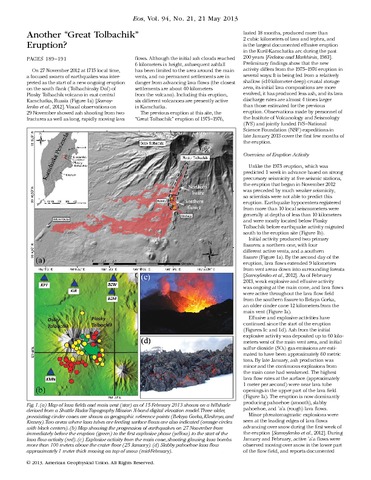
On 27 November 2012 at 1715 local time, a focused swarm of earthquakes was interpreted as the start of a new ongoing eruption on the south flank (Tolbachinsky Dol) of Plosky Tolbachik volcano in east central Kamchatka, Russia (Figure 1a) [Samoylenko et al., 2012]. Visual observations on 29 November showed ash shooting from two fractures as well as long, rapidly moving lava flows. Although the initial ash clouds reached 6 kilometers in height, subsequent ashfall has been limited to the area around the main vents, and no permanent settlements are in danger from advancing lava flows (the closest settlements are about 40 kilometers from the volcano). Including this eruption, six different volcanoes are presently active in Kamchatka.
Areal variability of tephra composition as indicated by bulk silicate analysis data (1990)
Felitsyn S.B., Kirianov V.Yu. Areal variability of tephra composition as indicated by bulk silicate analysis data // Volcanology and Seismology. 1990. Vol. 9. № 1. P. 1-20.
Assessment of Kamchatkan Ash Hazard to Airlines (1993)
Kirianov V.Yu. Assessment of Kamchatkan Ash Hazard to Airlines // Volcanology and Seismology. 1993. Vol. 14. № 3. P. 246-269.
Asymmetric caldera-related structures in the area of the Avacha group of volcanoes in Kamchatka as revealed by ambient noise tomography and deep seismic sounding (2014)
Koulakov Ivan, Jaxybulatov Kayrly, Shapiro Nikolay M., Abkadyrov Ilyas, Deev Evgeny, Jakovlev Andrey, Kuznetsov Pavel, Gordeev Evgeny, Chebrov Viktor Asymmetric caldera-related structures in the area of the Avacha group of volcanoes in Kamchatka as revealed by ambient noise tomography and deep seismic sounding // Journal of Volcanology and Geothermal Research. 2014. Vol. 285. P. 36 - 46. https://doi.org/10.1016/j.jvolgeores.2014.08.012
Аннотация
Avacha group includes two active and potentially dangerous volcanoes, Avachinsky and Koryaksky, located close to Petropavlovsk-Kamchatsky, the main city of Kamchatka. We present the results of two independent seismic studies of shallow crustal structures beneath the Avacha group based on passive and active source observations. The first study is based on the analysis of continuous recording by 11 seismic stations installed over the Avacha group in 2012 and 7 permanent stations in the same region. We present a series of 2D Rayleigh-wave group velocity maps based on correlation of ambient noise, that were then converted into 3D distribution of shear wave velocity. The second work was based on the reprocessing of an active source deep seismic sounding profile across the Avachinsky volcano that was shot in 1982–1984. We made the analysis of travel times of refracted waves using a 2D tomography inversion. The resulting seismic models appear to be consistent with each other and show clear low-velocity zone to the SW of the Avachinsky volcano and high velocity structures to NE. These observations also agree with the existing gravity and magnetotelluric measurements. Based on the obtained seismic models we identify two large buried calderas and large lava flows that are thought to be related to a series of large eruption episodes of Avachinsky occurred within the last 30,000 years.
Atmochemical halos of mercury (Hg) within the area of active volcanic edifices in Kamchatka (2008)
Ozerova N., Ozerov A. Atmochemical halos of mercury (Hg) within the area of active volcanic edifices in Kamchatka // IAVCEI 2008 - General Assembly, Reykjavik, Iceland. Abstracts. 2008. P. 7.
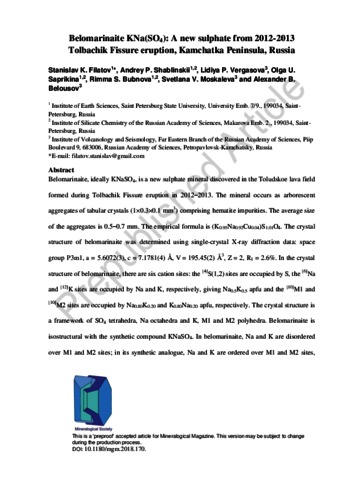
Belomarinaite KNa (SO 4): A new sulfate from 2012–2013 Tolbachik Fissure eruption, Kamchatka Peninsula, Russia (2019)
Filatov S., Shablinskii A., Vergasova L., Saprikina O., Bubnova R., Moskaleva S., Belousov Alexander Belomarinaite KNa (SO 4): A new sulfate from 2012–2013 Tolbachik Fissure eruption, Kamchatka Peninsula, Russia // Mineralogical Magazine. 2019. Vol. 83. № 4. P. 569-577. https://doi.org/10.1180/mgm.2018.170