|
Записей: 445
Horváth Á, Girina O.A., Carr J.L., Wu D.L., Bril A.A., Mazurov A.A., Melnikov D.V., Hoshyaripour G.A., Buehler S.A. Geometric estimation of volcanic eruption column height from GOES-R near-limb imagery – Part 2: Case studies // Atmospheric Chemistry and Physics. 2021. Vol. 21. Vol. 16. P. 12207-12226. https://doi.org/10.5194/acp-21-12207-2021
Аннотация
In a companion paper (Horváth et al., 2021), we introduced a new technique to estimate volcanic eruption column height from extremely oblique near-limb geostationary views. The current paper demonstrates and validates the technique in a number of recent eruptions, ranging from ones with weak columnar plumes to subplinian events with massive umbrella clouds and overshooting tops that penetrate the stratosphere. Due to its purely geometric nature, the new method is shown to be unaffected by the limitations of the traditional brightness temperature method, such as height underestimation in subpixel and semitransparent plumes, ambiguous solutions near the tropopause temperature inversion, or the lack of solutions in undercooled plumes. The side view height estimates were in good agreement with plume heights derived from ground-based video and satellite stereo observations, suggesting they can be a useful complement to established techniques.

|
Ionov D.A., Bénard A., Plechov P.Yu., Shcherbakov V.D. Along-arc variations in lithospheric mantle compositions in Kamchatka, Russia: First trace element data on mantle xenoliths from the Klyuchevskoy Group volcanoes // Journal of Volcanology and Geothermal Research. 2013. Vol. 263. P. 122 - 131. https://doi.org/10.1016/j.jvolgeores.2012.12.022
Аннотация
Abstract We provide results of a detailed study of the first peridotite xenoliths of proven mantle origin reported from Bezymyanny volcano in the Klyuchevskoy Group, northern Kamchatka arc. The xenoliths are coarse spinel harzburgites made up mainly of Mg-rich olivine as well as subhedral orthopyroxene (opx) and Cr-rich spinel, and also contain fine-grained interstitial pyroxenes, amphibole and feldspar. The samples are unique in preserving the evidence for both initial arc mantle substrate produced by high-degree melt extraction and subsequent enrichment events. We show that the textures, modal and major oxide compositions of the Bezymyanny xenoliths are generally similar to those of spinel harzburgite xenoliths from Avacha volcano in southern Kamchatka. However, coarse opx from the Bezymyanny harzburgites has higher abundances of light and medium rare earth elements and other highly incompatible elements than coarse opx from the Avacha harzburgites. We infer that (1) the sub-arc lithospheric mantle beneath both Avacha and Bezymyanny (and possibly between these volcanoes) consists predominantly of harzburgitic melting residues, which experienced metasomatism by slab-related fluids or low-fraction, fluid-rich melts and (2) the degrees of metasomatism are higher beneath Bezymyanny. By contrast, xenolith suites from Shiveluch and Kharchinsky volcanoes 50–100 km north of the Klyuchevskoy Group include abundant cumulates and products of reaction of mantle rocks with silicate melts at high melt/rock ratios. The high melt flux through the lithospheric mantle beneath Shiveluch and Kharchinsky may be related to the asthenospheric flow around the northern edge of the sinking Pacific plate; lateral propagation of fluids in the mantle wedge south of the plate edge may contribute to metasomatism in the mantle lithosphere beneath the Klyuchevskoy Group volcanoes.
|
Ivanov B.V., Chirkov A.M., Dubik Y.M., Khrenov A.P., Dvigalo V.N., Razina A.A., Stepanov V.V., Chubarova O.S. Active Volcanoes of Kamchatka and Kuril Islands: Status in 1982 // Volcanology and Seismology. 1988. Vol. 6. № 4. P. 623-634.
|
Ivanov B.V., Gavrilenko G.M., Dvigalo V.N., Ovsyannikov A.A., Ozerov A.Yu., Razina A.A., Tokarev P.I., Khrenov A.P., Chirkov A.M. Activity of Volcanoes in Kamchatka and the Kuril Islands in 1983 // Volcanology and Seismology. 1988. Vol. 6. № 6. P. 959-972.
|
Ivanov B.V., Kadik A.A., Maksimov A.P. Conditions of the crystallization of andesites from the Klyuchevskaya volcanic group (Kamchatka) Arc volcanism (abstr.).. // Arc Volcanism: Physics and Tectonics. Proceedings of a 1981 IAVCEI Symposium, Arc Volcanism, August-September, 1981, Tokyo and Hakone. Tokyo: Terra Scientific Pub. Co.. 1983.
|
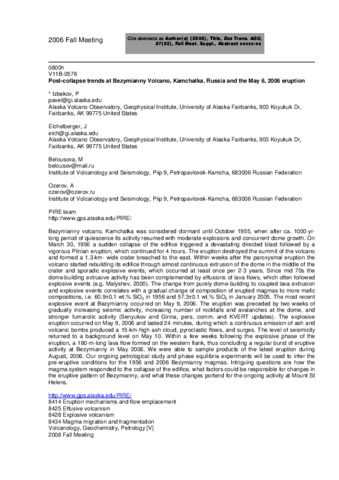
Izbekov P., Eichelberger J., Belousova M., Ozerov A. Post-collapse trends at Bezymianny Volcano, Kamchatka, Russia and the May 6, 2006 eruption // AGU Fall Meeting 2006. Eos Trans. AGU, 87(52), Fall Meet. Suppl., Abstracts. 2006. P. V11B-0576.
|
Kirianov V.Yu. Assessment of Kamchatkan Ash Hazard to Airlines // Volcanology and Seismology. 1993. Vol. 14. № 3. P. 246-269.
|
Kirianov V.Yu. Volcanic Ash in Kamchatka as a Source of Potential Hazard to Air Traffic // Volcanic Ash and Aviation Safety: Proc. First Intern. Symp. on Volcanic Ash and Aviation safety. US Geological Survey Bull. US Geological Survey. 1994. Vol. 2047. P. 57-63. https://doi.org/10.3133/b2047
|
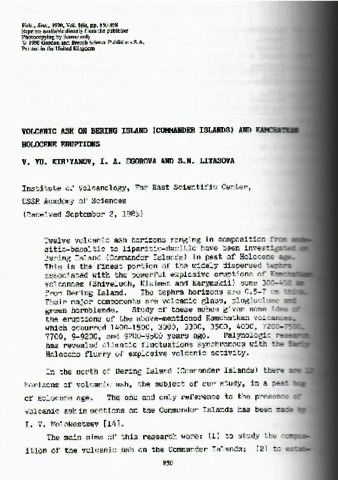
Kirianov V.Yu., Egorova I.A., Litasova S.N. Volcanic ash on Bering Island (Commander Islands) and Kamchatkan Holocene Eruptions // Volcanology and Seismology. 1990. Vol. 8. № 6. P. 850-868.
|
Kiryukhin A.V., Bergal-Kuvikas Olga, Lemzikov M.V. Magmatic activity of Klyuchevskoy volcano triggering eruptions of Bezymianny volcano based on seismological and petrological data // Journal of Volcanology and Geothermal Research. 2023. https://doi.org/10.1016/j.jvolgeores.2023.107892
|
|