Moiseenko K.B., Malik N.A. Linear inverse problem for inferring eruption source parameters from sparse ash deposit data as viewed from an atmospheric dispersion modeling perspective // Bulletin of Volcanology. 2019. Vol. 81. № 3. P. 19. https://doi.org/10.1007/s00445-019-1281-1
Annotation
Determination of the volcanic eruption source parameters—total grain-size distribution and vertical ash mass distribution (VMD) within the source—is carried out on a collection of measured-area samples and granulometry data. For this, the geophysical inverse methods and Hybrid Particle and Concentration Transport Model (HYPACT) driven by wind and turbulence fields simulated with the Regional Atmospheric Modeling System (RAMS) are used. A two-step inversion procedure is proposed to obtain approximate but physically meaningful solution when the total number of ashfall samples is small and it is not possible to make a good initial guess of the source parameters. First, a spectrum of particle fall velocities is estimated by selecting a best-fit subset of aerodynamically distinct subpopulations of free and aggregate particles from the trial set used to simulate a polycomponent ashfall. The singular value decomposition (SVD) analysis is then employed to identify spatial components of the ash emissions’ vertical distribution, as resolvable by the observations. Model validation experiments are conducted for the January 12, 2011, short-duration vulcanian explosion at Kizimen and paroxysmal phase of the December 24, 2006, sub-Plinian eruption at Bezymianny. The derived VMDs exhibit high variability in fine ash content (~ 60–100 wt%) as well as strong secondary maxima in the lower troposphere, likely reflecting the contribution of ash particles fallen out of co-pyroclastic flow ash clouds and partially collapsing eruption columns.
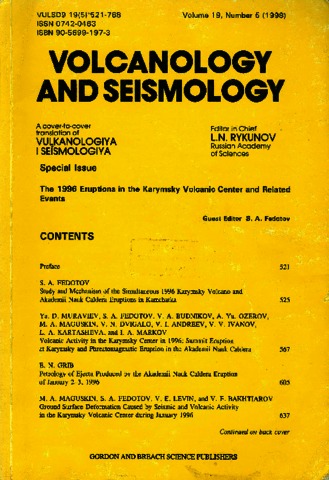
Muravyev Y.D., Fedotov S.A., Budnikov V.A., Ozerov A.Yu., Maguskin M.A., Dvigalo V.N., Andreev V.I., Ivanov V.V., Kartasheva L.A., Markov I.A. Activity in the Karymsky Center in 1996: Summit Eruption at Karymsky and Phreatomagmatic Eruption in the Akademii Nauk Caldera // Volcanology and Seismology. 1998. Vol. 19. № 5. P. 567-604.
Annotation
Представлены материалы исследований деятельности вулканов Карымского долгоживущего вулканического центра на Камчатке в 1996 г. Рассмотрены особенности динамики и вещественный состав пород одновременно начавшихся извержений вулкана Карымский и в кальдере Академии Наук. Эффузивно-эксплозивное извержение Карымского вулкана возобновилось после 14-летнего периода покоя и в течение года поставило через вершинный кратер -30 млн.т вещества андезитодацитового состава. Предполагается длительная эруптивная активность этого вулкана в ближайшие годы. Одновременно с типичной для Карымского вулкана активностью в 6 км южнее впервые на Камчатке в историческое время наблюдалось субаквальное эксплозивное извержение в озере, занимающем кальдеру Академии Наук. За 18ч извержения в северной части Карымского озера выросла постройка из пирокластического материала базальтового, андезитобазальтового состава с кратером диаметром 650 м. Объем извергнутого пирокластического материала оценивается в 0.04 км3, общий вес >70 млн.т. Обсуждены последствия извержений для окружающей среды, описаны оживление гидротермальной деятельности и образование новой группы горячих источников в кальдере Академии Наук, сделаны оценки прорывных паводков из Карымского озера и т.п.
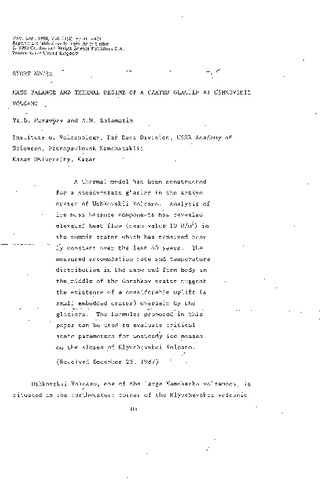
Muravyev Y.D., Salamatin A.N. Mass balance and thermal regime of a crater glacier at Ushkovskii volcano // Volcanology and Seismology. 1990. Vol. 11. № 3. P. 411-424.
Annotation
Построена теплофизическая модель стационарного состояния ледника в активном кратере Ушковского вулкана. Анализ составляющих баланса массы льда показал повышенный геотермический поток (среднее значение 10 Вт/м¤) в пределах вершинного конуса и слабую его изменчивость за последние 40 лет. По измеренной скорости аккумуляции и распределению температуры в снежнофирновой скорости аккумуляции и распределению температуры в снежно-фирновой толще в центре кратера Горшкова предполагается существование значительного поднятия (вложенного малого кратера), перекрытого ледником.
Полученные расчетные формулы помогут оценить параметры критических состояний нестационарных ледяных масс на склонах Ключевского вулкана.
Muravyev Y.D., Shiraiwa T. 400 years of climatic change in Kamchatka Peninsula, Russia: paleoglaciologic, tree-ring and ice-core evidance // Proceedings International Workshop. Matsuyama, Japan, 2002. 2002. P. 76-91.
Naboko S.I. Change in the fumarole regime of Kliuchevsky volcano // Bulletin Volcanologique. 1960. Vol. 23. Vol. 1. P. 135-140. 6 p. https://doi.org/10.1007/BF02596638
Naboko S.I., Glavatskikh S.F. Indicator-Elements in Exhalation and Hydrothermal Processes // Volcanology and Seismology. 1988. Vol. 7. № 4. P. 517-538.
Naboko S.I., Glavatskikh S.F. Posteruptive Hematite Mineralization // Volcanology and Seismology. 1983. № 1. P. 83-96.
Naboko S.I., Glavatskikh S.F. The Behaviour of Cu, Zn, and Pb in Modern Volcanic Processes: Implications for the Genesis of Sulphide Deposits // Volcanology and Seismology. 1991. Vol. 12. № 2. P. 214-240.
Nakagawa Mitsuhiro, Ishizuka Yoshihiro, Kudo Takashi, Yoshimoto Mitsuhiro, Hirose Wataru, Ishizaki Yoshio, Gouchi Nobuo, Katsui Yoshio, Solovyow Alexander W., Steinberg Genrikh S., Abdurakhmanov Arslan I. Tyatya Volcano, southwestern Kuril arc: Recent eruptive activity inferred from widespread tephra // The Island Arc. 2002. Vol. 11. № 4. P. 236-254. doi:10.1046/j.1440-1738.2002.00368.x
Annotation
Tyatya Volcano, situated in Kunashir Island at the southwestern end of Kuril Islands, is a large composite stratovolcano and one of the most active volcanoes in the Kuril arc. The volcanic edifice can be divided into the old and the young ones, which are composed of rocks of distinct magma types, low‐ and medium‐K series, respectively. The young volcano has a summit caldera with a central cone. Recent eruptions have occurred at the central cone and at the flank vents of the young volcano. We found several distal ash layers at the volcano and identified their ages and sources, that is, tephras of ad 1856, ad 1739, ad 1694 and ca 1 Ka derived from three volcanoes of Hokkaido, Japan, and caad 969 from Baitoushan Volcano of China/North Korea. These could provide good time markers to reveal the eruptive history of the central cone, which had continued intermittently with Strombolian eruptions and lava flow effusions since before 1 Ka. Relatively explosive eruptions have occurred three times at the cone during the past 1000 years. We revealed that, topographically, the youngest lava flows from the cone are covered not by the tephra of ad 1739 but by that of ad 1856. This evidence, together with a report of dense smoke rising from the summit in ad 1812, suggests that the latest major eruption with lava effusion from the central cone occurred in this year. In 1973, after a long period of dormancy, short‐lived phreatomagmatic eruptions began to occur from fissure vents at the northern flank of the young volcano. This was followed by large eruptions of Strombolian to sub‐Plinian types occurring from several craters at the southern flank. The 1973 activity is evaluated as Volcanic Explosivity Index = 4 (approximately 0.2 km3), the largest eruption during the 20th century in the southwestern Kuril arc. The rocks of the central cone are strongly porphyritic basalt and basaltic andesite, whereas the 1973 scoria is aphyric basalt, suggesting that magma feeding systems are definitely different between the summit and flank eruptions.
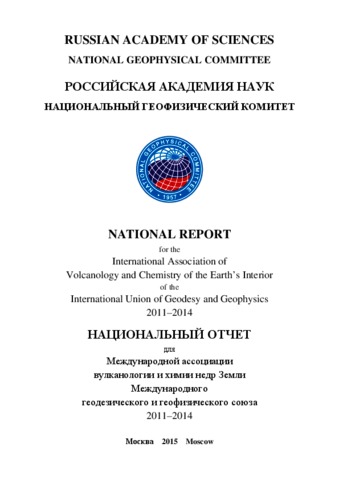
National Report for the International Association of Volcanology and Chemistry of the Earth’s Interior of the International Union of Geodesy and Geophysics 2011–2014. Presented to the XXVI General Assembly of the IUGG Geoinf. Res. Papers, 3, BS3011. / Ed. Churikova T.G., Gordeychik B.N., Fedotov S.A. Moscow: GCRAS Publ. 2015. 185 p. https://doi.org/10.2205/2015IUGG-RU-IAVCEI
Annotation
В данном Национальном отчете представлены основные результаты исследований, проводимых российскими учеными в 2011—2014 гг., по темам, соответствующим направлениям деятельности Международной ассоциации вулканологии и химии недр Земли (МАВХНЗ) Международного геодезического и геофизического союза (МГГС). Полуостров Камчатка с его знаменитой Ключевской группой вулканов являются наиболее вулканически активной областью России и одной из самых активных в мире. Основные результаты исследований по вулканологии и химии недр Земли в 2011—2014 гг. были получены в данном регионе, включая недавние данные по новому трещинному извержению вулкана Толбачик в 2012—2013 гг. Кроме того, в отчет включены полученные российскими учеными научные результаты по магматизму за пределами России. В отчете представлены основные достижения по геохимии, геотермии, геодинамике, геохронологии и глубинному строению мантии. Описаны исследования как для отдельных вулканов, так и для целых регионов. Рассмотрены теоретические прикладные вопросы вулканических процессов. Основные выводы приведены на сводных иллюстрациях. Приведены все требуемые ссылки.